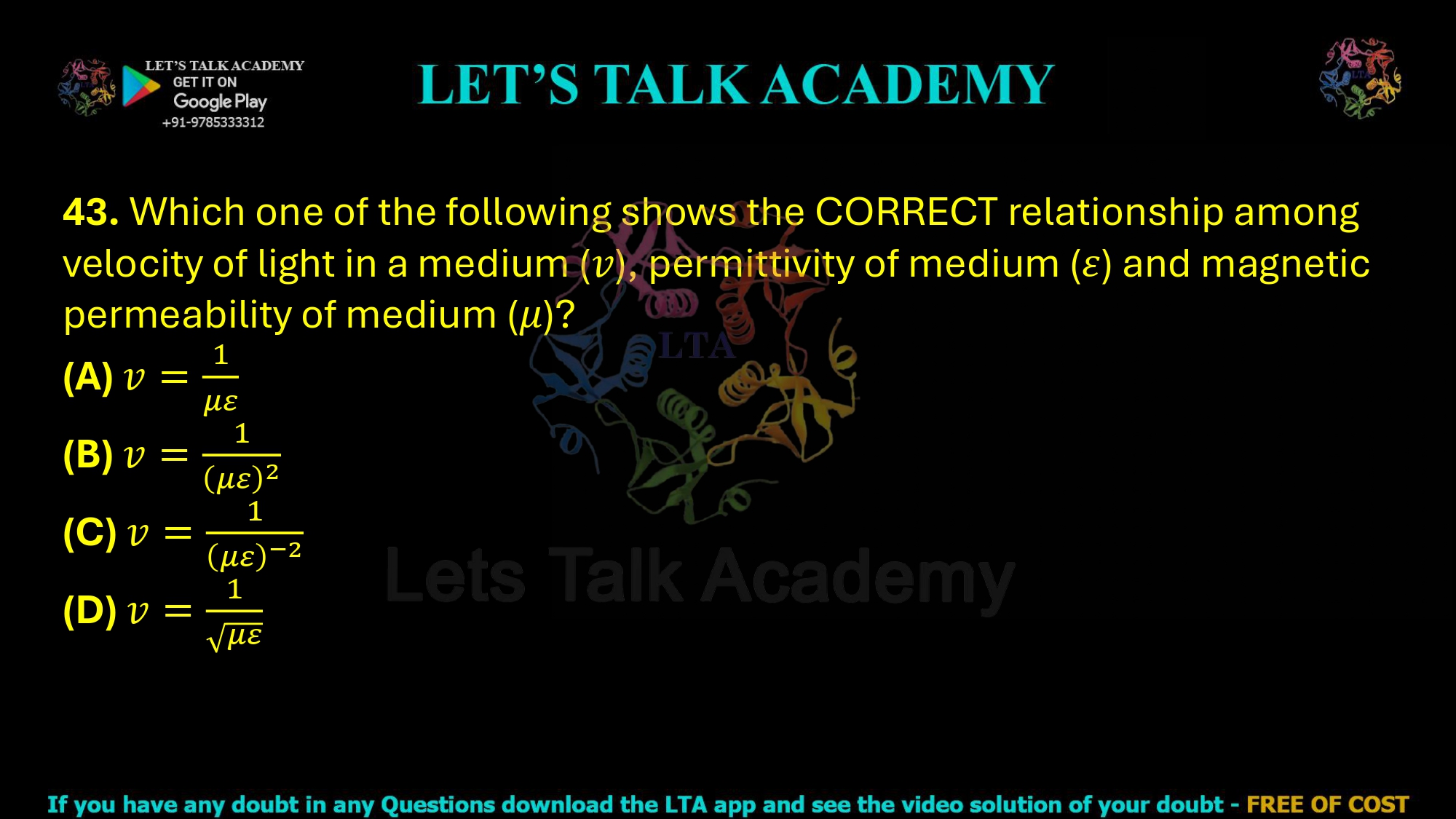
43. Which one of the following shows the CORRECT relationship among velocity of light in a medium (𝑣), permittivity of medium (𝜀) and magnetic permeability of medium (𝜇)?
Correct Relationship Between Velocity of Light, Permittivity and Magnetic Permeability
Correct Answer: v = 1/√(με)
Understanding the Speed of Light in a Medium
Light is an electromagnetic wave consisting of mutually perpendicular oscillating electric and magnetic fields. The speed at which an electromagnetic wave propagates through a medium is determined by the electrical and magnetic properties of that medium.
The two important properties that control the propagation speed are the permittivity ε and the magnetic permeability μ of the medium. The correct relationship among these quantities is:
v = 1/√(με)
Here, v represents the velocity of light or any electromagnetic wave in the medium, ε represents the permittivity of the medium, and μ represents its magnetic permeability.
Correct Formula for the Velocity of Light in a Medium
The velocity of an electromagnetic wave in a material medium is given by:
v = 1/√(με)
This equation shows that the speed of light is inversely proportional to the square root of the product of permittivity and magnetic permeability.
In proportional form:
v ∝ 1/√(με)
Therefore, if the product με increases, the velocity of light decreases. If the product με decreases, the velocity of light increases.
Physical Meaning of Permittivity
Permittivity, represented by ε, describes the electrical response of a medium to an applied electric field. It indicates how the medium interacts with and responds to the electric component of an electromagnetic wave.
A medium with greater permittivity generally produces a lower propagation speed for an electromagnetic wave when other factors remain unchanged. This dependence appears directly in the denominator of the expression v = 1/√(με).
The SI unit of permittivity is farad per metre, written as F m−1.
Physical Meaning of Magnetic Permeability
Magnetic permeability, represented by μ, describes how a medium responds to a magnetic field. Since an electromagnetic wave contains an oscillating magnetic field as well as an oscillating electric field, the magnetic properties of the medium also influence the wave velocity.
An increase in magnetic permeability, with other quantities remaining unchanged, decreases the speed of the electromagnetic wave because μ also appears in the denominator under the square root.
The SI unit of magnetic permeability is henry per metre, written as H m−1.
How the Formula Follows from Electromagnetic Wave Theory
According to Maxwell’s electromagnetic theory, changing electric fields produce magnetic fields, while changing magnetic fields produce electric fields. These continuously varying fields sustain each other and propagate through space as an electromagnetic wave.
When Maxwell’s equations are combined to obtain the electromagnetic wave equation, the wave speed is found to depend on the permittivity and permeability of the medium. The resulting relationship is:
v = 1/√(με)
This result was historically important because, for free space, the calculated electromagnetic wave speed was found to be equal to the measured speed of light. This established that light itself is an electromagnetic wave.
Velocity of Light in Vacuum
For vacuum, the permittivity and permeability are represented by ε0 and μ0, respectively. Therefore, the speed of light in vacuum is:
c = 1/√(μ0ε0)
The numerical value of the speed of light in vacuum is approximately:
c = 3.0 × 10⁸ m s−1
This is the maximum speed at which light propagates in vacuum.
Relationship with Relative Permittivity and Relative Permeability
For a material medium, the permittivity and permeability can be expressed as:
ε = εrε0
and:
μ = μrμ0
Here, εr is the relative permittivity of the medium and μr is its relative permeability.
Substituting these expressions into the wave velocity formula gives:
v = 1/√(μrμ0εrε0)
Using c = 1/√(μ0ε0), we obtain:
v = c/√(μrεr)
This equation shows how the velocity of light in a medium is related to the speed of light in vacuum and the electromagnetic properties of the material.
Why Are μ and ε Under the Square Root?
The velocity of an electromagnetic wave does not vary directly as the reciprocal of μ or ε individually. Instead, it depends on the reciprocal square root of their product.
Therefore, doubling either μ or ε alone does not reduce the wave speed to one-half. For example, if the product με becomes four times its original value, the velocity becomes:
vnew = vold/√4 = vold/2
This inverse square-root dependence is essential when comparing different possible mathematical relationships in multiple-choice questions.
Dimensional Verification of the Relationship
The correctness of the equation can also be checked using dimensions. The product of magnetic permeability and permittivity has dimensions such that its square root has the dimensions of inverse velocity.
Therefore:
1/√(με)
has the dimensions of velocity, confirming that the equation is dimensionally consistent.
Final Answer
The correct relationship among the velocity of light in a medium (v), permittivity (ε), and magnetic permeability (μ) is:
v = 1/√(με)
The velocity of light in a medium is inversely proportional to the square root of the product of the medium’s permittivity and magnetic permeability. Therefore, a larger value of με results in a lower velocity of electromagnetic waves in that medium.


