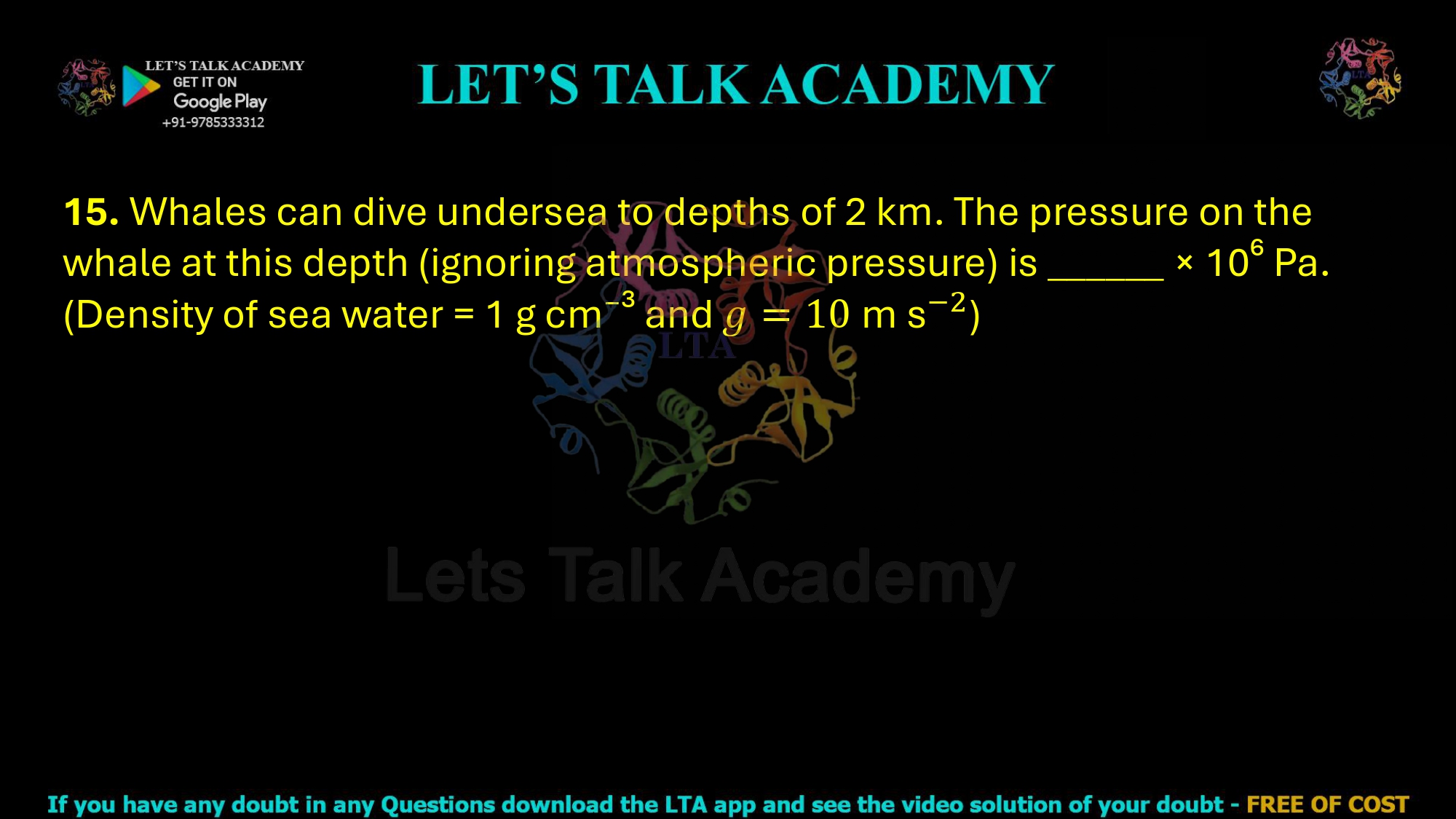
15. Whales can dive undersea to depths of 2 km. The pressure on the whale at this depth (ignoring atmospheric pressure) is ______ × 10⁶ Pa. (Density of sea water = 1 g cm⁻³ and g = 10ms−2 )
Pressure on a Whale at 2 km Depth Under Sea: Hydrostatic Pressure Calculation
Correct Answer: 20
Therefore, the pressure on the whale is:
20 × 106 Pa
Understanding the Pressure on a Whale Deep Under the Sea
When a whale dives deep below the surface of the sea, it experiences pressure due to the enormous column of seawater above it. The deeper the whale goes, the greater the height of the water column above its body and, consequently, the greater the pressure exerted by the seawater.
In this problem, the whale dives to a depth of 2 km. We are asked to calculate only the pressure produced by the seawater because the question specifically states that atmospheric pressure should be ignored. Therefore, the required pressure is the hydrostatic pressure or gauge pressure due to the water column.
The calculation depends on three quantities: the density of seawater, the acceleration due to gravity and the depth of the whale below the sea surface.
Formula for Pressure at a Depth in a Liquid
The pressure produced by a liquid column at a depth h is given by:
P = ρgh
where P is the pressure due to the liquid column, ρ is the density of the liquid, g is the acceleration due to gravity and h is the depth below the liquid surface.
This formula shows that pressure inside a liquid increases directly with depth. If the depth is doubled while the density and gravitational acceleration remain unchanged, the hydrostatic pressure also doubles.
Given Values in the Question
The depth to which the whale dives is:
h = 2 km
The density of seawater is:
ρ = 1 g cm−3
The acceleration due to gravity is:
g = 10 m s−2
Before substituting these values into the pressure formula, all quantities must be converted into SI units. This is necessary because the final answer is required in pascals.
Converting the Depth from Kilometres to Metres
The given depth is 2 km. We know that:
1 km = 1000 m
Therefore:
2 km = 2 × 1000 m
Hence:
h = 2000 m
This large depth explains why the pressure experienced by a whale deep under the sea is extremely high.
Converting the Density of Seawater into SI Units
The density of seawater is given as 1 g cm−3. However, for calculating pressure in pascals, density must be expressed in kilograms per cubic metre.
We know that:
1 g = 10−3 kg
and:
1 cm = 10−2 m
Therefore:
1 cm3 = (10−2)3 m3
1 cm3 = 10−6 m3
Thus:
1 g cm−3 = 10−3 kg / 10−6 m3
Therefore:
1 g cm−3 = 103 kg m−3
Hence, the density to be used in the calculation is:
ρ = 1000 kg m−3
Step-by-Step Calculation of Pressure
Using the hydrostatic pressure formula:
P = ρgh
Substituting the given values:
P = 1000 × 10 × 2000
Writing the quantities in powers of ten:
P = 103 × 10 × 2 × 103
Combining the numerical factors and powers of ten:
P = 2 × 10⁷ Pa
The question asks for the answer in the form:
______ × 106 Pa
Therefore, we rewrite 2 × 10⁷ Pa as:
2 × 10⁷ Pa = 20 × 106 Pa
Hence, the number that should be filled in the blank is:
20
Why Atmospheric Pressure Is Not Included
At the surface of the sea, atmospheric pressure already acts on the water and everything in contact with it. At a depth below the surface, the total or absolute pressure normally includes both atmospheric pressure and the pressure produced by the water column.
The absolute pressure at depth can generally be written as:
Pabsolute = Patmospheric + ρgh
However, this question explicitly instructs us to ignore atmospheric pressure. Therefore, only the pressure due to the seawater column is calculated:
P = ρgh
This is why no atmospheric pressure term is added to the final answer.
Why Pressure Increases with Depth
The pressure at a point inside a liquid is caused by the weight of the liquid column above that point. As the whale dives deeper, the height of the seawater column above it increases. A taller column of water has greater weight, so it exerts greater pressure.
According to the relation P = ρgh, pressure is directly proportional to depth h. Therefore, a whale at a depth of 2 km experiences twice the hydrostatic pressure that it would experience at a depth of 1 km, assuming the density of seawater and the value of gravitational acceleration remain constant.
This direct relationship between pressure and depth is one of the fundamental principles of fluid mechanics and hydrostatics.
Understanding the Magnitude of the Pressure
The calculated pressure is:
20 × 106 Pa
This can also be written as:
2 × 10⁷ Pa
or:
20 MPa
where MPa represents megapascal and:
1 MPa = 106 Pa
Therefore, the whale experiences a hydrostatic pressure of approximately 20 MPa at a depth of 2 km when atmospheric pressure is ignored.
Dimensional Check of the Hydrostatic Pressure Formula
The formula used is:
P = ρgh
The SI unit of density is kg m−3, the SI unit of gravitational acceleration is m s−2, and the SI unit of depth is m.
Therefore:
Unit of P = (kg m−3) × (m s−2) × (m)
On simplification:
Unit of P = kg m−1 s−2
This is equivalent to N m−2, which is called the pascal (Pa). Therefore, the calculation correctly gives pressure in pascals.
Final Answer
The pressure due to seawater at a depth of 2 km is calculated using:
P = ρgh
Using:
ρ = 1000 kg m−3
g = 10 m s−2
h = 2000 m
we get:
P = 1000 × 10 × 2000
P = 2 × 10⁷ Pa
P = 20 × 106 Pa
Therefore, the value to be filled in the blank is:
Final Answer: 20


