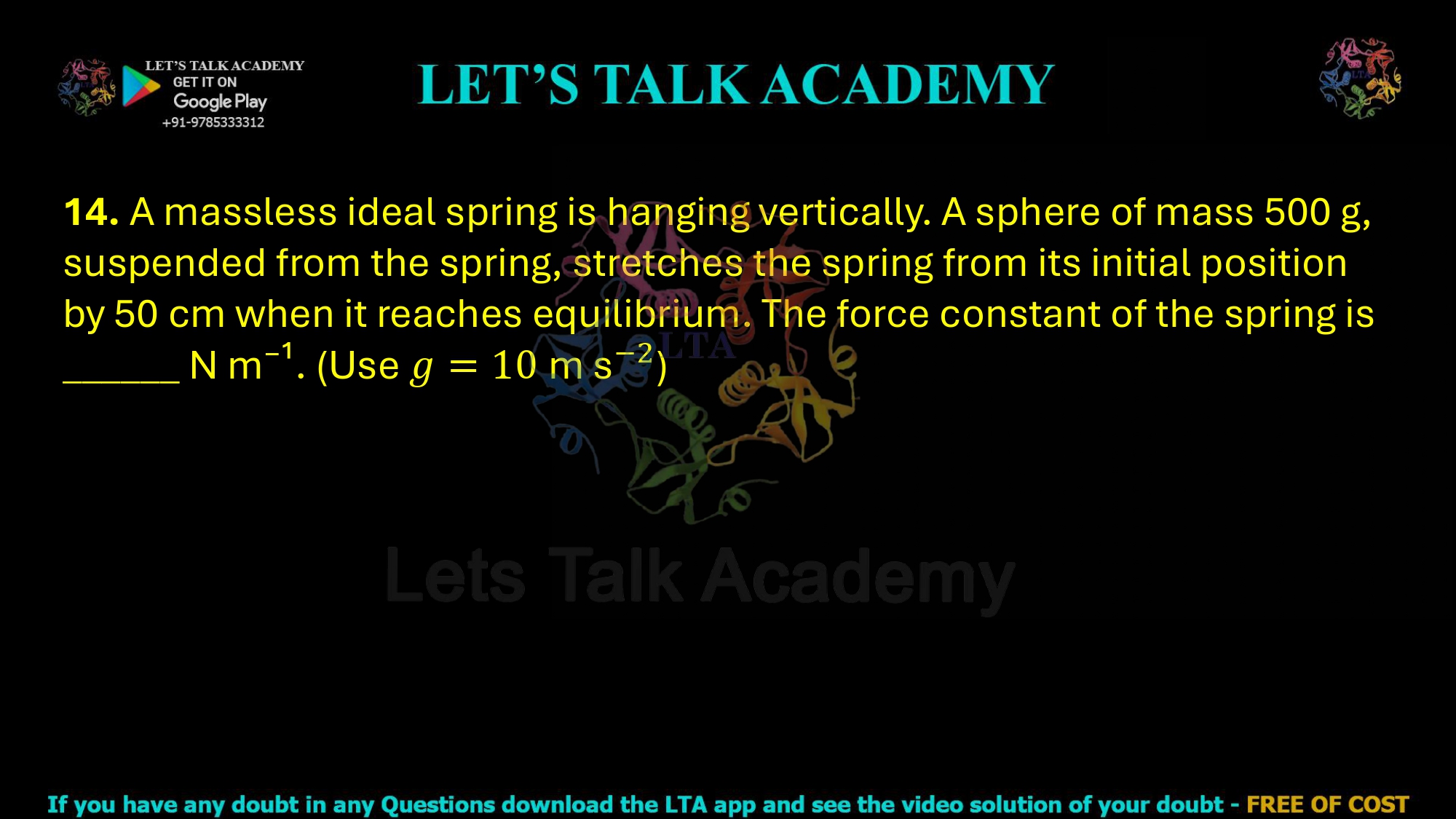
14. A massless ideal spring is hanging vertically. A sphere of mass 500 g, suspended from the spring, stretches the spring from its initial position by 50 cm when it reaches equilibrium. The force constant of the spring is ______ N m⁻¹. (Use )
Force Constant of a Spring: Calculate Spring Constant Using Hooke’s Law
Correct Answer: 10 N m−1
Understanding the Vertical Spring Equilibrium Problem
This question is based on Hooke’s law and the condition of mechanical equilibrium. When a sphere is suspended from a vertical spring, the weight of the sphere pulls it downward and stretches the spring. As the spring stretches, it develops an upward restoring force.
At the equilibrium position, the sphere is at rest and its acceleration is zero. Therefore, the net force acting on the sphere must also be zero. This means that the upward spring force is exactly equal to the downward gravitational force acting on the sphere.
The two forces acting on the suspended sphere are the downward weight mg and the upward spring restoring force kx. At equilibrium, these forces balance each other.
Applying Hooke’s Law at Equilibrium
According to Hooke’s law, the magnitude of the restoring force produced by an ideal spring is directly proportional to its extension from the natural length. The spring force is written as:
F = kx
where F is the spring restoring force, k is the force constant or spring constant, and x is the extension of the spring.
At equilibrium, the spring force balances the weight of the sphere. Therefore:
kx = mg
Rearranging the equation to calculate the force constant:
k = mg/x
Given Values in the Question
The mass of the sphere is:
m = 500 g = 0.5 kg
The extension of the spring is:
x = 50 cm = 0.5 m
Taking the acceleration due to gravity as:
g = 10 m s−2
Step-by-Step Calculation of the Force Constant
Step 1: Calculate the Weight of the Sphere
The gravitational force or weight acting downward on the sphere is:
Weight = mg
Substituting the given values:
mg = 0.5 × 10 = 5 N
Therefore, the sphere exerts a downward force of 5 N. At equilibrium, the spring must exert an equal upward restoring force of 5 N.
Step 2: Use the Equilibrium Condition
At equilibrium:
kx = mg
Substituting the values:
k × 0.5 = 5
Therefore:
k = 5/0.5
k = 10 N m−1
Final Answer
The force constant of the spring is 10 N m−1.
Why Does the Spring Force Equal the Weight?
The word equilibrium is the most important clue in this question. Equilibrium means that the sphere has no acceleration. According to Newton’s second law, if acceleration is zero, the net force must also be zero.
The weight of the sphere acts vertically downward with magnitude mg, while the stretched spring exerts an upward restoring force of magnitude kx. For the net force to be zero, these two forces must be equal in magnitude and opposite in direction. Hence:
kx = mg
This force-balance equation directly connects the mass of the suspended object, the extension of the spring, and the force constant of the spring.
Physical Meaning of the Force Constant
The force constant k measures the stiffness of a spring. A spring with a large force constant is stiff and requires a greater force to produce a given extension. A spring with a small force constant is softer and stretches more easily under the same applied force.
In this problem, the force constant is 10 N m−1. This means that a force of 10 N would be required to stretch the ideal spring by 1 m, provided the spring remains within its elastic limit and continues to obey Hooke’s law.
Importance of Unit Conversion
The given mass and extension must be converted into SI units before using the formula. The mass is given as 500 g, which is equal to 0.5 kg, while the extension is given as 50 cm, which is equal to 0.5 m.
Using grams directly instead of kilograms or centimetres directly instead of metres would produce an incorrect numerical value for the spring constant in N m−1. Correct SI unit conversion is therefore essential in this calculation.
Key Concept Behind the Numerical
This numerical combines two fundamental ideas: Hooke’s law and mechanical equilibrium. Hooke’s law gives the restoring force of the spring as kx, while the equilibrium condition requires the net force on the sphere to be zero.
Therefore, the upward spring force must balance the downward gravitational force. Using kx = mg and substituting the mass of 0.5 kg, extension of 0.5 m, and gravitational acceleration of 10 m s−2 gives the force constant as 10 N m−1.
Conclusion
When the 500 g sphere reaches equilibrium, its downward weight is exactly balanced by the upward restoring force of the spring. Applying the equilibrium condition kx = mg and using an extension of 50 cm gives a force constant of 10 N m−1. Therefore, the required answer is 10 N m−1.


