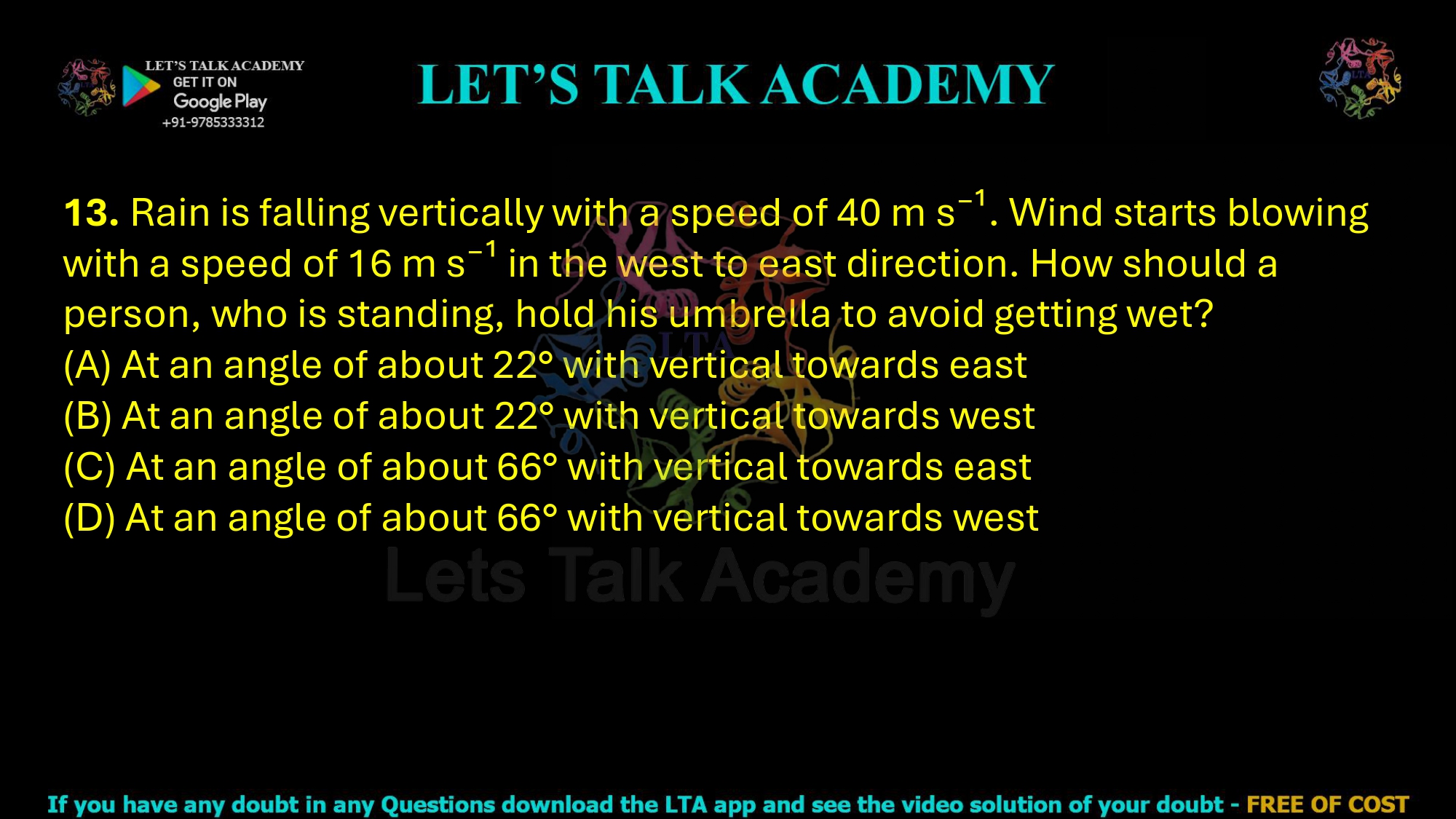
13. Rain is falling vertically with a speed of 40 m s⁻¹. Wind starts blowing with a speed of 16 m s⁻¹ in the west to east direction. How should a person, who is standing, hold his umbrella to avoid getting wet?
(A) At an angle of about 22° with vertical towards east
(B) At an angle of about 22° with vertical towards west
(C) At an angle of about 66° with vertical towards east
(D) At an angle of about 66° with vertical towards west
Rain and Wind Relative Velocity Problem: How Should a Person Hold an Umbrella?
Understanding the Rain and Wind Relative Velocity Problem
This question is based on the concept of relative velocity and the apparent direction of rain. Initially, the rain is falling vertically downward with a speed of 40 m s−1. When the wind starts blowing from west to east with a speed of 16 m s−1, the raindrops acquire a horizontal velocity component towards the east.
As a result, the rain no longer moves vertically downward. Its actual velocity becomes the vector combination of a vertical downward component of 40 m s−1 and a horizontal eastward component of 16 m s−1. Since the person is standing still, the velocity of rain relative to the person is the same as the actual resultant velocity of the rain.
To avoid getting wet, the person must hold the umbrella in the direction from which the rain appears to be coming. Therefore, both the angle of inclination and the correct direction of the umbrella must be determined carefully.
Velocity Components of the Falling Rain
The rain has two mutually perpendicular velocity components after the wind starts blowing. The vertical component is directed downward and has a magnitude of 40 m s−1, while the horizontal component is directed from west to east and has a magnitude of 16 m s−1.
Therefore:
Vertical component of rain velocity = 40 m s−1
Horizontal component of rain velocity = 16 m s−1 towards east
These two velocity components form a right-angled triangle. The resultant velocity of the rain is inclined to the vertical, and the angle of this inclination can be calculated using trigonometry.
Calculating the Angle of the Umbrella With the Vertical
Let θ be the angle made by the resultant velocity of rain with the vertical direction. From the velocity triangle:
tan θ = Horizontal velocity component / Vertical velocity component
Substituting the given values:
tan θ = 16/40
tan θ = 0.4
Taking the inverse tangent:
θ = tan−1(0.4)
θ ≈ 21.8°
Therefore, the required angle is approximately:
θ ≈ 22° with the vertical
This calculation eliminates options (C) and (D), because the required angle is approximately 22° and not 66°.
Determining the Correct Direction of the Umbrella
Finding the angle alone is not sufficient. We must also determine whether the umbrella should be inclined towards the east or towards the west.
The wind is blowing in the west-to-east direction. Therefore, the raindrops acquire a horizontal velocity component towards the east. This means that while the raindrops fall downward, they also move horizontally from west to east.
Consequently, the rain approaches the standing person from the western side and moves towards the east. A person must tilt the umbrella towards the direction from which the rain is coming. Therefore, the umbrella should be inclined towards the west.
Combining the calculated angle and the correct direction, the person should hold the umbrella at an angle of approximately 22° with the vertical towards the west.
Vector Explanation of the Apparent Direction of Rain
The velocity of the rain after the wind starts blowing can be represented by a resultant vector. Its vertical component is 40 m s−1 downward, while its horizontal component is 16 m s−1 towards the east. Therefore, the resultant velocity vector points downward and towards the east.
However, the umbrella must not be tilted in the direction in which the raindrops are moving. It must be tilted towards the direction from which the raindrops are approaching. Since the rain moves towards the east, it approaches the person from the west. Therefore, the upper end of the umbrella must be inclined towards the west.
This distinction between the direction of motion of the rain and the direction from which the rain appears to come is essential for selecting the correct answer.
Detailed Analysis of All Options
Option (A): At an Angle of About 22° With Vertical Towards East
This option has the correct angle but the wrong direction. The calculation tan θ = 16/40 gives θ ≈ 22°, so the angular value is correct. However, because the wind carries the rain from west to east, the rain approaches the person from the western side. Therefore, the umbrella must be tilted towards the west rather than towards the east. Hence, option (A) is incorrect.
Option (B): At an Angle of About 22° With Vertical Towards West
This is the correct option. The horizontal velocity of the rain is 16 m s−1 towards the east, while its vertical downward velocity is 40 m s−1. Therefore, tan θ = 16/40 = 0.4, which gives θ ≈ 22°. Since the rain is moving from west to east, it approaches the person from the west. Thus, the umbrella should be held at approximately 22° with the vertical towards the west.
Option (C): At an Angle of About 66° With Vertical Towards East
This option is incorrect in both angle and direction. The required angle with the vertical is obtained from tan θ = 16/40, giving approximately 22°, not 66°. In addition, the umbrella must be tilted towards the west because the rain approaches from that direction. Therefore, option (C) does not satisfy the physical situation.
Option (D): At an Angle of About 66° With Vertical Towards West
This option gives the correct general direction but the wrong angle. The umbrella must indeed be inclined towards the west, but the angle with the vertical is approximately 22°. An angle close to 66° would result from incorrectly measuring or interpreting the angle with respect to the horizontal instead of the vertical. Hence, option (D) is incorrect.
Why Is the Angle Measured With the Vertical?
The question specifically asks how the umbrella should be held relative to the vertical. Therefore, the vertical rain velocity of 40 m s−1 forms the adjacent side of the velocity triangle, while the horizontal wind-induced velocity of 16 m s−1 forms the opposite side.
This is why the correct relation is:
tan θ = 16/40
If the angle were measured from the horizontal, the trigonometric ratio would be interpreted differently. Since the required angle is explicitly measured with the vertical, the answer is approximately 22°.
Physical Interpretation of the Answer
The result means that the umbrella should remain mostly upright but should be tilted slightly towards the west. The rain has a much larger vertical speed of 40 m s−1 compared with its horizontal speed of 16 m s−1. Therefore, the resultant rain direction is much closer to the vertical than to the horizontal, which is consistent with the relatively small inclination angle of approximately 22°.
The person is stationary, so no additional horizontal velocity of the person needs to be considered. If the person were walking or running, the relative velocity of the rain with respect to the person would change, and a different angle might be required.
Final Answer
Correct Option: (B) At an angle of about 22° with vertical towards west
The wind gives the vertically falling rain a horizontal velocity component of 16 m s−1 towards the east. Therefore, tan θ = 16/40 = 0.4, giving θ ≈ 22°. Since the rain moves from west to east, it approaches the standing person from the west. Hence, the person should hold the umbrella at an angle of approximately 22° with the vertical towards the west to avoid getting wet.


