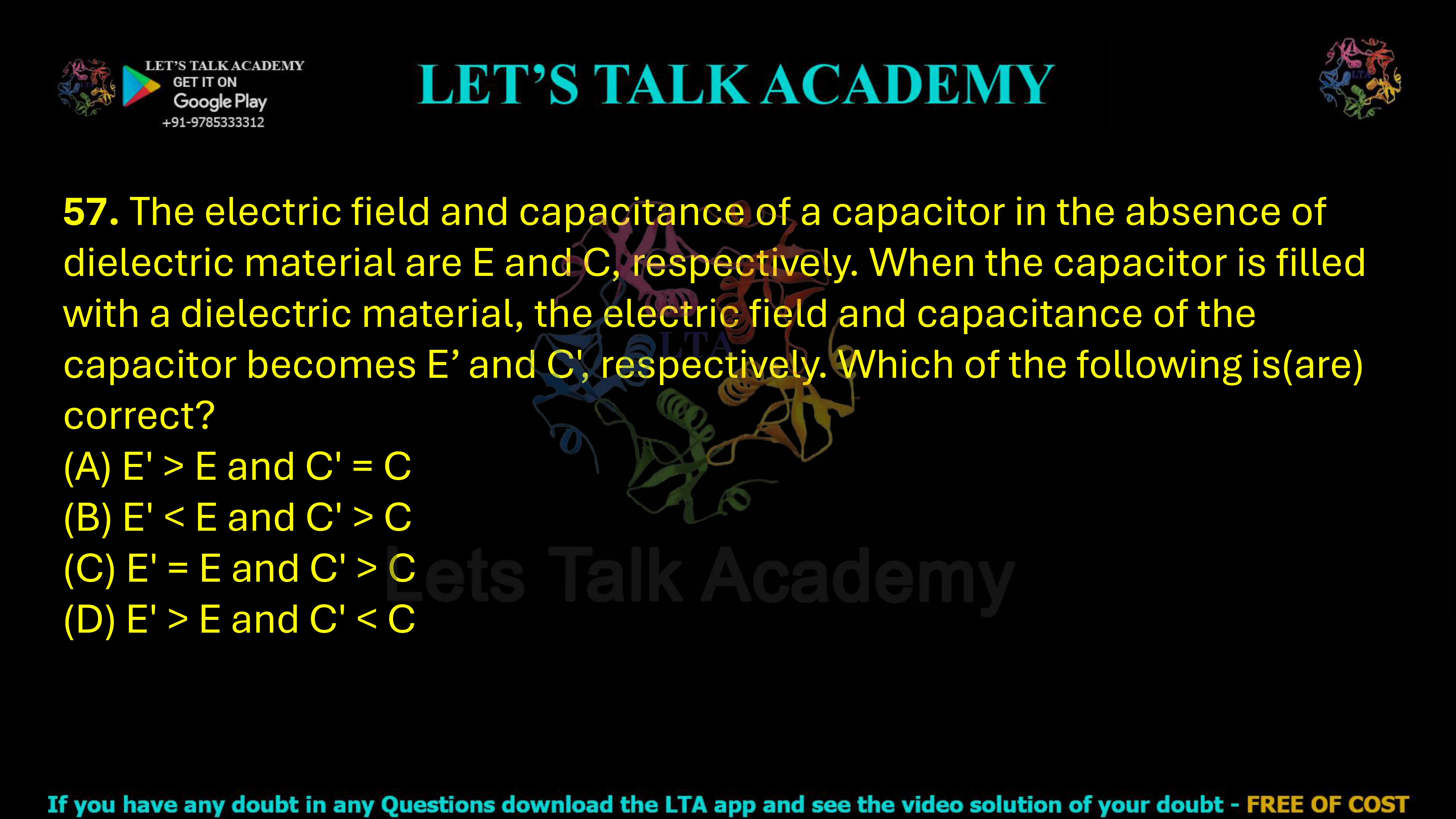
57. The electric field and capacitance of a capacitor in the absence of dielectric material are E and C, respectively. When the capacitor is filled with a dielectric material, the electric field and capacitance of the capacitor becomes E’ and C’, respectively. Which of the following is(are) correct?
(A) E’ > E and C’ = C
(B) E’ < E and C’ > C
(C) E’ = E and C’ > C
(D) E’ > E and C’ < C
Effect of Dielectric on Electric Field and Capacitance of a Capacitor – Complete Explanation with Dimensional Concepts
Correct Answer
(B) E′ < E and C′ > C
Step-by-Step Explanation
When a dielectric material having dielectric constant K is inserted completely between the plates of a capacitor, the dielectric molecules become polarized. The induced charges on the dielectric surfaces produce an electric field opposite to the original electric field created by the capacitor plates.
Because the induced electric field opposes the original field, the resultant electric field inside the capacitor decreases. Mathematically, the new electric field is given by:
E′ = E / K
Since the dielectric constant K > 1, it follows that:
E′ < E
At the same time, the dielectric increases the ability of the capacitor to store electric charge. The new capacitance becomes:
C′ = KC
Again, because K > 1, the capacitance becomes larger than its original value.
Therefore,
C′ > C
Combining both observations, we conclude that the electric field decreases while the capacitance increases after inserting a dielectric.
Important Formulae
Electric Field after Inserting Dielectric
E′ = E / K
where K is the dielectric constant of the material.
Capacitance after Inserting Dielectric
C′ = KC
This equation shows that capacitance increases directly with the dielectric constant.
Why Does the Electric Field Decrease?
A dielectric is made of insulating molecules. When placed inside an electric field, these molecules become polarized, meaning that positive and negative charges shift slightly in opposite directions. This polarization creates an induced electric field opposite to the original field between the capacitor plates. Since the induced field opposes the external field, the resultant electric field inside the capacitor becomes smaller.
A weaker electric field means the potential difference between the plates decreases for the same amount of charge. Because capacitance is defined as the ratio of charge to potential difference, a lower potential difference allows the capacitor to store more charge, thereby increasing its capacitance.
Detailed Explanation of Every Option
Option (A): E′ > E and C′ = C
This statement is incorrect because inserting a dielectric never increases the electric field. The electric field always decreases due to polarization. Moreover, the capacitance does not remain unchanged; it increases by a factor equal to the dielectric constant.
Option (B): E′ < E and C′ > C
This is the correct option. The dielectric reduces the electric field by opposing it through polarization, while simultaneously increasing the capacitance because the capacitor can now store more charge for the same applied voltage.
Option (C): E′ = E and C′ > C
This option is partially correct regarding capacitance but incorrect regarding the electric field. The electric field does not remain unchanged after inserting a dielectric; it decreases.
Option (D): E′ > E and C′ < C
This statement is completely incorrect. A dielectric neither increases the electric field nor decreases the capacitance. In fact, it produces exactly the opposite effect.
Concept Summary
Whenever a dielectric completely fills the space between the plates of a capacitor, the electric field decreases because of polarization, while the capacitance increases because the dielectric reduces the potential difference for the same stored charge. These two effects always occur together and form one of the most fundamental concepts in Electrostatics.
Final Answer
Electric Field: E′ < E
Capacitance: C′ > C
Correct Option: (B)


