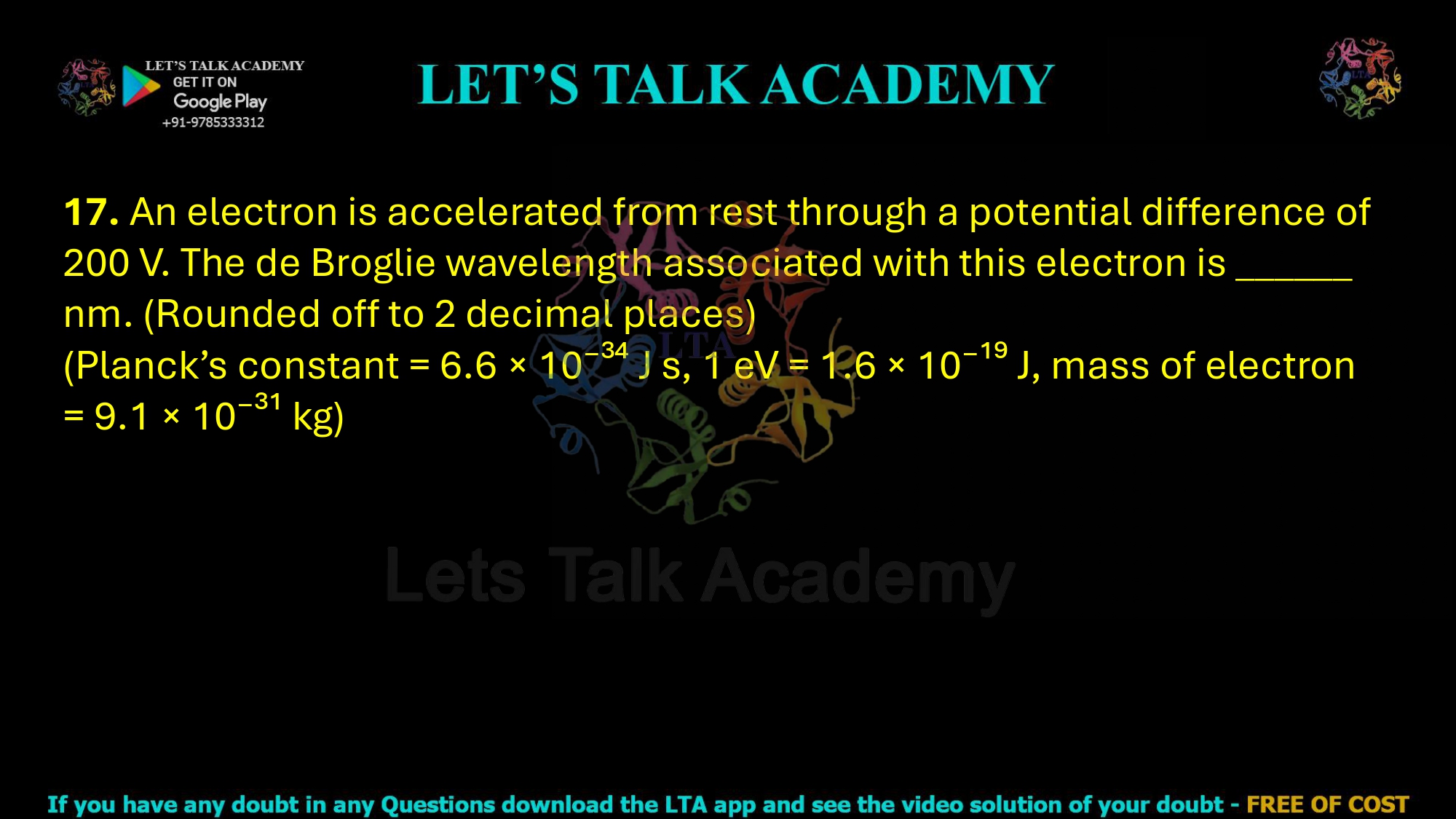
17. An electron is accelerated from rest through a potential difference of 200 V. The de Broglie wavelength associated with this electron is ______ nm. (Rounded off to 2 decimal places)
(Planck’s constant = 6.6 × 10⁻³⁴ J s, 1 eV = 1.6 × 10⁻¹⁹ J, mass of electron = 9.1 × 10⁻³¹ kg)
de Broglie Wavelength of an Electron Accelerated Through 200 V: Detailed Solution
Understanding the de Broglie Wavelength Problem
This question is based on the wave nature of matter. According to the de Broglie hypothesis, every moving particle is associated with a matter wave. The wavelength of this matter wave depends on the momentum of the particle. Since the electron is initially at rest and then accelerated through a potential difference of 200 V, electrical energy is converted into the kinetic energy of the electron.
Therefore, the solution requires two connected concepts. First, we calculate the kinetic energy gained by the electron due to the accelerating potential difference. Then, this kinetic energy is used to determine the momentum of the electron. Finally, the momentum is substituted into the de Broglie equation to calculate the associated wavelength.
de Broglie Relation for a Moving Electron
The de Broglie wavelength associated with a moving particle is given by:
λ = h/p
Here, λ represents the de Broglie wavelength, h is Planck’s constant, and p is the linear momentum of the particle.
For a non-relativistic particle, the kinetic energy is related to momentum by:
K = p2/(2m)
Therefore, the momentum can be written as:
p = √(2mK)
When an electron is accelerated from rest through a potential difference V, the kinetic energy gained by the electron is:
K = eV
Combining these relations gives the useful expression:
λ = h/√(2meV)
This formula directly calculates the de Broglie wavelength of a non-relativistic electron accelerated from rest through a potential difference V.
Step 1: Calculate the Kinetic Energy Gained by the Electron
An electron accelerated through a potential difference of 200 V gains an energy of 200 eV. Since the calculation is being performed in SI units, this energy must be converted into joules.
We are given:
1 eV = 1.6 × 10⁻¹⁹ J
Therefore:
K = 200 × 1.6 × 10−19 J
K = 320 × 10−19 J
K = 3.2 × 10⁻¹⁷ J
Thus, after being accelerated through 200 V, the electron has a kinetic energy of 3.2 × 10⁻¹⁷ J.
Step 2: Calculate the Momentum of the Electron
The momentum of the electron can be calculated from its kinetic energy using:
p = √(2mK)
Substituting m = 9.1 × 10⁻³¹ kg and K = 3.2 × 10⁻¹⁷ J:
p = √[2 × (9.1 × 10−31) × (3.2 × 10−17)]
Multiplying the numerical values:
p = √(58.24 × 10−48)
Writing this in standard scientific notation:
p = √(5.824 × 10−47)
Therefore:
p ≈ 7.63 × 10⁻²⁴ kg m s−1
This is the momentum acquired by the electron after acceleration through the given potential difference.
Step 3: Calculate the de Broglie Wavelength
Using the de Broglie relation:
λ = h/p
Substituting h = 6.6 × 10⁻³⁴ J s and p = 7.63 × 10⁻²⁴ kg m s−1:
λ = (6.6 × 10⁻³⁴)/(7.63 × 10−24)
λ ≈ 0.865 × 10⁻¹⁰ m
Therefore:
λ ≈ 8.65 × 10⁻¹¹ m
Converting the Wavelength From Metres to Nanometres
The question asks for the answer in nanometres. We know that:
1 nm = 10−9 m
Therefore:
λ = (8.65 × 10⁻¹¹)/(10−9) nm
λ = 8.65 × 10⁻² nm
λ = 0.0865 nm
Rounding the result to two decimal places:
λ = 0.09 nm
Direct Calculation Using the Combined Formula
The entire calculation can also be performed directly using the formula for the de Broglie wavelength of an electron accelerated through a potential difference:
λ = h/√(2meV)
Substituting the given values:
λ = (6.6 × 10⁻³⁴)/√[2 × (9.1 × 10−31) × (200 × 1.6 × 10−19)]
Therefore:
λ ≈ 8.65 × 10⁻¹¹ m
Converting into nanometres:
λ ≈ 0.0865 nm
Hence, when rounded off to two decimal places:
λ = 0.09 nm
Why Does an Accelerated Electron Have a de Broglie Wavelength?
According to classical physics, an electron is treated as a particle. However, quantum mechanics shows that moving particles also exhibit wave-like behaviour. Louis de Broglie proposed that a particle with momentum p has an associated wavelength given by λ = h/p.
When the electron is accelerated through a potential difference, it gains kinetic energy and momentum. A greater momentum produces a smaller de Broglie wavelength. Therefore, the wavelength calculated in this problem represents the matter-wave character of the accelerated electron.
Effect of Accelerating Potential on de Broglie Wavelength
For an electron accelerated from rest through a potential difference V, the de Broglie wavelength varies inversely as the square root of the accelerating potential:
λ ∝ 1/√V
This means that increasing the accelerating potential increases the kinetic energy and momentum of the electron, thereby decreasing its de Broglie wavelength. Conversely, a smaller accelerating voltage produces a larger de Broglie wavelength.
This relationship is important in electron diffraction and electron microscopy, where high-energy electrons can have wavelengths much smaller than the wavelengths of visible light.
Final Answer
de Broglie wavelength = 0.09 nm
The electron gains a kinetic energy of 200 eV when accelerated from rest through a potential difference of 200 V. Using the relation λ = h/√(2meV), the de Broglie wavelength is approximately 0.0865 nm. Therefore, when rounded off to two decimal places, the required answer is 0.09 nm.


