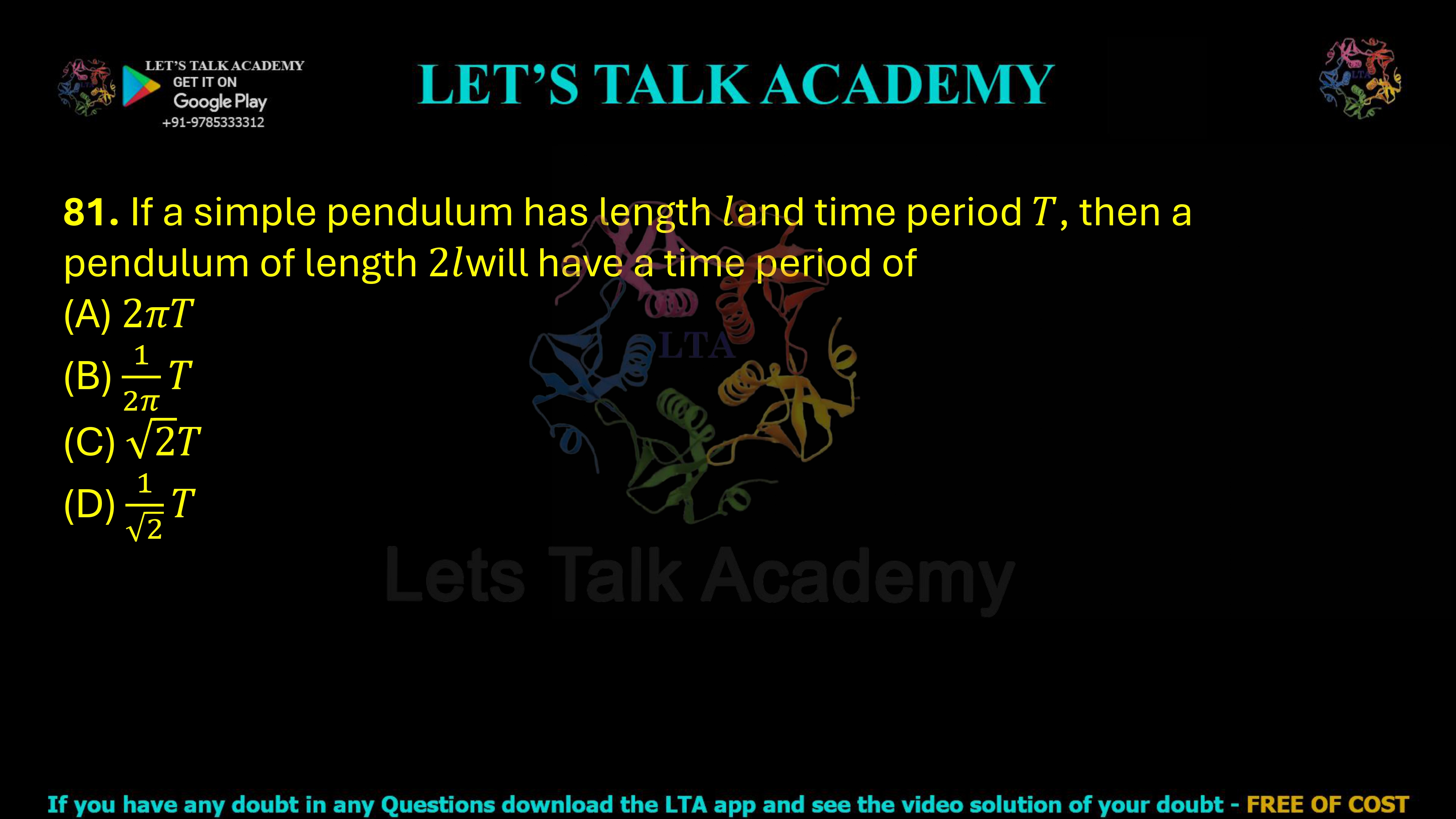
81. If a simple pendulum has length and time period , then a pendulum of length will have a time period of
Time Period of a Simple Pendulum When Its Length is Reduced to One-Fourth
Correct Answer
Option (C) – T/2
Understanding the Concept of a Simple Pendulum
A simple pendulum consists of a small heavy bob suspended from a fixed support by a light, inextensible string. When the bob is displaced slightly from its equilibrium position and released, it oscillates to and fro about the mean position. For small angular displacements (usually less than 10°), these oscillations are simple harmonic in nature.
The time taken by the pendulum to complete one full oscillation is called its time period. One complete oscillation consists of the bob moving from one extreme position to the other and returning to its initial position.
Formula for the Time Period of a Simple Pendulum
The time period of a simple pendulum executing small oscillations is given by
T = 2π√(l/g)
where
- T = Time period of the pendulum
- l = Length of the pendulum
- g = Acceleration due to gravity
This equation shows that the time period depends only on the length of the pendulum and the local value of gravitational acceleration. It does not depend on the mass of the bob or the material from which the bob is made.
Relationship Between Length and Time Period
From the time period equation, it is evident that
T ∝ √l
This means that the time period is directly proportional to the square root of the length of the pendulum.
This proportionality is extremely useful in solving numerical problems without substituting numerical values into the complete formula.
Step-by-Step Solution
Initially,
Length = l
Time Period = T
The new pendulum has a length
l’ = l/4
Using the proportionality relation,
T’/T = √(l’/l)
Substituting the new length,
T’/T = √[(l/4)/l]
= √(1/4)
= 1/2
Therefore,
T’ = T/2
Hence, the time period of the new pendulum becomes exactly half of the original time period.
Alternative Solution Using the Formula
The original time period is
T = 2π√(l/g)
The new time period is
T’ = 2π√[(l/4)/g]
Simplifying,
T’ = 2π × (1/2)√(l/g)
T’ = T/2
This confirms the result obtained using the proportionality method.
Why Does the Time Period Decrease?
A shorter pendulum has a smaller distance to travel during each oscillation. Moreover, the restoring force acts more effectively because the pendulum completes its motion over a shorter path. As a result, the pendulum oscillates more rapidly, reducing its time period.
Since the time period depends on the square root of the length rather than the length itself, reducing the length by four times reduces the time period by only two times.
Detailed Explanation of Every Option
Option (A): 2πT
This option is incorrect because multiplying the original time period by 2π would significantly increase the oscillation time. The formula for a simple pendulum does not predict such behaviour when the length is reduced. Students sometimes choose this option by mistakenly introducing the constant 2π again, even though it is already included in the original time period.
Option (B): T/2π
This option is incorrect because the constant 2π is part of the complete time period expression and cannot simply be divided out when the length changes. The relationship between two time periods depends only on the square root of the ratio of their lengths.
Option (C): T/2
This is the correct answer. Since the time period is proportional to the square root of the length, reducing the length to one-fourth reduces the time period to one-half of its original value.
Option (D): T/√2
This option would be correct only if the length were reduced to one-half of its original value. Since the length becomes one-fourth, the correct multiplying factor is one-half rather than one divided by the square root of two.
Conceptual Understanding
It is important to remember that the time period of a simple pendulum does not change linearly with its length. Instead, it changes according to the square root of the length. This means that doubling the length does not double the time period. Similarly, reducing the length by a factor of four does not reduce the time period by four. Instead, it becomes half.
This square-root relationship is one of the most frequently tested concepts in oscillation-based objective questions.
Real-Life Applications of a Simple Pendulum
The principles of the simple pendulum are used in pendulum clocks, timing devices, seismometers, vibration measurement instruments, gravimeters for measuring gravitational acceleration, and several scientific experiments. Although modern electronic clocks have largely replaced pendulum clocks, the concept remains fundamental in physics and engineering.
Final Answer
Since
T ∝ √l
and
l’ = l/4,
the new time period is
T’ = T/2
Correct Option: (C)


