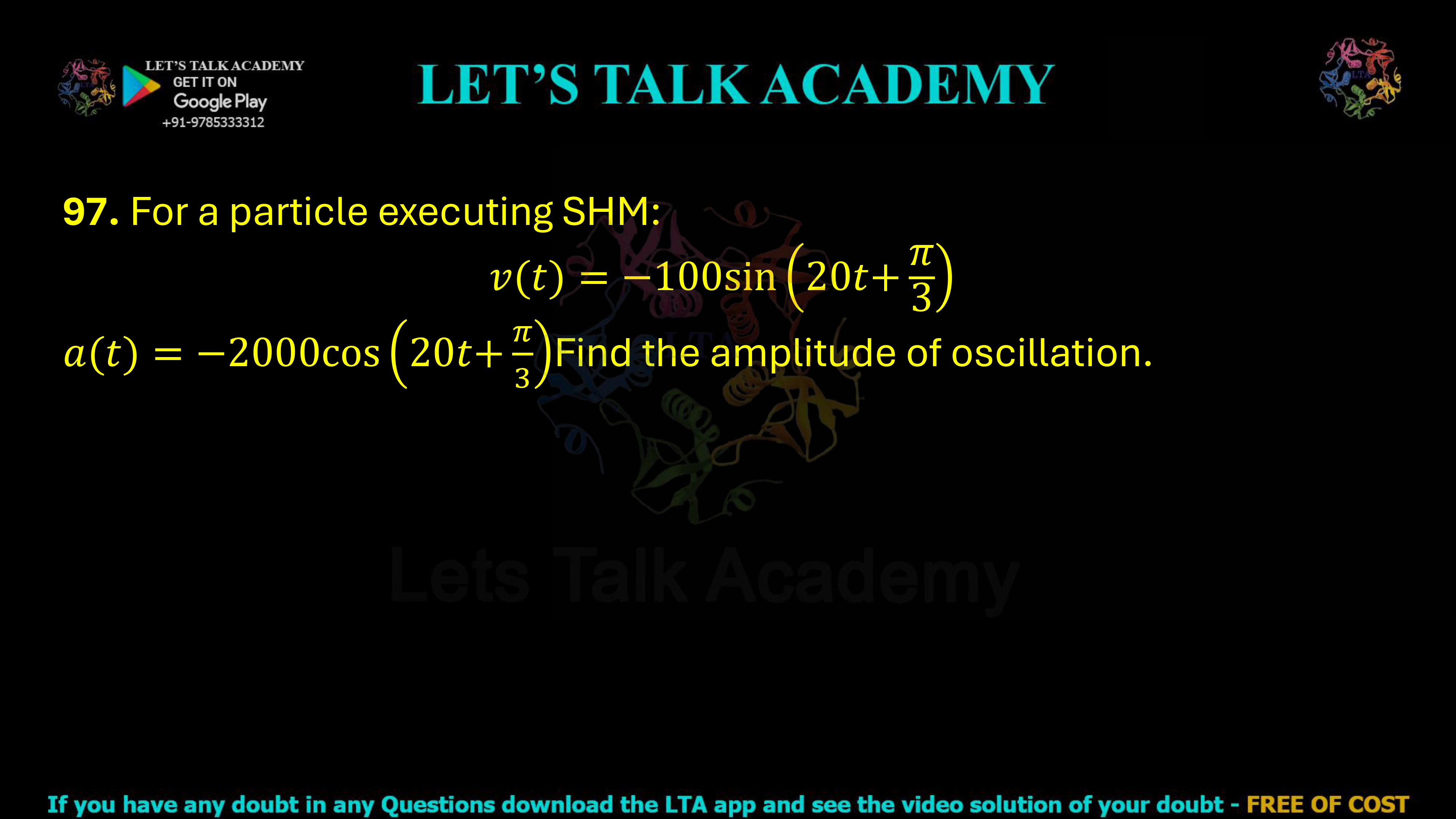
97. For a particle executing SHM:
v(t) = −100 sin (20t + π/3)
a(t) = −2000 cos (20t + π/3)
Find the amplitude of oscillation.
How to Find the Amplitude of SHM from Velocity and Acceleration Equations
Concept Used
For a particle performing Simple Harmonic Motion, the displacement can be written as
x = A cos(ωt + φ)
where:
A = Amplitude
ω = Angular frequency
φ = Phase constant
The corresponding velocity and acceleration are:
v = −Aω sin(ωt + φ)
a = −Aω² cos(ωt + φ)
Step 1: Compare the Velocity Equation
The given velocity equation is
v(t) = −100 sin(20t + π/3)
Comparing it with the standard equation
v = −Aω sin(ωt + φ)
we obtain
Aω = 100
Also, from the argument of the sine function,
ω = 20 rad/s
Step 2: Calculate the Amplitude
Using the relation
Aω = 100
Substituting ω = 20 rad/s,
A × 20 = 100
A = 100/20
A = 5 m
Verification Using the Acceleration Equation
The given acceleration equation is
a(t) = −2000 cos(20t + π/3)
Comparing it with
a = −Aω² cos(ωt + φ)
we get
Aω² = 2000
Since
ω = 20 rad/s
ω² = 400
Therefore,
A = 2000/400 = 5 m
The result agrees with the value obtained from the velocity equation, confirming the correctness of the solution.
Understanding the Physics Behind the Result
The amplitude of SHM represents the maximum displacement of the particle from its mean position. It is a constant characteristic of the oscillation and determines the maximum values of displacement, velocity, and acceleration.
In SHM, the maximum velocity is given by Aω, while the maximum acceleration is given by Aω². Therefore, if either the velocity equation or the acceleration equation is known, the amplitude can be determined easily by comparing the coefficients with the standard SHM equations.
In the given problem, both equations contain the same angular frequency and phase constant, showing that they represent the same oscillatory motion. Using either equation gives the identical amplitude of 5 m.
Final Answer
Amplitude of oscillation = 5 m


