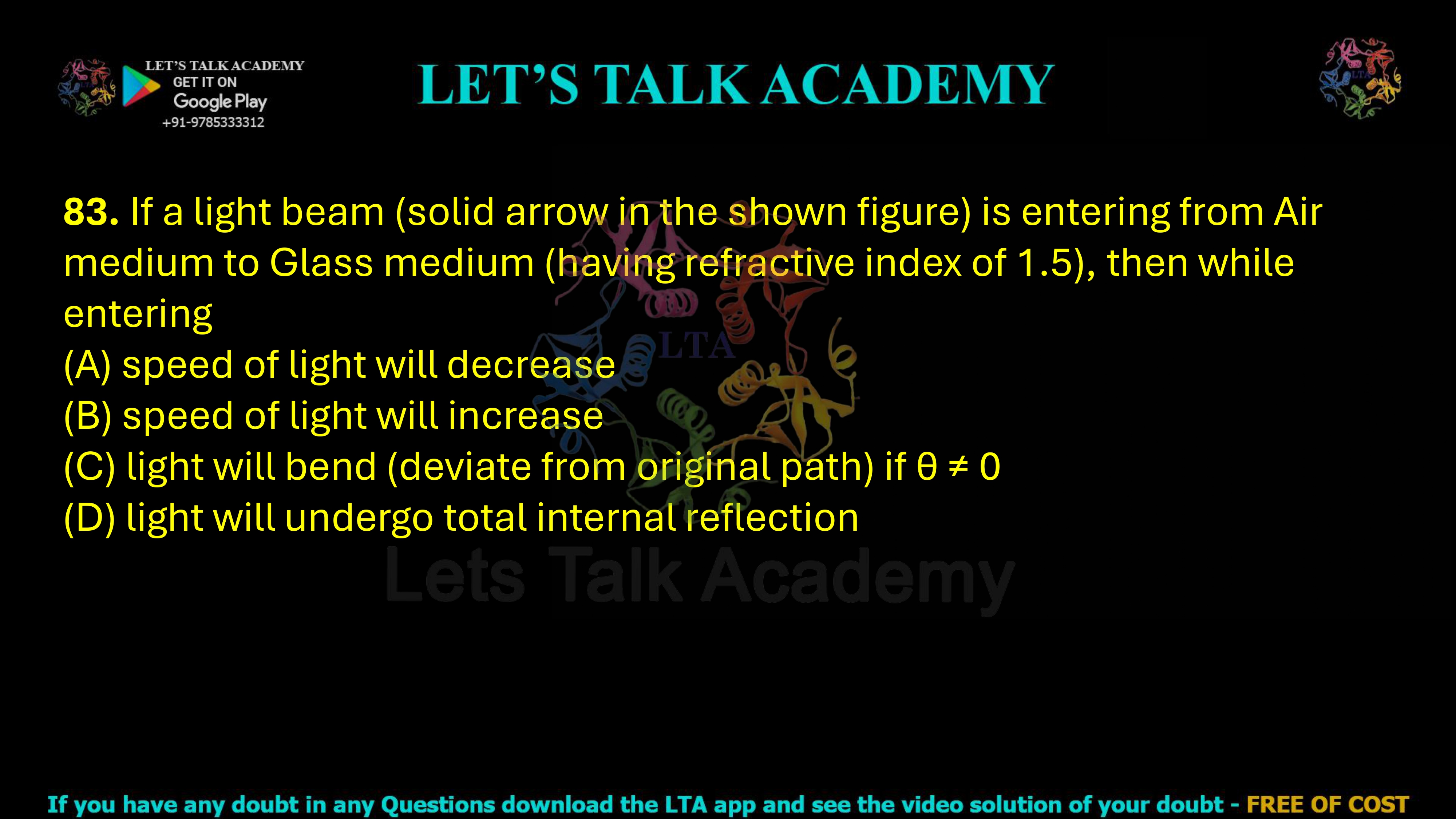
83. If a light beam (solid arrow in the shown figure) is entering from Air medium to Glass medium (having refractive index of 1.5), then while entering
(A) speed of light will decrease
(B) speed of light will increase
(C) light will bend (deviate from original path) if θ ≠ 0
(D) light will undergo total internal reflection
Light Entering from Air to Glass – Complete Explanation of Speed, Refraction and Total Internal Reflection
Correct Answer
Options (A) and (C)
Understanding Refraction of Light
Refraction is the change in the direction of light when it passes from one transparent medium to another having a different refractive index. The bending occurs because the speed of light changes from one medium to another, while its frequency remains constant.
Air is considered an optically rarer medium, whereas glass is an optically denser medium. Since glass has a higher refractive index than air, light travels more slowly inside glass than it does in air.
Why Does the Speed of Light Decrease?
The speed of light in any medium is given by the relation:
v = c/n
where:
v = Speed of light in the medium
c = Speed of light in vacuum (3 × 10⁸ m/s)
n = Refractive index of the medium
For glass, the refractive index is:
n = 1.5
Therefore,
v = (3 × 10⁸)/(1.5)
v = 2 × 10⁸ m/s
This value is less than the speed of light in air. Hence, whenever light enters glass from air, its speed decreases. This is a direct consequence of the higher optical density of glass.
Why Does Light Bend?
The reduction in speed causes the direction of the light ray to change at the boundary between the two media. This phenomenon is governed by Snell’s Law:
n₁ sin i = n₂ sin r
Since the refractive index of glass is greater than that of air, the refracted ray bends towards the normal.
However, bending occurs only if the light strikes the surface at an angle. If the angle of incidence is zero (normal incidence), the light enters the glass without changing its direction, although its speed decreases.
Therefore, the statement “light will bend if θ ≠ 0” is correct.
What Happens to Frequency and Wavelength?
Many students confuse speed with frequency. Although the speed of light changes while entering a different medium, the frequency of light remains unchanged because it is determined by the source of light.
Since
v = fλ
and the frequency remains constant, the decrease in speed results in a corresponding decrease in wavelength inside the glass.
Thus, when light enters glass:
- Speed decreases.
- Frequency remains constant.
- Wavelength decreases.
- The ray bends towards the normal (except at normal incidence).
Can Total Internal Reflection Occur?
Total internal reflection is a special phenomenon that occurs only under two essential conditions.
First, light must travel from an optically denser medium to an optically rarer medium.
Second, the angle of incidence in the denser medium must be greater than the critical angle.
In the given question, light is travelling from air (rarer medium) to glass (denser medium). Since the first condition itself is not satisfied, total internal reflection cannot occur.
Therefore, option (D) is incorrect.
Detailed Explanation of Every Option
Option (A): Speed of light will decrease
This statement is correct. The speed of light in a medium is inversely proportional to its refractive index. Since glass has a refractive index of 1.5, light travels more slowly in glass than in air.
Option (B): Speed of light will increase
This statement is incorrect. Speed increases only when light travels from an optically denser medium to a rarer medium. Here, light is entering a denser medium, so its speed decreases instead.
Option (C): Light will bend (deviate from original path) if θ ≠ 0
This statement is correct. Whenever the angle of incidence is not zero, the change in speed causes the light ray to refract towards the normal. If the light is incident normally (θ = 0), no deviation occurs, although the speed still changes.
Option (D): Light will undergo total internal reflection
This statement is incorrect because total internal reflection occurs only when light travels from a denser medium to a rarer medium with an angle of incidence greater than the critical angle. Since the light is travelling from air to glass, total internal reflection is impossible.
Concept Summary
When light enters glass from air, the higher refractive index of glass causes its speed and wavelength to decrease while the frequency remains unchanged. If the angle of incidence is not zero, the light ray bends towards the normal according to Snell’s Law. Total internal reflection cannot occur because the light is travelling from a rarer medium to a denser medium.
Final Answer
Correct Options: (A) and (C)


