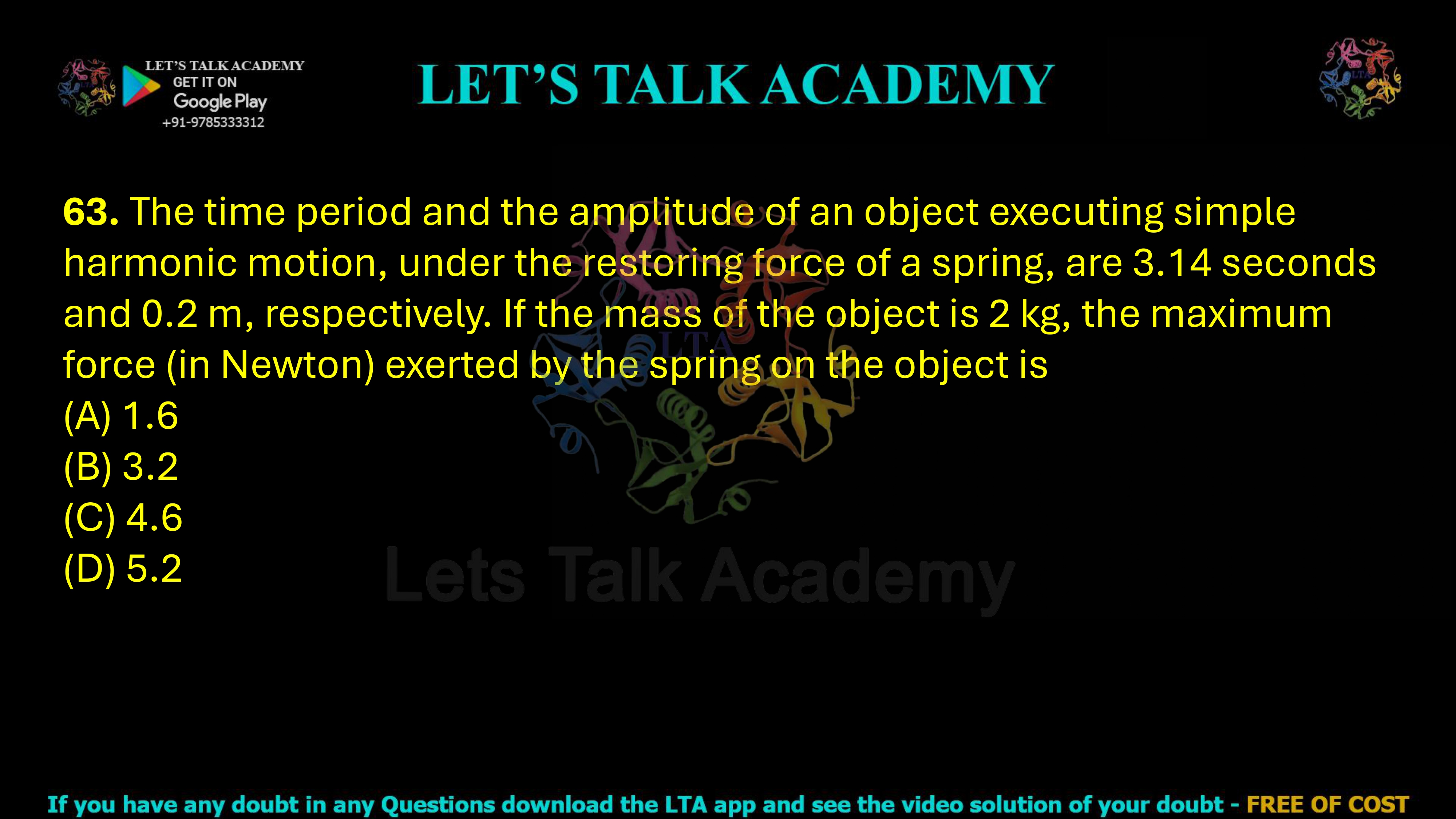
63. The time period and the amplitude of an object executing simple harmonic motion, under the restoring force of a spring, are 3.14 seconds and 0.2 m, respectively. If the mass of the object is 2 kg, the maximum force (in Newton) exerted by the spring on the object is
(A) 1.6
(B) 3.2
(C) 4.6
(D) 5.2
Maximum Restoring Force in Simple Harmonic Motion – Complete Theory and Detailed Solution
Correct Answer
Option (A) – 1.6 N
Understanding the Concept
When a body attached to a spring performs Simple Harmonic Motion, the restoring force always acts towards the mean position. According to Hooke’s Law, the restoring force is directly proportional to the displacement from the mean position and is directed opposite to it.
Mathematically,
F = –kx
where
- F = Restoring force
- k = Spring constant
- x = Displacement from the mean position
The negative sign indicates that the force always acts opposite to the displacement.
The restoring force becomes maximum when the displacement is maximum. Since the maximum displacement is the amplitude A, the maximum restoring force is
Fmax = kA
Step 1: Calculate the Angular Frequency
The angular frequency of SHM is related to the time period by
ω = 2π/T
Given,
- Time period, T = 3.14 s
- π ≈ 3.14
Therefore,
ω = (2 × 3.14)/3.14 = 2 rad/s
Step 2: Calculate the Spring Constant
For a spring-mass system, the angular frequency is related to the spring constant by
ω = √(k/m)
Squaring both sides,
k = mω²
Substituting the given values,
k = 2 × (2)²
k = 2 × 4
k = 8 N/m
Step 3: Calculate the Maximum Restoring Force
Using the formula
Fmax = kA
Substituting the values,
Fmax = 8 × 0.2
Fmax = 1.6 N
Hence, the maximum restoring force exerted by the spring is 1.6 N.
Alternative Short Method
Instead of calculating the spring constant separately, we can directly use the relation
Fmax = mω²A
Substituting the values,
Fmax = 2 × (2)² × 0.2
= 2 × 4 × 0.2
= 1.6 N
This method is often quicker and is preferred in competitive examinations.
Why is the Restoring Force Maximum at the Extreme Position?
In SHM, the restoring force depends directly on the displacement from the equilibrium position. At the mean position, the displacement is zero, so the restoring force is also zero. As the object moves away from the mean position, the displacement increases, causing the restoring force to increase proportionally.
At the extreme positions, the displacement reaches its maximum value, which is equal to the amplitude. Therefore, the restoring force also becomes maximum at these points.
Detailed Explanation of Every Option
Option (A): 1.6 N
This is the correct answer. Using either Fmax = kA or Fmax = mω²A, the calculated value is exactly 1.6 N. This option satisfies all the given conditions.
Option (B): 3.2 N
This value is obtained if the amplitude or spring constant is incorrectly doubled. It does not satisfy the correct SHM formula and is therefore incorrect.
Option (C): 4.6 N
This value does not arise from any valid SHM equation. It usually results from incorrect substitution or arithmetic mistakes during calculation.
Option (D): 5.2 N
This option is also inconsistent with the relationship between spring constant, angular frequency, and amplitude. It is not supported by Hooke’s Law or the equations of SHM.
Important Formulae for Competitive Exams
Hooke’s Law
F = –kx
Maximum Restoring Force
Fmax = kA
Angular Frequency
ω = 2π/T
Spring Constant
k = mω²
Time Period of a Spring-Mass System
T = 2π√(m/k)
Key Takeaways
Whenever the time period and mass are given, first calculate the angular frequency and then determine the spring constant. Once the spring constant is known, multiplying it by the amplitude immediately gives the maximum restoring force.
Remember that the restoring force is zero at the mean position and maximum at the extreme positions. This concept is frequently used in numerical as well as conceptual questions in competitive examinations.
Final Answer
Maximum restoring force = 1.6 N
Correct Option: (A)


