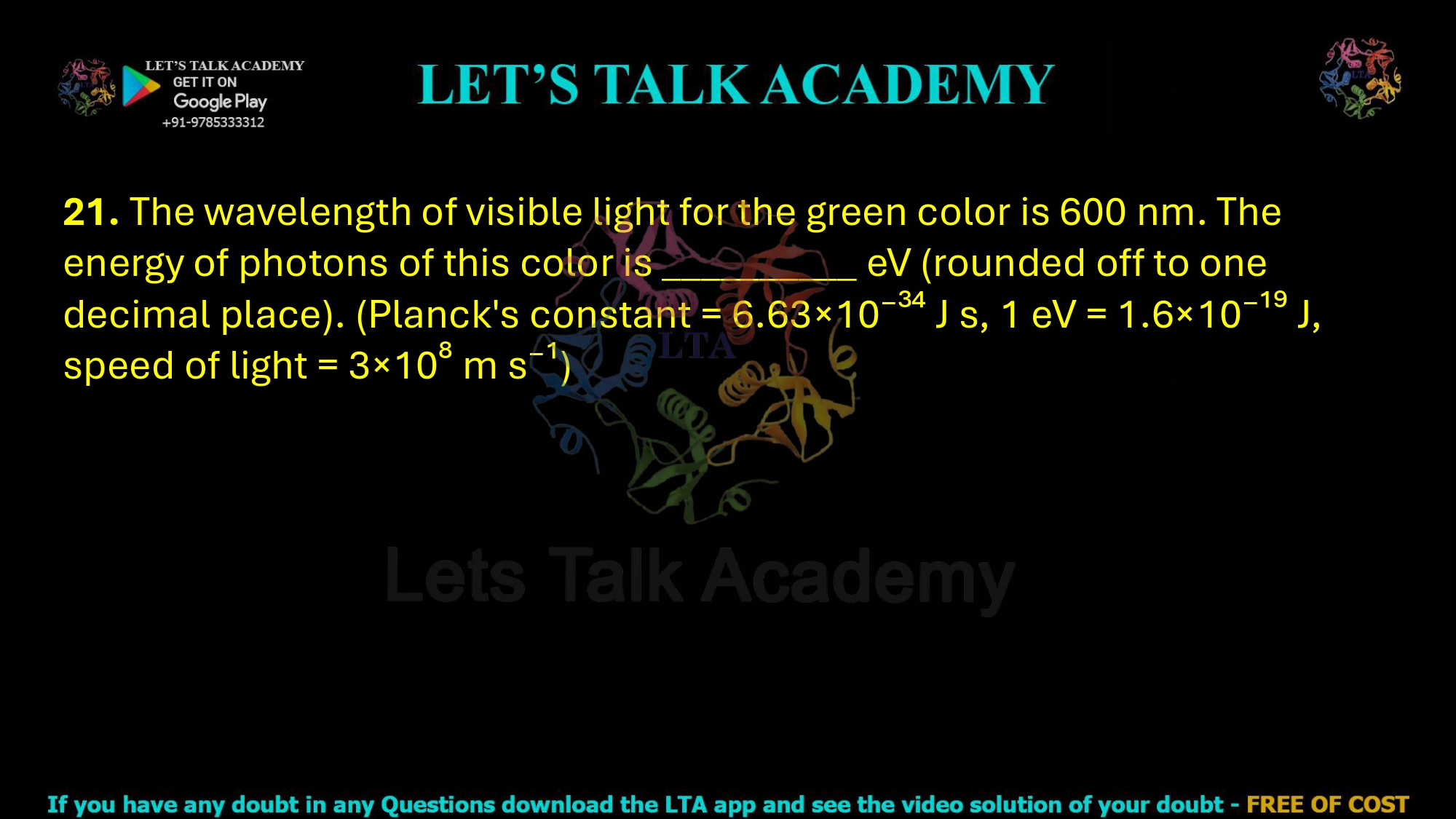
21. The wavelength of visible light for the green color is 600 nm. The energy of photons of this color is __________ eV (rounded off to one decimal place). (Planck’s constant = 6.63×10⁻³⁴ J s, 1 eV = 1.6×10⁻¹⁹ J, speed of light = 3×10⁸ m s⁻¹)
Energy of a 600 nm Green Light Photon in Electron Volts (eV)
Correct Answer: 2.1 eV
Understanding the Given Photon Energy Problem
This question asks us to calculate the energy of a photon of visible light whose wavelength is 600 nm. The final answer is required in electron volts (eV) and must be rounded off to one decimal place.
Light behaves as a stream of tiny packets of energy called photons. The energy carried by each photon depends on the frequency and wavelength of the electromagnetic radiation. Light with a shorter wavelength has higher photon energy, whereas light with a longer wavelength has lower photon energy.
To solve this problem, we first use the relationship between photon energy and wavelength to calculate the energy in joules. We then convert the result from joules into electron volts.
Formula for the Energy of a Photon
The energy of a photon is given by Planck’s relation:
E = hν
where E is the energy of one photon, h is Planck’s constant and ν is the frequency of the light.
The frequency and wavelength of light are related by:
c = νλ
Therefore:
ν = c/λ
Substituting this expression for frequency into Planck’s equation gives:
E = hc/λ
This is the most convenient formula for calculating photon energy when the wavelength of light is given.
Given Values in the Question
The wavelength of the green light is:
λ = 600 nm
Planck’s constant is:
h = 6.63 × 10⁻³⁴ J s
The speed of light is:
c = 3 × 10⁸ m s−1
The conversion between joules and electron volts is:
1 eV = 1.6 × 10⁻¹⁹ J
Before substituting the wavelength into the photon energy formula, it must be converted from nanometres into metres.
Converting the Wavelength from Nanometres to Metres
The wavelength is given as 600 nm. We know that:
1 nm = 10−9 m
Therefore:
600 nm = 600 × 10−9 m
This can be written in standard scientific notation as:
λ = 6 × 10⁻⁷ m
Using the wavelength in metres is necessary because Planck’s constant and the speed of light are given in SI units.
Calculating the Energy of the Photon in Joules
Using the photon energy formula:
E = hc/λ
Substituting the given values:
E = [(6.63 × 10−34) × (3 × 108)] / (6 × 10⁻⁷)
Multiplying the values in the numerator:
6.63 × 3 = 19.89
and:
10−34 × 108 = 10−26
Therefore:
E = (19.89 × 10⁻²⁶) / (6 × 10⁻⁷)
Dividing the numerical values and powers of ten:
E = 3.315 × 10⁻¹⁹ J
Thus, the energy of one photon of 600 nm light is approximately 3.315 × 10⁻¹⁹ joule.
Converting Photon Energy from Joules to Electron Volts
The question requires the answer in electron volts rather than joules. The given conversion is:
1 eV = 1.6 × 10⁻¹⁹ J
Therefore, the photon energy in electron volts is:
E (in eV) = Energy in joules / (1.6 × 10⁻¹⁹)
Substituting the calculated energy:
E = (3.315 × 10⁻¹⁹) / (1.6 × 10⁻¹⁹) eV
The powers of ten cancel:
E = 3.315/1.6 eV
Therefore:
E = 2.071875 eV
Rounding this value off to one decimal place gives:
E = 2.1 eV
Direct Calculation of Photon Energy in Electron Volts
The complete calculation can also be performed in a single sequence. Starting with:
E = hc/λ
we obtain:
E = [(6.63 × 10−34) × (3 × 108)] / (600 × 10−9)
Therefore:
E = 3.315 × 10⁻¹⁹ J
Converting into electron volts:
E = (3.315 × 10⁻¹⁹) / (1.6 × 10⁻¹⁹)
E = 2.071875 eV
After rounding to one decimal place:
E = 2.1 eV
Why Photon Energy Depends on Wavelength
The relationship between photon energy and wavelength is:
E = hc/λ
Since Planck’s constant h and the speed of light c are constant, photon energy is inversely proportional to wavelength:
E ∝ 1/λ
This means that as wavelength decreases, the energy of each photon increases. Conversely, as wavelength increases, photon energy decreases.
Within the visible spectrum, light toward the shorter-wavelength region carries more energy per photon than light toward the longer-wavelength region. This relationship between wavelength and energy is fundamental to understanding the electromagnetic spectrum, spectroscopy, the photoelectric effect and many other topics in modern physics.
Understanding the Electron Volt as a Unit of Energy
The electron volt is a convenient unit of energy commonly used in atomic, nuclear and particle physics. One electron volt is defined as the energy gained by an electron when it moves through a potential difference of one volt.
The relationship between the electron volt and the joule is:
1 eV = 1.6 × 10⁻¹⁹ J
Since the energy of an individual photon is extremely small when measured in joules, electron volts provide a more convenient numerical scale. In this question, the energy 3.315 × 10⁻¹⁹ J becomes approximately 2.1 eV.
Significance of Rounding to One Decimal Place
The calculated photon energy is:
2.071875 eV
The question specifically asks for the answer rounded off to one decimal place. To round a number to one decimal place, we examine the digit in the second decimal position.
In 2.071875, the first decimal digit is 0 and the second decimal digit is 7. Since 7 is greater than or equal to 5, the first decimal digit is increased by one.
Therefore:
2.071875 eV ≈ 2.1 eV
Final Answer
The energy of a photon is calculated using:
E = hc/λ
For the given values:
h = 6.63 × 10⁻³⁴ J s
c = 3 × 10⁸ m s−1
λ = 600 nm = 6 × 10⁻⁷ m
Therefore:
E = 3.315 × 10⁻¹⁹ J
Converting into electron volts:
E = (3.315 × 10⁻¹⁹) / (1.6 × 10⁻¹⁹)
E = 2.071875 eV
Rounded off to one decimal place:
Final Answer: 2.1 eV


