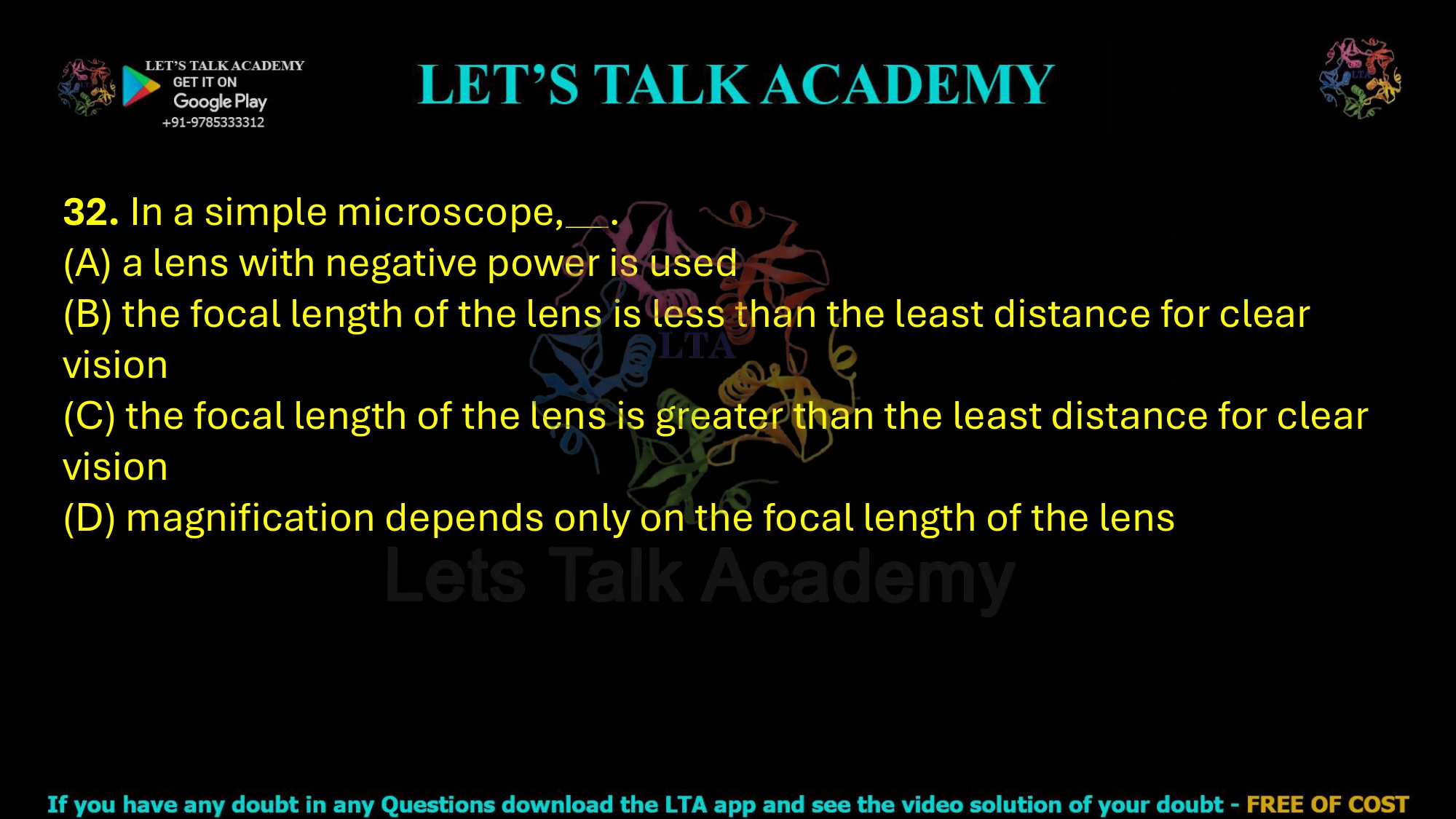
32. In a simple microscope, .
(A) a lens with negative power is used
(B) the focal length of the lens is less than the least distance for clear vision
(C) the focal length of the lens is greater than the least distance for clear vision
(D) magnification depends only on the focal length of the lens
In a Simple Microscope, Which Statement Is Correct?
Correct Answer: Option (B) – The focal length of the lens is less than the least distance for clear vision.
Understanding the Working Principle of a Simple Microscope
A simple microscope is an optical instrument used to observe small objects that cannot be seen clearly in sufficient detail with the unaided eye. It consists essentially of a single converging lens of short focal length. A common magnifying glass is the simplest example of a simple microscope.
The object to be viewed is placed within the focal length of the convex lens. Under this condition, the lens produces an image that is virtual, erect, and magnified. Since the image is virtual, it cannot be obtained on a screen, but it can be observed directly through the lens.
The ability of a simple microscope to enlarge the apparent size of an object is described by its angular magnification or magnifying power. A shorter focal length generally produces greater magnification, which is why a simple microscope uses a convex lens with a relatively small focal length.
What Is the Least Distance for Clear Vision?
The least distance for clear vision, also called the least distance of distinct vision, is the minimum distance from the eye at which a normal human eye can see an object clearly without excessive strain. It is conventionally represented by D.
For a normal human eye:
D = 25 cm
A simple microscope must have a focal length smaller than this least distance of distinct vision. Therefore:
f < D
This condition allows the lens to provide useful angular magnification. Hence, the statement given in option (B) is correct.
Detailed Analysis of Each Option
Option (A): A Lens with Negative Power Is Used
This statement is incorrect. A lens with negative power is a concave or diverging lens. A concave lens causes parallel light rays to diverge and generally forms a virtual, erect, and diminished image of a real object.
A simple microscope must produce a magnified image, so it uses a convex lens rather than a concave lens. A convex lens is a converging lens and has positive focal length and positive optical power.
Therefore, a lens with negative power is not used as the magnifying lens of a simple microscope, making option (A) incorrect.
Option (B): The Focal Length of the Lens Is Less Than the Least Distance for Clear Vision
This statement is correct. The magnifying power of a simple microscope depends strongly on the ratio of the least distance of distinct vision D to the focal length f of the lens.
For effective magnification, the focal length of the convex lens should be shorter than the least distance for clear vision. Since the least distance of distinct vision for a normal eye is approximately 25 cm, a simple microscope uses a convex lens whose focal length is less than 25 cm.
Therefore:
f < D
This makes option (B) the correct answer.
Option (C): The Focal Length of the Lens Is Greater Than the Least Distance for Clear Vision
This statement is incorrect. If the focal length of the lens were greater than the least distance of distinct vision, the lens would not provide the useful magnification expected from a simple microscope.
A simple microscope requires a short-focal-length convex lens. Since its magnifying power increases as the focal length decreases, the condition required for practical magnification is f < D rather than f > D.
Therefore, option (C) gives the opposite of the correct relationship and is incorrect.
Option (D): Magnification Depends Only on the Focal Length of the Lens
This statement is incorrect because the magnification of a simple microscope is not described only by the focal length in every viewing condition. It also depends on the position of the final image and the least distance of distinct vision of the observer.
When the final image is formed at infinity, the magnifying power is:
M = D/f
When the final image is formed at the least distance of distinct vision, the magnifying power is:
M = 1 + D/f
These expressions show that magnification involves both the focal length f and the least distance of distinct vision D. The viewing condition also determines which expression is used. Therefore, saying that magnification depends only on focal length is not completely correct.
Why Is Option (B) the Correct Answer?
A simple microscope is designed to increase the angular size of a small object as seen by the eye. To achieve useful magnification, it uses a convex lens of short focal length. The focal length must be less than the least distance of distinct vision.
For a normal eye, D is approximately 25 cm. Therefore, the condition for the lens of a simple microscope is:
f < 25 cm
A smaller focal length produces a larger angular magnification. This is why option (B) correctly describes the lens used in a simple microscope.
Image Formation in a Simple Microscope
For a simple microscope to work as a magnifying instrument, the object is placed between the optical centre of the convex lens and its principal focus. In other words, the object distance is smaller than the focal length of the lens.
Under this condition, the refracted rays diverge after passing through the lens. When these rays are extended backward, they appear to meet on the same side of the lens as the object. The resulting image is virtual, erect, and enlarged.
This enlarged virtual image subtends a greater angle at the eye than the object would subtend when viewed directly from the least distance of distinct vision. As a result, the object appears larger and its fine details become easier to observe.
Magnifying Power of a Simple Microscope
The magnifying power of a simple microscope is the ratio of the angle subtended at the eye by the image seen through the microscope to the angle subtended by the object when viewed directly at the least distance of distinct vision.
For relaxed viewing, when the final image is formed at infinity:
M = D/f
For maximum magnification, when the final image is formed at the least distance of distinct vision:
M = 1 + D/f
Both expressions show that decreasing the focal length increases the magnifying power. Therefore, a short-focal-length convex lens is an essential feature of a simple microscope.
Final Answer
The correct answer is Option (B): The focal length of the lens is less than the least distance for clear vision.
A simple microscope uses a convex lens of positive power and short focal length. For effective magnification, its focal length must be less than the least distance of distinct vision, which is approximately 25 cm for a normal human eye. Therefore, f < D, making option (B) correct.


