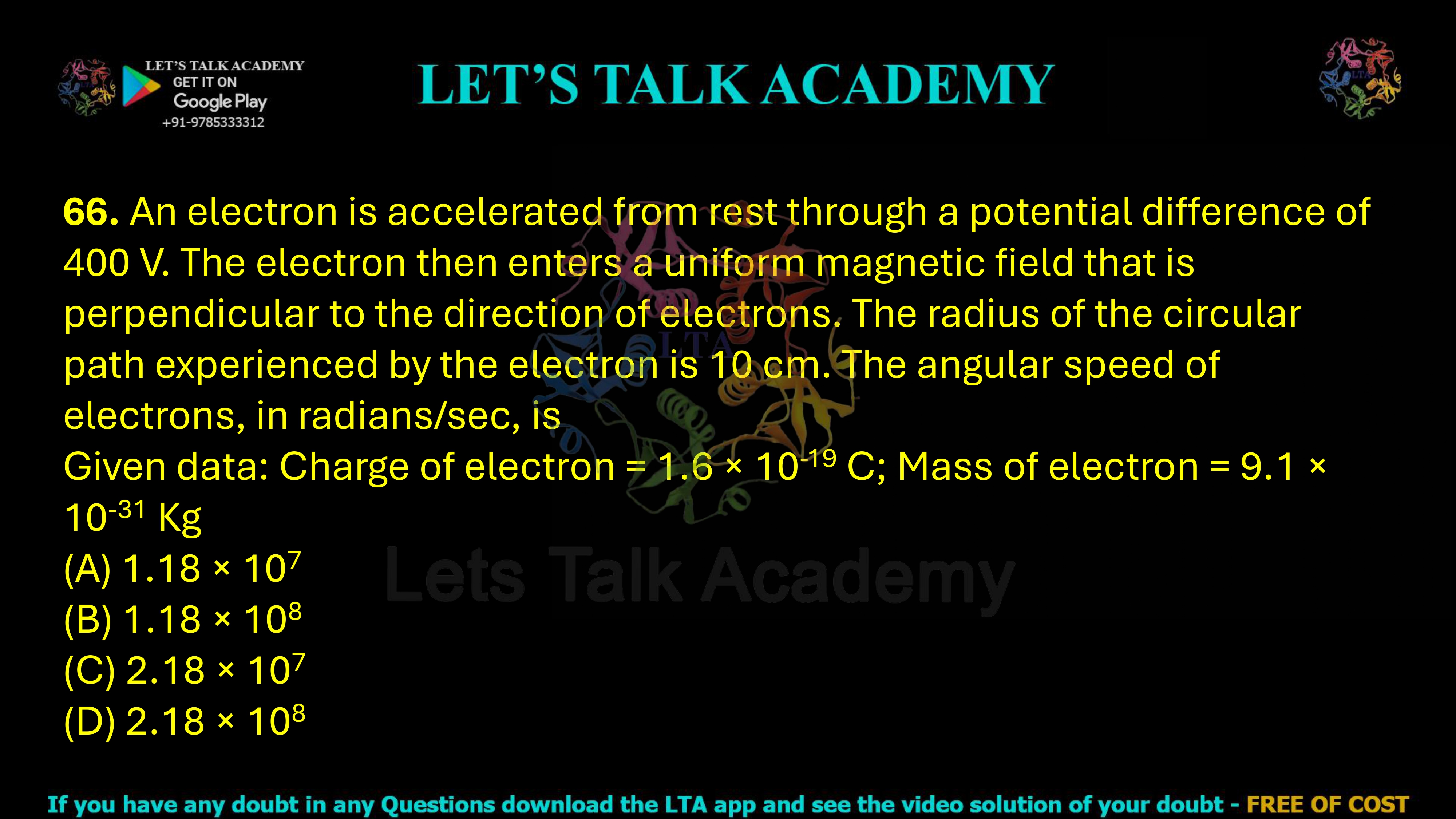
66. An electron is accelerated from rest through a potential difference of 400 V. The electron then enters a uniform magnetic field that is perpendicular to the direction of electrons. The radius of the circular path experienced by the electron is 10 cm. The angular speed of electrons, in radians/sec, is
Given data: Charge of electron = 1.6 × 10⁻¹⁹ C; Mass of electron = 9.1 × 10⁻³¹ Kg
(A) 1.18 × 10⁷
(B) 1.18 × 10⁸
(C) 2.18 × 10⁷
(D) 2.18 × 10⁸
Electron Angular Speed in a Uniform Magnetic Field – Complete Theory and Detailed Numerical Solution
Correct Answer
(B) 1.18 × 10⁸ rad/s
Concept Behind the Problem
The problem consists of two stages. In the first stage, the electron is accelerated through an electric potential difference, causing it to gain kinetic energy. In the second stage, the electron enters a magnetic field perpendicular to its velocity, where the magnetic force acts as the centripetal force required for circular motion.
Since the magnetic field is always perpendicular to the velocity, it changes only the direction of motion and not the magnitude of the velocity. Therefore, the speed of the electron remains constant inside the magnetic field.
Step 1: Calculate the Speed of the Electron
When an electron is accelerated through a potential difference V, the electrical potential energy is converted completely into kinetic energy.
The energy equation is
eV = ½mv²
Substituting the given values,
1.6 × 10−19 × 400 = ½ × 9.1 × 10⁻³¹ × v²
Therefore,
v² = (2 × 1.6 × 10−19 × 400) / (9.1 × 10⁻³¹)
v² = 1.406 × 10¹⁴
Taking the square root,
v ≈ 1.186 × 10⁷ m/s
Step 2: Calculate the Angular Speed
The angular speed of an object moving in a circle is given by
ω = v / r
where
- v = linear speed
- r = radius of the circular path
Substitute the known values,
ω = (1.186 × 10⁷) / (0.10)
ω = 1.186 × 10⁸ rad/s
Rounding appropriately,
ω = 1.18 × 10⁸ rad/s
Alternative Method
Once the electron’s speed has been calculated, the angular speed can always be obtained directly using
ω = v/r
This follows from the definition of angular velocity in uniform circular motion and is often the quickest approach in examination problems.
Option-Wise Analysis
Option (A): 1.18 × 10⁷ rad/s
This value is ten times smaller than the calculated angular speed. The error usually occurs if the radius is incorrectly taken as 1 m instead of 0.10 m.
Incorrect.
Option (B): 1.18 × 10⁸ rad/s
This exactly matches the value obtained using the work-energy theorem and the formula for angular speed.
Correct.
Option (C): 2.18 × 10⁷ rad/s
This value does not satisfy the energy equation or the circular motion relation.
Incorrect.
Option (D): 2.18 × 10⁸ rad/s
This value is nearly twice the correct result and does not match the calculation based on the given data.
Incorrect.
Physical Interpretation
The electron gains kinetic energy while moving through the accelerating potential difference. After entering the magnetic field, the magnetic force acts perpendicular to its velocity at every point, continuously changing its direction. Since no work is done by the magnetic force, the speed remains constant and only the direction changes, resulting in uniform circular motion. The angular speed represents how rapidly the electron completes one revolution around the circular path.
Exam-Oriented Key Concepts
Students should remember that the kinetic energy gained by a charged particle accelerated through a potential difference is equal to eV. Once the speed is known, the angular speed in a circular path is obtained using ω = v/r. The magnetic field changes only the direction of motion and never the magnitude of velocity because the magnetic force is always perpendicular to the velocity. These concepts are frequently tested in competitive examinations through direct numerical questions.
Final Answer
The angular speed of the electron is
ω = 1.18 × 10⁸ rad/s
Correct Option: (B)


