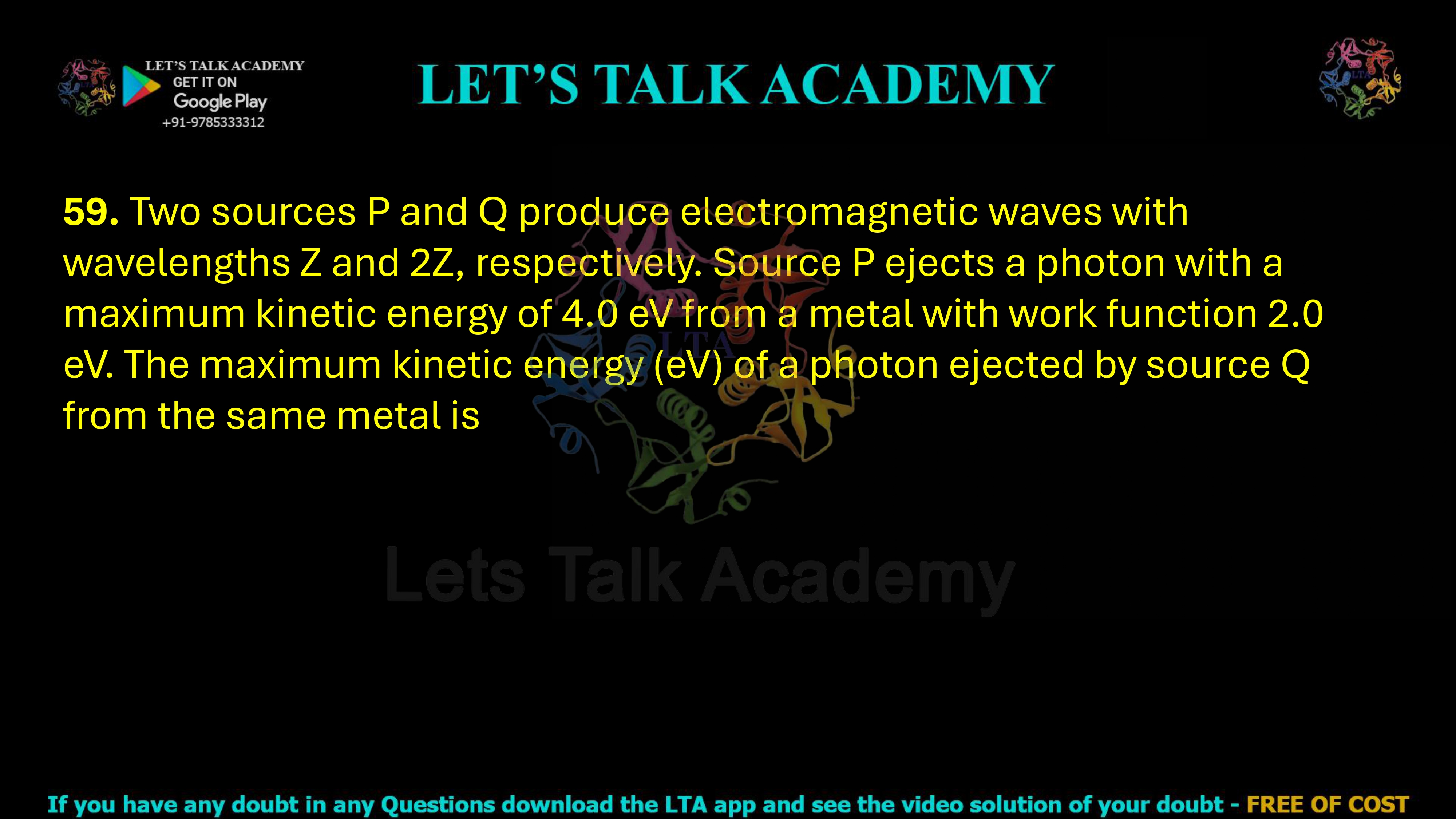
59. Two sources P and Q produce electromagnetic waves with wavelengths Z and 2Z, respectively. Source P ejects a photon with a maximum kinetic energy of 4.0 eV from a metal with work function 2.0 eV. The maximum kinetic energy (eV) of a photon ejected by source Q from the same metal is
Maximum Kinetic Energy in the Photoelectric Effect for Different Wavelengths – Complete Theory and Detailed Solution
Correct Answer
2.0 eV
Understanding the Photoelectric Effect
When light of sufficiently high frequency falls on a metal surface, electrons are emitted from that surface. This phenomenon is known as the Photoelectric Effect. Albert Einstein explained this phenomenon by proposing that light consists of tiny packets of energy called photons. Each photon carries a fixed amount of energy that depends on its frequency or wavelength.
When a photon strikes the metal surface, its energy is first used to overcome the attraction holding the electron inside the metal. The minimum energy required to remove an electron from the metal surface is known as the work function (ϕ). Any remaining energy appears as the kinetic energy of the emitted electron.
Einstein’s Photoelectric Equation
The fundamental equation governing the photoelectric effect is
Photon Energy = Work Function + Maximum Kinetic Energy
or
hν = ϕ + Kmax
Since photon energy can also be written as
E = hc/λ
we see that photon energy is inversely proportional to wavelength.
Step 1: Calculate the Photon Energy from Source P
For source P, the wavelength is Z.
The question states that the emitted photoelectron has a maximum kinetic energy of 4.0 eV, while the work function of the metal is 2.0 eV.
Using Einstein’s equation,
Photon Energy = Work Function + Maximum Kinetic Energy
= 2.0 + 4.0
= 6.0 eV
Thus, each photon coming from source P has an energy of 6.0 eV.
Step 2: Determine the Photon Energy from Source Q
Source Q has wavelength 2Z, which is exactly twice the wavelength of source P.
Since photon energy is inversely proportional to wavelength, doubling the wavelength reduces the photon energy to one-half.
Therefore,
Photon Energy from Source Q = 6.0/2 = 3.0 eV
Step 3: Calculate the Maximum Kinetic Energy
The work function of the metal remains unchanged because the same metal is used.
Applying Einstein’s equation again,
Kmax = Photon Energy − Work Function
= 3.0 − 2.0
= 1.0 eV
Therefore, the maximum kinetic energy of the emitted photoelectron is
1.0 eV.
Why This Method Works
The key idea in this problem is that changing the wavelength changes the energy of each photon. Because the wavelength of source Q is twice that of source P, every photon emitted by Q carries only half as much energy as a photon from P. Once the work function has been supplied, the remaining energy becomes the kinetic energy of the emitted electron.
Many students unnecessarily substitute the values of Planck’s constant and the speed of light. However, such calculations are not required here because only the ratio of wavelengths is involved.
Concept Behind Wavelength and Photon Energy
Shorter Wavelength Means Higher Energy
Photon energy is inversely proportional to wavelength.
As wavelength decreases, photon energy increases.
As wavelength increases, photon energy decreases.
This relationship is one of the most frequently tested concepts in modern physics.
Role of the Work Function
The work function is a characteristic property of a metal. It depends only on the material and remains constant regardless of the wavelength or intensity of the incident light.
Only after the work function has been overcome does the remaining photon energy appear as kinetic energy of the emitted electron.
Detailed Conceptual Explanation
Imagine that each photon behaves like a person carrying a fixed amount of money. Before leaving a building, the person must first pay an entry fee equal to the work function. Whatever money remains after paying the fee is the kinetic energy of the electron. If the incoming photon has less energy because of a larger wavelength, the amount left after paying the work function is also smaller.
In this question, the photon energy decreases from 6 eV to 3 eV because the wavelength doubles. After paying the same work function of 2 eV, only 1 eV remains as kinetic energy.
Important Formulae
Einstein’s Photoelectric Equation
hν = ϕ + Kmax
Photon Energy
E = hc/λ
Maximum Kinetic Energy
Kmax = hν − ϕ
Relationship Between Wavelength and Energy
E ∝ 1/λ
Final Answer
Photon energy from source P = 6.0 eV.
Photon energy from source Q = 3.0 eV.
Maximum kinetic energy from source Q = 3.0 − 2.0 = 1.0 eV.
Correct Answer: 1.0 eV


