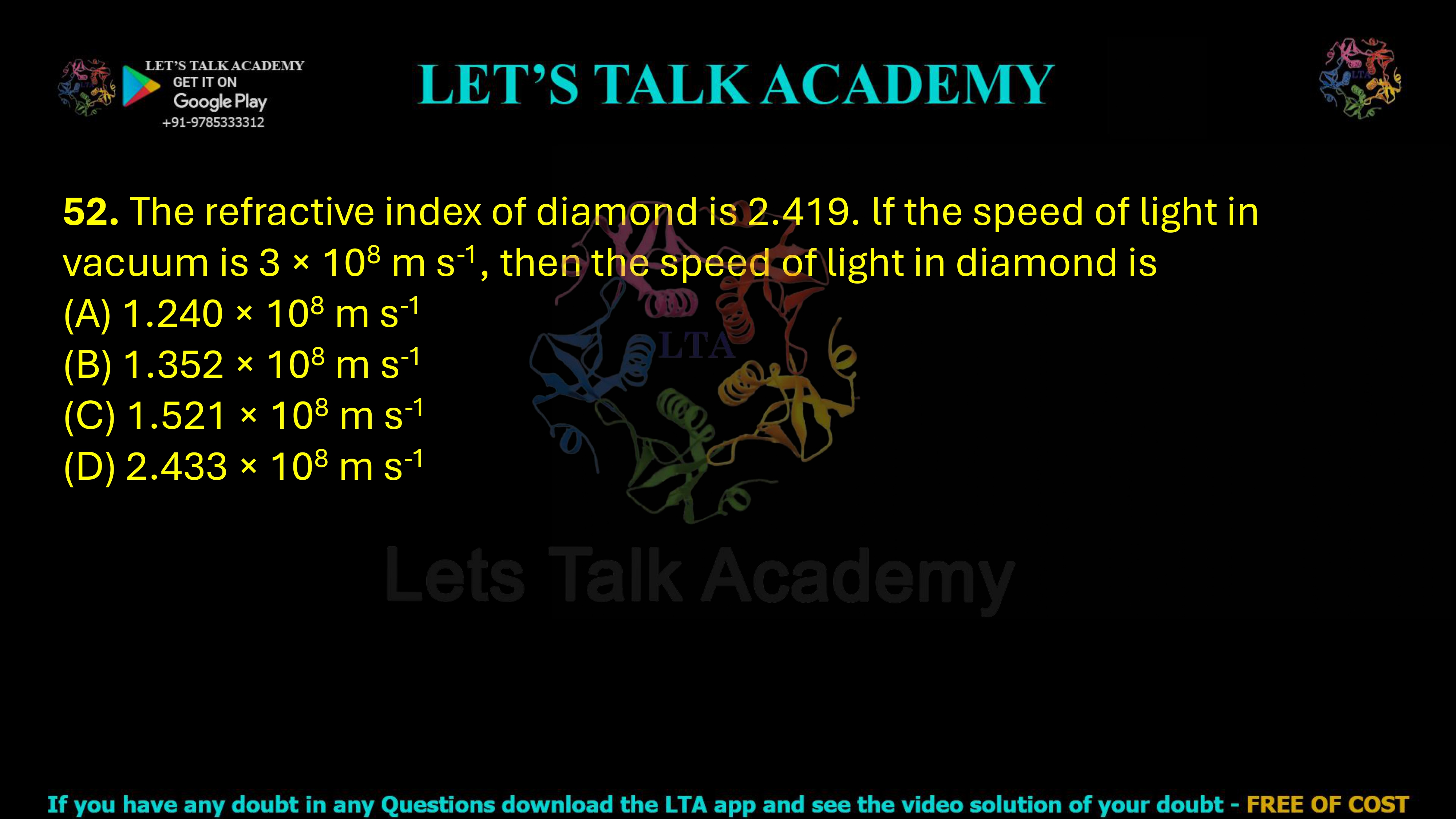
52. The refractive index of diamond is 2.419. lf the speed of light in vacuum is 3 × 10⁸ m s-1, then the speed of light in diamond is
(A) 1.240 × 10⁸ m s-1
(B) 1.352 × 10⁸ m s-1
(C) 1.521 × 10⁸ m s-1
(D) 2.433 × 10⁸ m s-1
Speed of Light in Diamond – Refractive Index Formula, Numerical Solution and Complete Explanation
Correct Answer
(A) 1.240 × 10⁸ m s−1
Understanding the Concept of Refractive Index
The refractive index tells us how much a transparent medium slows down light compared to its speed in vacuum. Light always travels at its maximum speed in vacuum, and when it enters a material such as glass, water, or diamond, its speed decreases because of interactions with the particles of the medium.
Diamond has one of the highest refractive indices among naturally occurring transparent materials. This is why light slows down significantly inside diamond, producing its characteristic brilliance and sparkle.
Formula Used
The relationship between refractive index and the speed of light is
n = c / v
where
- n = Refractive index of the medium
- c = Speed of light in vacuum = 3 × 10⁸ m s−1
- v = Speed of light in the medium
Rearranging the equation, we get
v = c / n
Step-by-Step Solution
Given,
Refractive index of diamond,
n = 2.419
Speed of light in vacuum,
c = 3 × 10⁸ m s−1
Using the formula,
v = c / n
v = (3 × 10⁸) / 2.419
v = 1.240 × 10⁸ m s−1
Therefore, the speed of light inside diamond is
1.240 × 10⁸ m s−1
Why Option (A) is Correct
Option (A) exactly matches the value obtained using the standard refractive index equation. Since the refractive index is greater than one, the speed of light in diamond must always be less than its speed in vacuum. The calculated value satisfies this physical condition perfectly.
Why the Other Options are Incorrect
Option (B): 1.352 × 10⁸ m s−1
This value does not satisfy the given refractive index of 2.419. If substituted back into the formula, it produces a different refractive index. Therefore, this option is mathematically incorrect.
Option (C): 1.521 × 10⁸ m s−1
This value is larger than the correct speed calculated using the refractive index equation. It corresponds to a much smaller refractive index than the one given in the question, making this option incorrect.
Option (D): 2.433 × 10⁸ m s−1
This value is very close to the speed of light in vacuum. A medium like diamond has a very high refractive index, meaning light slows down considerably. Therefore, this value is physically unrealistic and does not satisfy the formula.
Why Does Light Travel Slower in Diamond?
When light enters diamond, it interacts repeatedly with the atoms of the material. These interactions delay the overall propagation of light, reducing its average speed. Although the frequency of light remains unchanged while entering the new medium, its wavelength decreases because the speed has reduced. This relationship is a fundamental concept in wave optics and is frequently tested in objective examinations.
Important Formula to Remember
Refractive Index (n) = Speed of Light in Vacuum (c) ÷ Speed of Light in Medium (v)
or
Speed of Light in Medium (v) = Speed of Light in Vacuum (c) ÷ Refractive Index (n)
Final Answer
Speed of light in diamond = 1.240 × 10⁸ m s−1
Correct Option: (A)


