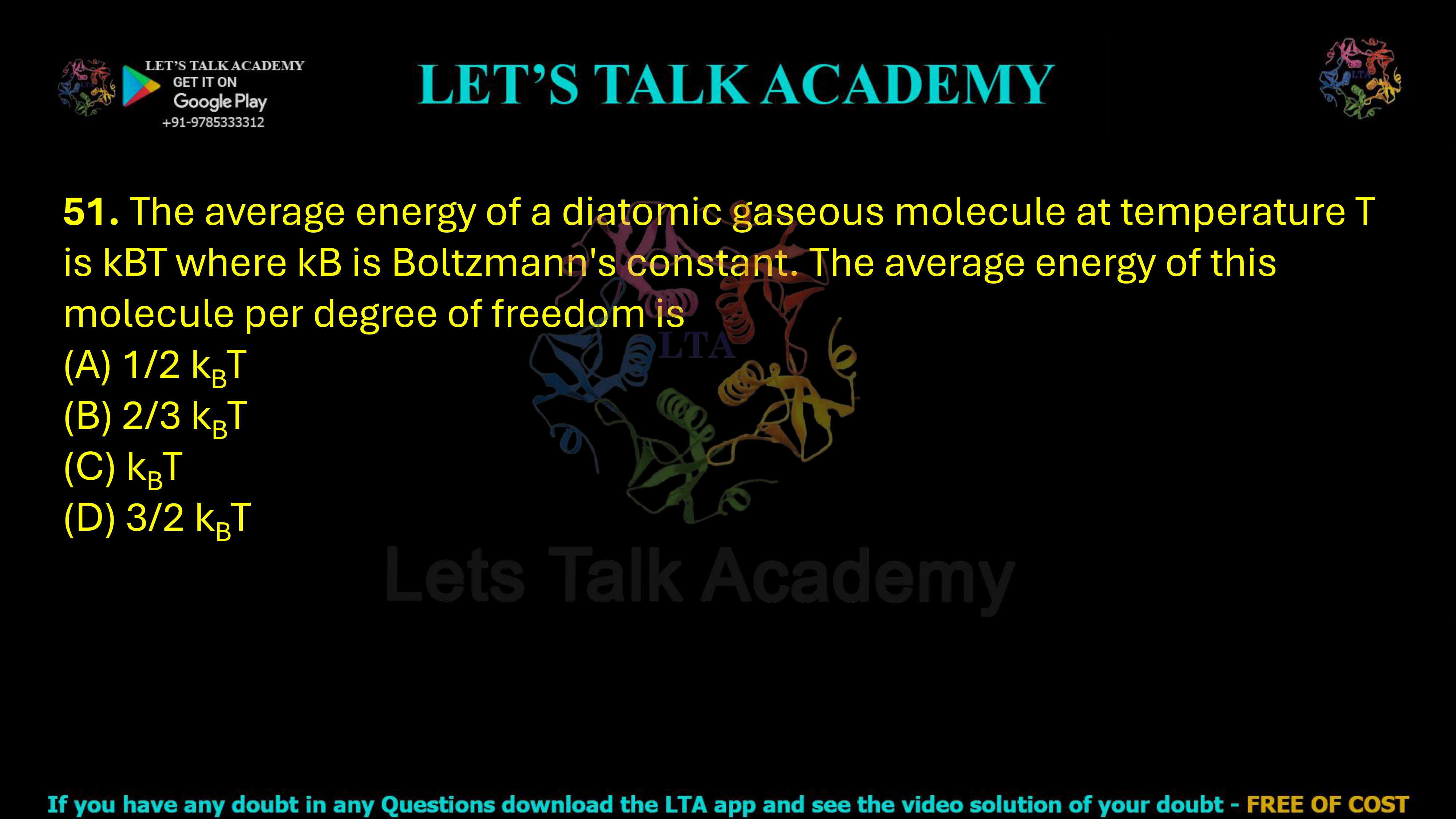
51. The average energy of a diatomic gaseous molecule at temperature T is kBT where kB is Boltzmann’s constant. The average energy of this molecule per degree of freedom is
(A) 1/2 kBT
(B) 2/3 kBT
(C) kBT
(D) 3/2 kBT
Average Energy of a Diatomic Gas Molecule Per Degree of Freedom – Complete Explanation
Correct Answer
Option (A) – ½kBT
Understanding the Equipartition Theorem
The Equipartition Theorem states that every independent quadratic degree of freedom contributes an average energy of
½kBT
to the total energy of a molecule at thermal equilibrium.
This principle is extremely important because it allows us to calculate the internal energy of gases simply by counting the number of active degrees of freedom.
Calculation
According to the question, the average energy of the molecule is
Total Energy = kBT
For a diatomic molecule at ordinary temperatures, the active degrees of freedom are:
- Three translational degrees of freedom
- Two rotational degrees of freedom
Thus, the total number of active degrees of freedom is
f = 5
However, regardless of how many degrees of freedom are active, the energy contributed by each degree of freedom is always
Average Energy per Degree of Freedom = ½kBT
This result comes directly from the Equipartition Theorem and does not depend on the total energy already provided in the question.
Hence, the correct answer is
½kBT.
Why Option (A) is Correct
Option (A) correctly represents the fundamental statement of the Equipartition Theorem. Every quadratic degree of freedom contributes an average energy equal to ½kBT. This rule applies universally to translational, rotational, and vibrational quadratic energy terms whenever they are active. Since the question asks specifically for the energy per degree of freedom, this option is the only correct choice.
Why Option (B) is Incorrect
The value ⅔kBT does not correspond to the average energy contributed by any degree of freedom in classical statistical mechanics. It is not obtained from the Equipartition Theorem and therefore cannot represent the required answer.
Why Option (C) is Incorrect
The quantity kBT is the total average energy mentioned in the question. The question, however, asks for the energy associated with a single degree of freedom, which is only half of this value according to the Equipartition Theorem. Therefore, this option confuses total molecular energy with energy per degree of freedom.
Why Option (D) is Incorrect
The expression 3⁄2kBT represents the average translational kinetic energy of a monatomic ideal gas molecule because a monatomic molecule has three translational degrees of freedom. It is not the energy associated with a single degree of freedom, making this option incorrect.
Key Concept for Competitive Exams
Average Energy Per Degree of Freedom
One of the most important formulas in thermodynamics is
Average Energy per Degree of Freedom = ½kBT
This formula remains valid for every quadratic degree of freedom. Whether the molecule is monatomic, diatomic, or polyatomic, each active quadratic degree of freedom contributes exactly the same average energy.
Degrees of Freedom of Different Gas Molecules
Understanding the number of degrees of freedom helps solve numerous numerical and conceptual questions.
- Monatomic gas: 3 translational degrees of freedom
- Diatomic gas (ordinary temperature): 3 translational + 2 rotational = 5 degrees of freedom
- Diatomic gas (high temperature): Vibrational degrees of freedom also become active, increasing the total number of degrees of freedom.
Final Answer
Average Energy per Degree of Freedom = ½kBT
Correct Option: (A)


