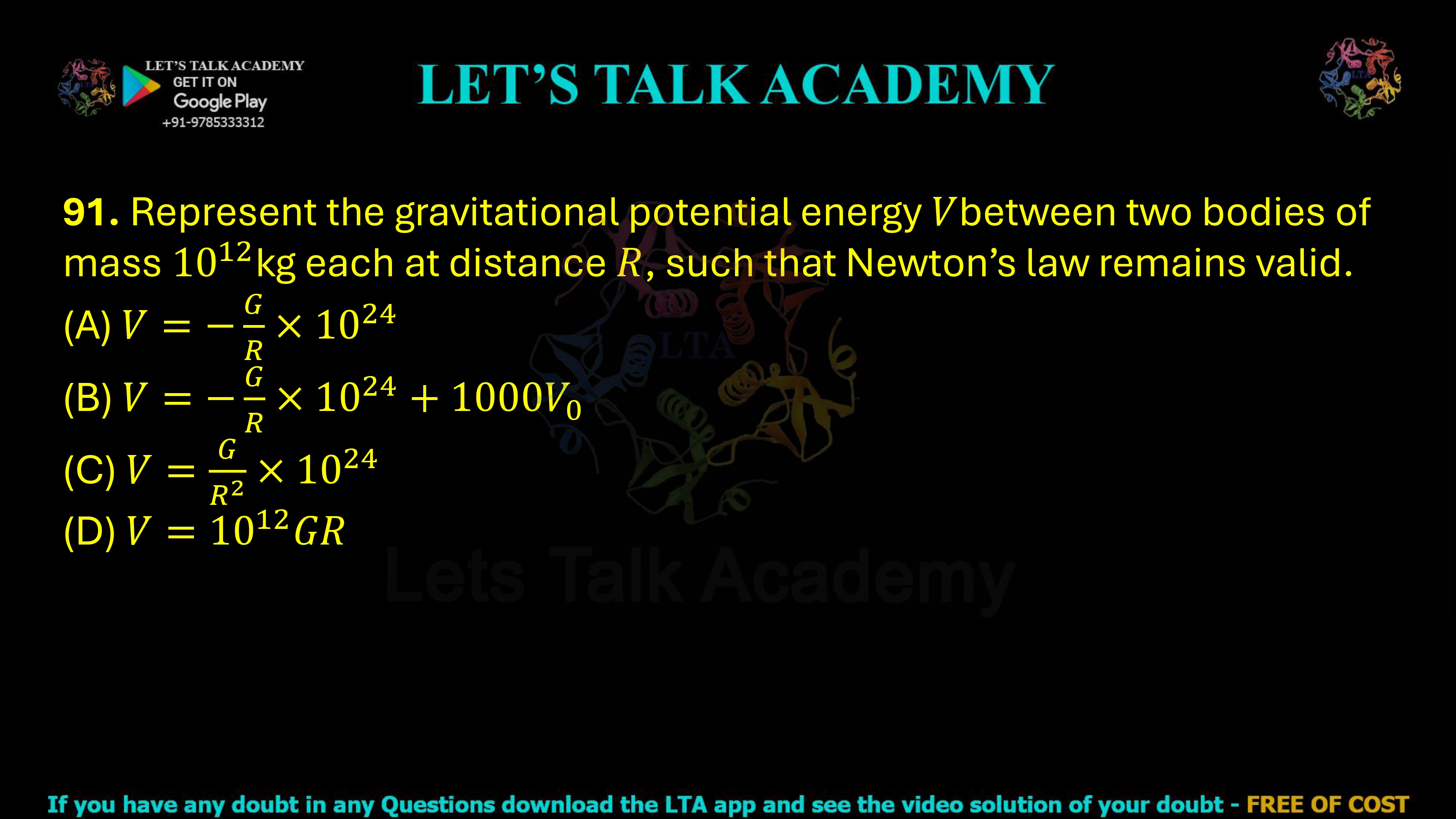
91. Represent the gravitational potential energy V between two bodies of mass 1012 kg each at distance R, such that Newton’s law remains valid.
(A) V = −(G/R) × 1024
(B) V = −(G/R) × 1024 + 1000V0
(C) V = (G/R²) × 1024
(D) V = 1012GR
Gravitational Potential Energy Between Two Masses
Correct Answer
Option (B)
Understanding Gravitational Potential Energy
Gravitational potential energy is the energy possessed by a system of two masses because of their positions relative to each other. Since gravity is an attractive force, external work must be done to separate two attracting masses. This stored energy is called gravitational potential energy.
Unlike kinetic energy, gravitational potential energy depends only on the positions of the masses and not on their velocities. Since gravitational force is a conservative force, potential energy can always be defined.
General Formula for Gravitational Potential Energy
The gravitational potential energy between two point masses is given by
::contentReference[oaicite:0]{index=0}
V = −GMm/R
where
- G = Universal gravitational constant
- M = Mass of the first body
- m = Mass of the second body
- R = Distance between their centres
The negative sign indicates that gravity is an attractive force. The potential energy becomes zero only when the two masses are infinitely far apart.
Step 1: Substitute the Given Masses
Each body has mass
M = m = 1012 kg
Therefore,
Mm = 1012 × 1012
= 1024
Substituting into the potential energy equation,
V = −G × 1024/R
This is the standard expression for gravitational potential energy.
Step 2: Understanding the Constant of Potential Energy
Potential energy is not an absolute quantity. It can always be increased or decreased by adding an arbitrary constant without changing the physical force.
The gravitational force is obtained from the derivative of potential energy with respect to distance:
F = −dV/dR
If a constant term is added to the potential energy, its derivative becomes zero. Therefore, the force remains exactly the same.
This means that both
V = −GMm/R
and
V = −GMm/R + Constant
produce the same gravitational force and therefore both satisfy Newton’s law of gravitation.
Why Option (B) is the Most Correct Answer
Option (B) contains the correct gravitational potential energy expression together with an added constant term.
Since
d(Constant)/dR = 0,
the additional constant does not change the gravitational force. Therefore, Newton’s law remains perfectly valid.
This question is testing an important concept from conservative forces—that the zero level of potential energy is arbitrary.
Detailed Explanation of Every Option
Option (A): V = −(G/R) × 1024
This expression is mathematically the standard gravitational potential energy when the zero of potential energy is chosen at infinity. It is physically correct.
However, the question specifically asks for an expression “such that Newton’s law remains valid.” Since adding any constant leaves Newton’s law unchanged, this expression is not the only possible representation.
Option (B): V = −(G/R) × 1024 + 1000V0
This is the most appropriate answer.
The first term is the correct gravitational potential energy. The additional constant 1000V0 does not affect the force because its derivative with respect to distance is zero.
This option demonstrates the important physical principle that potential energy is defined only up to an arbitrary additive constant.
Option (C): V = (G/R²) × 1024
This expression is incorrect because gravitational potential energy varies inversely with the first power of distance, not the square of distance.
The inverse-square dependence belongs to the gravitational force, not the potential energy.
Option (D): V = 1012GR
This expression is completely incorrect.
It predicts that potential energy increases linearly with distance, whereas gravitational potential energy actually approaches zero as the distance tends to infinity.
It also has incorrect dimensions and does not satisfy Newton’s law.
Why Gravitational Potential Energy is Negative
The negative sign indicates that work must be done against the gravitational attraction to separate two masses. When the bodies are infinitely far apart, their interaction disappears and the potential energy becomes zero. As the bodies move closer together, the system loses potential energy, making it negative.
This convention is universally used in gravitation and plays a vital role in orbital mechanics, planetary motion, satellites, and astrophysics.
Concept of Arbitrary Zero of Potential Energy
One of the most important properties of potential energy is that only differences in potential energy have physical significance. The absolute value of potential energy cannot be measured directly. Therefore, physicists are free to choose the zero level of potential energy wherever convenient.
This is why adding any constant to the gravitational potential energy expression does not change the resulting gravitational force.
Real-Life Applications
Gravitational potential energy is extensively used in satellite launches, spacecraft trajectory calculations, planetary motion, astrophysics, celestial mechanics, and orbital energy calculations. Understanding this concept is essential for analysing the motion of planets, moons, artificial satellites, and space missions.
Final Answer
The correct representation that preserves Newton’s law of gravitation is
V = −(G/R) × 1024 + 1000V0
Correct Option: (B)


