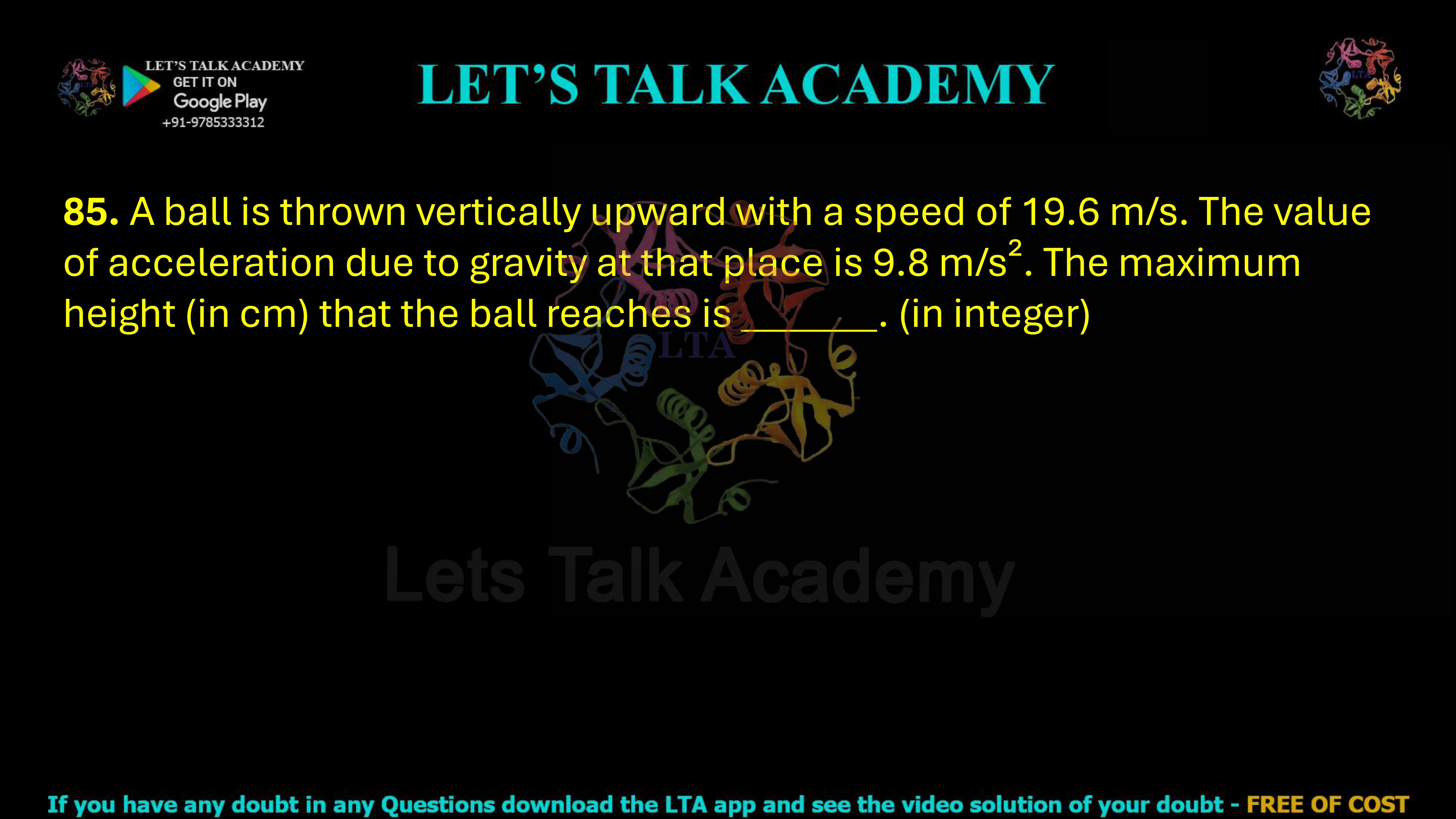
85. A ball is thrown vertically upward with a speed of 19.6 m/s. The value of acceleration due to gravity at that place is 9.8 m/s². The maximum height (in cm) that the ball reaches is _______. (in integer)
Maximum Height Reached by a Ball Thrown Vertically Upward – Complete Theory, Derivation, and Detailed Numerical Solution
Correct Answer
1960 cm
Understanding Vertical Motion Under Gravity
When a ball is thrown vertically upward, it initially moves against the force of gravity. Gravity always acts downward toward the center of the Earth, while the ball initially moves upward. Because the acceleration due to gravity acts opposite to the direction of motion, the speed of the ball continuously decreases during its upward journey.
Eventually, the velocity becomes zero for an instant. This point is known as the maximum height or the highest point of the motion. Although the velocity becomes zero at this instant, the acceleration due to gravity still acts downward with a constant magnitude of 9.8 m/s².
After reaching the highest point, the ball begins to fall back toward the ground under the influence of gravity.
Concept Used in This Numerical
To determine the maximum height, we use the third equation of motion because the final velocity at the highest point is known.
At the maximum height,
Final Velocity (v) = 0
The third equation of motion is
v² = u² + 2as
where
- v = Final velocity
- u = Initial velocity
- a = Acceleration
- s = Displacement (Maximum Height)
Since the motion is upward and gravity acts downward, the acceleration is taken as negative.
Therefore,
a = –9.8 m/s²
Given Data
Initial velocity,
u = 19.6 m/s
Final velocity at maximum height,
v = 0 m/s
Acceleration due to gravity,
g = 9.8 m/s²
Hence,
a = –9.8 m/s²
Step-by-Step Solution
Using the third equation of motion,
v² = u² + 2as
Substitute the given values,
0 = (19.6)² + 2(–9.8)s
0 = 384.16 – 19.6s
Rearranging the equation,
19.6s = 384.16
s = 384.16 / 19.6
s = 19.6 m
The question asks for the answer in centimetres.
Since
1 metre = 100 centimetres
Height = 19.6 × 100
Height = 1960 cm
Alternative Method Using the Maximum Height Formula
Students may directly use the standard formula for maximum height in vertical motion.
Maximum Height = u² / 2g
Substituting the given values,
H = (19.6)² / (2 × 9.8)
H = 384.16 / 19.6
H = 19.6 m
Converting into centimetres,
H = 1960 cm
This method is quicker and is commonly used in competitive examinations.
Why Does the Velocity Become Zero at the Highest Point?
As the ball moves upward, gravity continuously reduces its speed because it acts opposite to the direction of motion. At the highest point, the upward motion stops momentarily, and the velocity becomes zero.
However, it is important to understand that only the velocity becomes zero. The acceleration due to gravity remains constant throughout the motion and is always directed downward with a magnitude of 9.8 m/s².
This is one of the most frequently tested concepts in examinations. Many students mistakenly believe that acceleration also becomes zero at the highest point, which is incorrect.
Real-Life Applications of Vertical Motion
The principles of vertical motion are used in sports such as cricket, football, basketball, volleyball, and athletics. They are also important in engineering, missile technology, fireworks, rocket launches, and satellite motion. Understanding the relationship between velocity, height, and acceleration helps engineers design projectiles and predict the motion of objects under gravity.
Exam-Oriented Key Concepts
Students should remember that at the highest point of vertical motion, the velocity becomes zero but the acceleration remains equal to the acceleration due to gravity. The maximum height depends only on the initial velocity and the acceleration due to gravity. Increasing the initial speed increases the maximum height, whereas increasing the value of gravitational acceleration decreases it. The equation H = u² / 2g is one of the most frequently used formulas in competitive examinations.
Final Answer
The maximum height reached by the ball is
19.6 m
or
1960 cm
Final Answer: 1960


