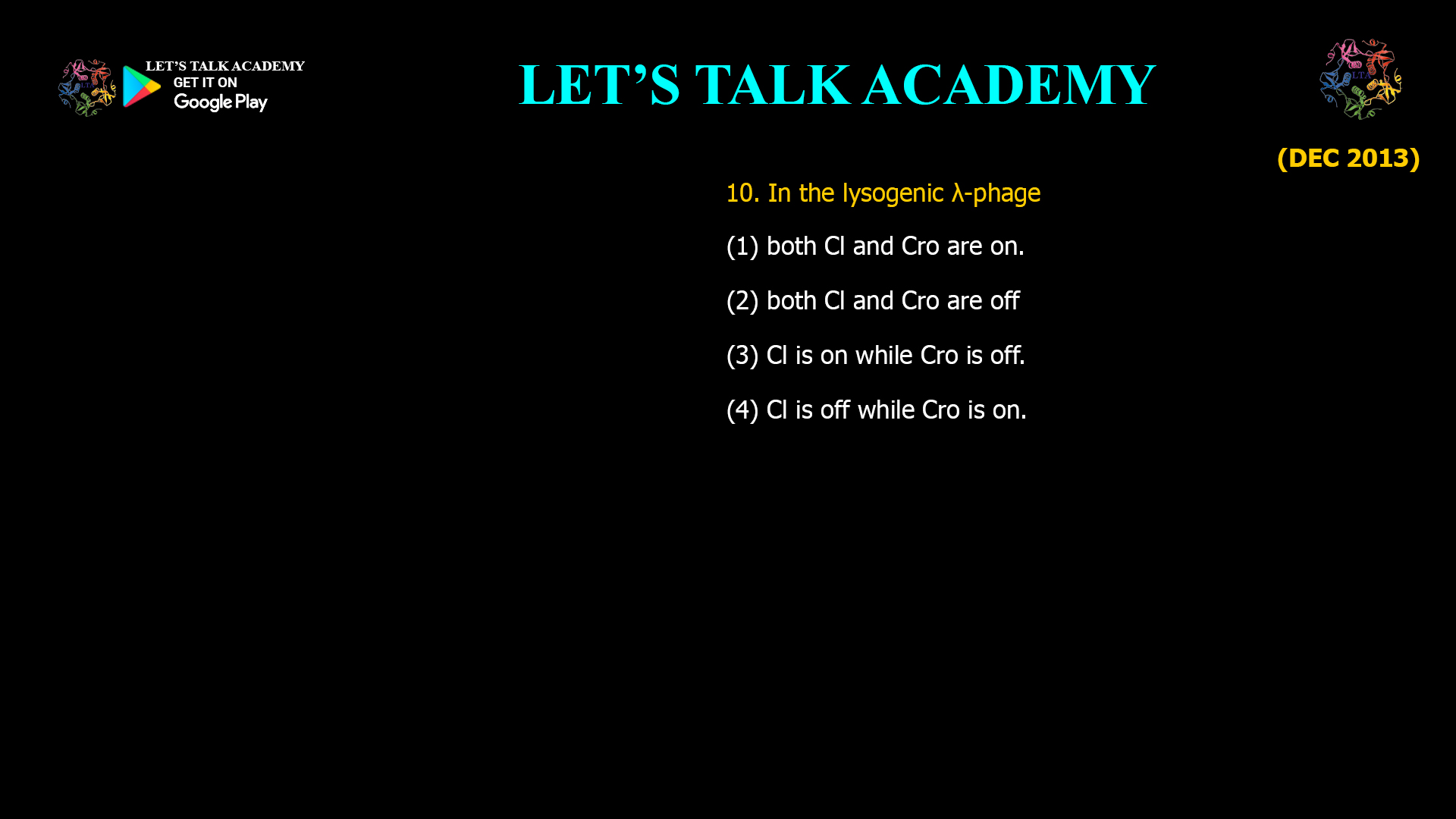
10. In the lysogenic λ-phage
(1) both Cl and Cro are on.
(2) both Cl and Cro are off
(3) Cl is on while Cro is off.
(4) Cl is off while Cro is on.
Bacteriophage lambda (λ phage) is a temperate virus that infects Escherichia coli and can follow two distinct life cycles: the lytic cycle, where it replicates and lyses the host, and the lysogenic cycle, where the viral genome integrates into the host chromosome and remains dormant. The decision between these pathways hinges on a finely tuned genetic switch controlled primarily by two proteins: CI (lambda repressor) and Cro.
The Genetic Switch: CI and Cro Proteins
The lysogenic versus lytic decision depends on the relative levels and activities of CI and Cro proteins:
-
CI protein promotes lysogeny by repressing lytic genes and activating its own expression.
-
Cro protein promotes the lytic cycle by repressing CI expression and allowing lytic genes to be transcribed.
What Happens During the Lysogenic Cycle?
In the lysogenic state, the viral genome is integrated into the bacterial chromosome as a prophage, and the phage remains dormant without killing the host. This state is maintained by the CI repressor protein, which binds to operator sites on the phage DNA, blocking transcription from the lytic promoters P_R and P_L.
-
CI binds strongly to operator sites OR1 and OR2, repressing the P_R promoter responsible for Cro and other lytic gene expression.
-
Binding to these sites also activates transcription from the P_RM promoter, which drives CI expression, creating a positive feedback loop to maintain high CI levels.
-
This repression of Cro ensures that the lytic genes remain off during lysogeny.
Is Cro Also On During Lysogeny?
No. During lysogeny, Cro is effectively turned off because CI represses its promoter. This repression is critical to prevent the initiation of the lytic cycle.
Summary of Protein States in Lysogeny
| Protein | Expression Status in Lysogeny | Role |
|---|---|---|
| CI | ON | Maintains lysogeny by repressing lytic genes |
| Cro | OFF | Repressed to prevent lytic gene expression |
Molecular Details of CI and Cro Interaction
-
The CI protein binds cooperatively to operator sites, forming dimers that repress lytic promoters and stimulate its own synthesis.
-
Cro protein, when expressed, binds to overlapping operator sites to repress CI expression, favoring the lytic pathway.
-
The balance between these two proteins forms a bistable switch controlling the phage life cycle.
Why Is This Important?
-
The lysogenic cycle allows the phage to persist in the host genome without killing the cell, providing a reservoir for future viral replication.
-
The CI protein provides immunity to superinfection by other lambda phages by repressing their lytic promoters.
-
The switch can be flipped to the lytic cycle by environmental cues that inactivate CI, allowing Cro expression and viral replication.
Correct Answer to the Query
Given the above, the correct statement is:
(3) CI is on while Cro is off during the lysogenic cycle of lambda phage.
Conclusion
The lysogenic cycle of bacteriophage lambda is maintained by the CI repressor protein being expressed (ON), which represses the lytic genes including Cro, keeping Cro OFF. This molecular switch ensures the phage genome remains integrated and dormant within the host, preventing host cell lysis and allowing stable inheritance of the prophage through bacterial replication. Understanding this regulatory mechanism is fundamental to molecular genetics and viral biology.


