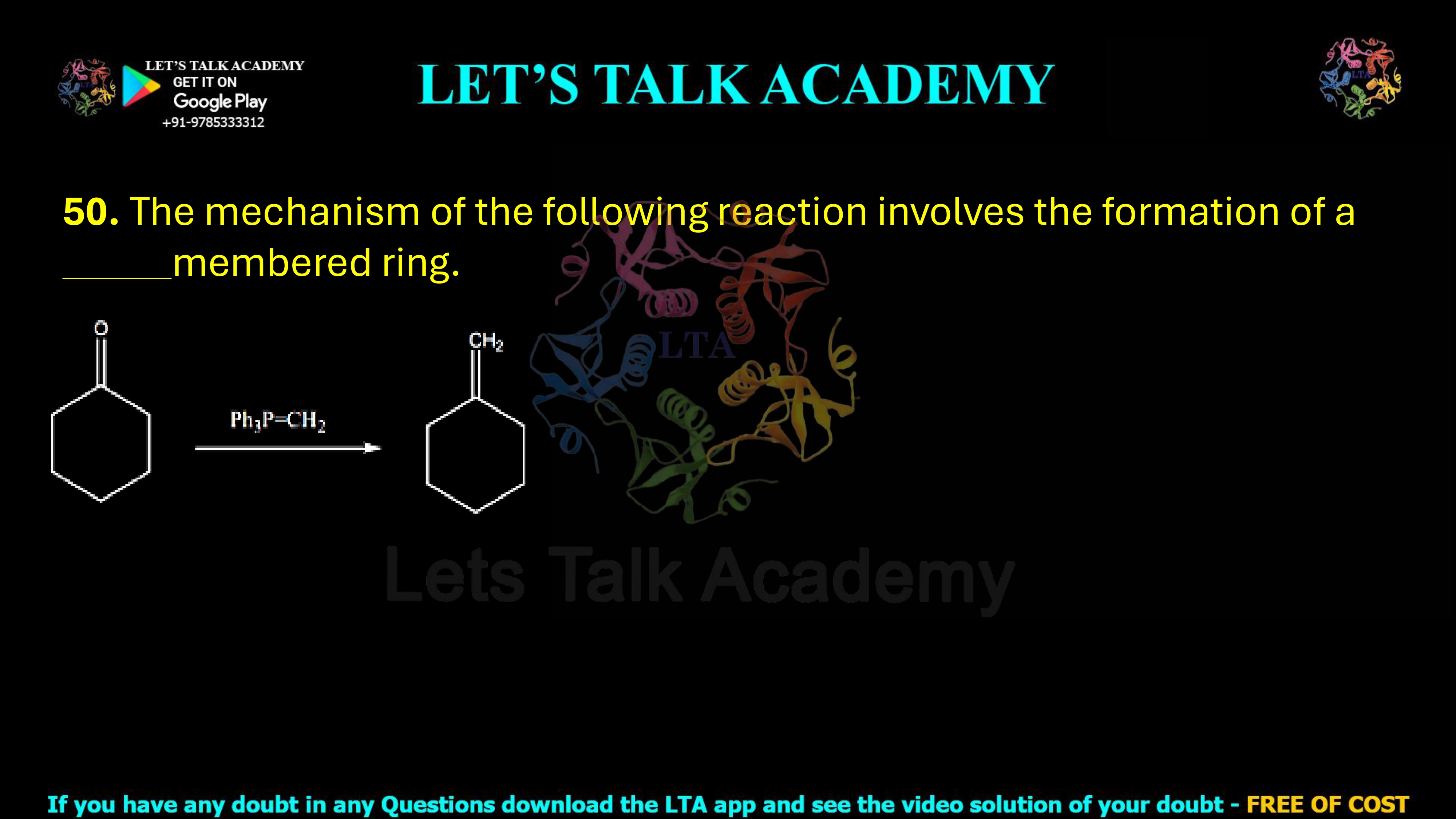
50. The mechanism of the following reaction involves the formation of a _____-membered ring.
Wittig Reaction Mechanism and Formation of a Four-Membered Ring
Correct Answer: 4
The mechanism of the given reaction involves the formation of a four-membered ring. The reaction is a classic Wittig reaction, in which a carbonyl compound reacts with a phosphorus ylide to produce an alkene. During the reaction, a cyclic intermediate known as an oxaphosphetane is formed.
An oxaphosphetane contains four atoms in its ring: one oxygen atom, one phosphorus atom, and two carbon atoms. Therefore, the cyclic intermediate formed during the mechanism is a four-membered ring, and the required answer is 4.
Understanding the Given Organic Reaction
Identification of the Reactants and Product
The starting carbonyl compound in the reaction is cyclohexanone. It contains a carbonyl group, C=O, within a six-membered cyclohexane ring. The second reactant is methylenetriphenylphosphorane, commonly represented as Ph3P=CH2.
Ph3P=CH2 is a phosphorus ylide, also called a Wittig reagent. Its function is to replace the oxygen atom of the carbonyl group with a carbon-containing group. In this case, the C=O group of cyclohexanone is converted into an exocyclic C=CH2 double bond.
The overall transformation can be represented as:
Cyclohexanone + Ph3P=CH2 → Methylenecyclohexane + Ph3P=O
This conversion of a carbonyl compound into an alkene using a phosphorus ylide identifies the reaction as a Wittig reaction.
What Is the Wittig Reaction?
The Wittig reaction is one of the most important methods for converting aldehydes and ketones into alkenes. In this reaction, a carbonyl compound reacts with a phosphorus ylide, generally represented as Ph3P=CR2, to form a carbon-carbon double bond.
The general reaction is:
R2C=O + Ph3P=CR′2 → R2C=CR′2 + Ph3P=O
The oxygen atom of the carbonyl compound ultimately combines with the phosphorus atom of the ylide to form triphenylphosphine oxide, Ph3P=O. At the same time, the carbonyl carbon and the ylide carbon become connected through a new carbon-carbon double bond.
Why Ph3P=CH2 Is Called a Phosphorus Ylide
The reagent Ph3P=CH2 can be represented using two important resonance forms:
Ph3P=CH2 ↔ Ph3P+–CH2−
The charge-separated resonance form is particularly useful for understanding the reaction mechanism. In this representation, the carbon atom adjacent to phosphorus carries a negative charge and behaves as a nucleophilic carbon center.
The carbonyl carbon of cyclohexanone is electrophilic because the C=O bond is strongly polarized. Oxygen attracts electron density more strongly than carbon, producing partial negative charge on oxygen and partial positive charge on the carbonyl carbon.
Therefore, the nucleophilic carbon of the phosphorus ylide reacts with the electrophilic carbonyl carbon, initiating the Wittig reaction.
Step-by-Step Mechanism of the Given Wittig Reaction
Step 1: Nucleophilic Attack on the Carbonyl Carbon
The negatively polarized carbon atom of Ph3P=CH2 attacks the electrophilic carbonyl carbon of cyclohexanone. As the new carbon-carbon bond begins to form, the π electrons of the C=O bond shift toward the oxygen atom.
This interaction brings the carbonyl oxygen, carbonyl carbon, ylide carbon, and phosphorus atom into the arrangement required for formation of the characteristic cyclic intermediate.
The reaction may be described through a zwitterionic betaine intermediate in the traditional stepwise mechanism or through direct formation of the cyclic intermediate in a concerted description. In either representation, the crucial cyclic species associated with the Wittig reaction is the oxaphosphetane.
Step 2: Formation of the Oxaphosphetane Intermediate
The oxygen atom interacts with the positively polarized phosphorus atom, producing a cyclic intermediate. The resulting ring contains four atoms connected in a closed sequence.
The ring atoms are:
1. Carbonyl carbon
2. Ylide carbon
3. Phosphorus atom
4. Oxygen atom
Therefore, the cyclic intermediate contains:
C–C–P–O
Since four atoms are present in the ring, the intermediate is a four-membered ring.
What Is an Oxaphosphetane?
An oxaphosphetane is a four-membered heterocyclic intermediate containing carbon, carbon, oxygen, and phosphorus atoms. The name itself reflects the presence of oxygen and phosphorus within a four-membered cyclic structure.
In the present reaction, the oxaphosphetane ring is formed from the carbonyl carbon and oxygen of cyclohexanone together with the carbon and phosphorus atoms of the phosphorus ylide.
The ring can be represented conceptually as:
O–C–C–P
with the final bond between phosphorus and oxygen completing the cyclic structure.
Thus, the mechanism involves a ring containing exactly four atoms.
Step 3: Decomposition of the Four-Membered Ring
The oxaphosphetane intermediate is not the final product. It undergoes fragmentation in which the carbon-oxygen and carbon-phosphorus connections are reorganized. This produces two highly stable products: the desired alkene and triphenylphosphine oxide.
In the given reaction, the products are:
Methylenecyclohexane
Triphenylphosphine oxide, Ph3P=O
The carbonyl carbon of cyclohexanone forms a double bond with the CH2 carbon originally present in the phosphorus ylide. Consequently, the C=O group is converted into an exocyclic C=CH2 group.
Complete Mechanistic Sequence
The essential sequence of the reaction can be summarized as:
Cyclohexanone + Ph3P=CH2
↓
Interaction of ylide carbon with carbonyl carbon
↓
Four-membered oxaphosphetane intermediate
↓
Methylenecyclohexane + Ph3P=O
The key cyclic intermediate in this sequence is the four-membered oxaphosphetane ring.
Why the Product Contains an Exocyclic Double Bond
In cyclohexanone, the carbonyl carbon is already part of the six-membered ring. During the Wittig reaction, the oxygen atom of the C=O group is effectively replaced by the CH2 unit of the phosphorus ylide.
Since the ylide used is Ph3P=CH2, the new carbon-carbon double bond formed is:
Ring carbon=C H2
More conventionally, this is written as:
Ring carbon=CH2
The CH2 group lies outside the original cyclohexane ring, so the resulting double bond is called an exocyclic double bond. The product is therefore methylenecyclohexane.
Role of Triphenylphosphine Oxide Formation
One of the major driving forces for the Wittig reaction is the formation of triphenylphosphine oxide, Ph3P=O. The interaction between phosphorus and oxygen is highly favorable, and formation of the strong phosphorus-oxygen bond helps drive the reaction toward the alkene product.
During fragmentation of the oxaphosphetane intermediate, the oxygen atom originally belonging to the ketone becomes bonded to the phosphorus atom of the Wittig reagent.
Therefore:
Carbonyl oxygen + Ph3P fragment → Ph3P=O
Simultaneously, the two carbon atoms become joined by a carbon-carbon double bond.
Counting the Atoms in the Cyclic Intermediate
The easiest way to determine the answer is to identify the atoms that participate in the cyclic intermediate. The oxaphosphetane contains:
One oxygen atom = 1
One phosphorus atom = 1
Two carbon atoms = 2
Therefore:
Total number of atoms in the ring = 1 + 1 + 2 = 4
Hence, the mechanism involves the formation of a four-membered ring.
Why the Six-Membered Cyclohexane Ring Is Not the Required Answer
The reactant cyclohexanone and the product methylenecyclohexane both contain a six-membered carbon ring. However, the question does not ask for the ring size already present in the starting material or product. It specifically asks for the ring formed during the reaction mechanism.
The cyclohexane framework remains present throughout the reaction. The new temporary ring formed during the Wittig mechanism is the oxaphosphetane intermediate, and this ring contains four atoms.
Therefore, the existing six-membered carbon ring should not be counted as the mechanistic cyclic intermediate asked about in the question.
Wittig Reaction and Carbonyl Methylenation
When the ylide Ph3P=CH2 is used in a Wittig reaction, the carbonyl group is converted specifically into a =CH2 group. This transformation is called methylenation.
The general transformation is:
>C=O → >C=CH2
Therefore, cyclohexanone undergoes methylenation to produce methylenecyclohexane. The four-membered oxaphosphetane is the crucial cyclic intermediate associated with this transformation.
Structural Features of the Oxaphosphetane Ring
The oxaphosphetane intermediate is a heterocyclic compound because its ring contains atoms other than carbon. Specifically, it contains both oxygen and phosphorus as heteroatoms.
The four ring positions are occupied by:
Position 1: Oxygen
Position 2: Carbonyl carbon
Position 3: Ylide carbon
Position 4: Phosphorus
The closed sequence of these four atoms creates the cyclic intermediate required for subsequent formation of the alkene and phosphine oxide products.
Traditional and Modern Description of the Wittig Mechanism
The traditional textbook mechanism often shows the nucleophilic addition of the phosphorus ylide to the carbonyl compound followed by formation of a zwitterionic intermediate known as a betaine. The betaine then cyclizes to form the four-membered oxaphosphetane.
More detailed mechanistic treatments may describe the formation of oxaphosphetane through a concerted or asynchronous cycloaddition pathway, depending on the nature of the ylide, substrate, solvent, and reaction conditions.
Regardless of the detailed mechanistic description used, the cyclic intermediate relevant to this question is the four-membered oxaphosphetane ring.
Final Answer
The given transformation is a Wittig reaction in which cyclohexanone reacts with the phosphorus ylide Ph3P=CH2. The carbonyl group is converted into an exocyclic C=CH2 double bond, producing methylenecyclohexane.
During the reaction mechanism, an oxaphosphetane intermediate is formed. This cyclic intermediate contains one oxygen atom, one phosphorus atom, and two carbon atoms.
Therefore:
Number of atoms in the ring = O + P + C + C = 4
Hence, the mechanism involves the formation of a four-membered ring.
Correct Answer: 4


