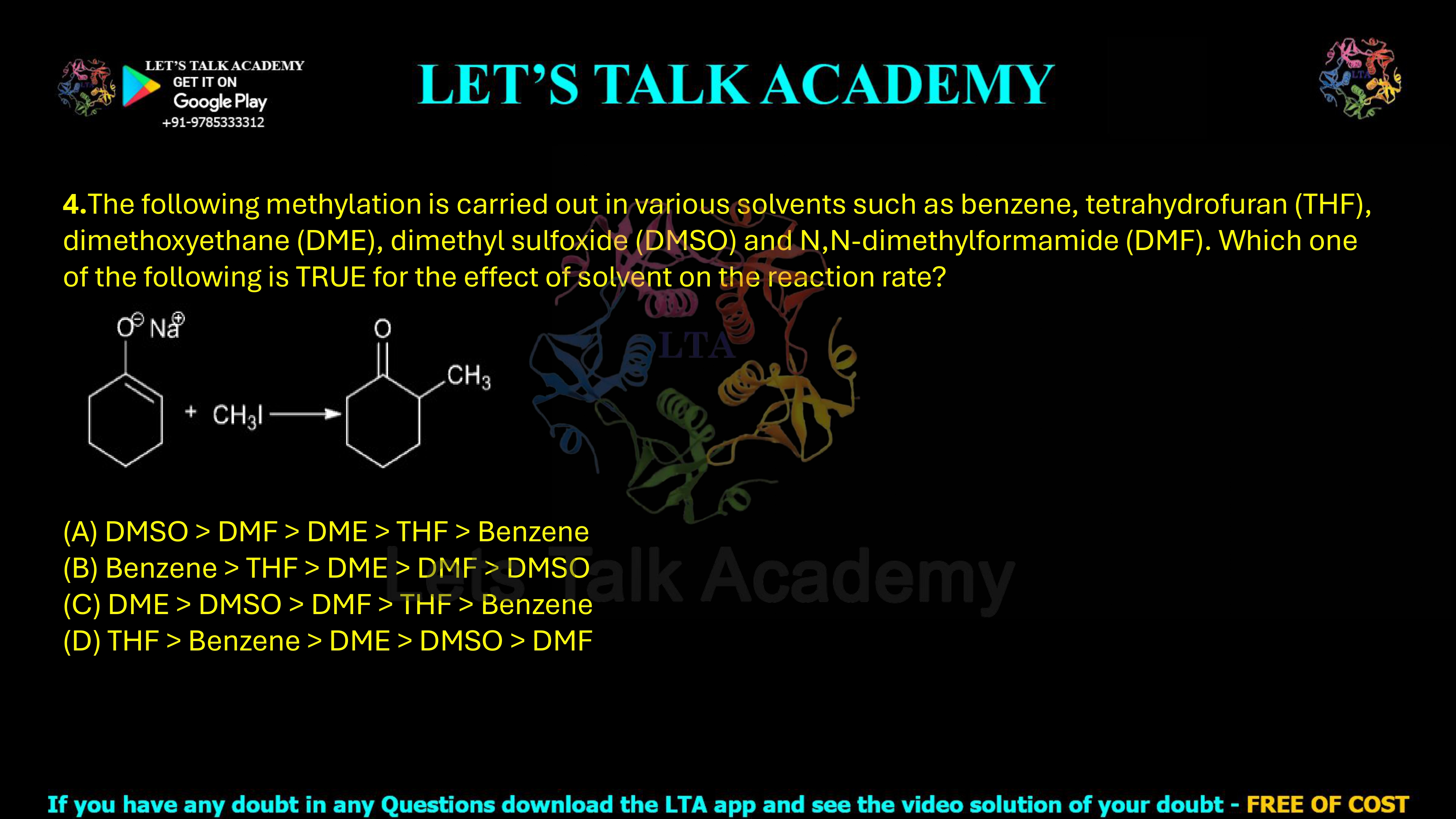
4. The following methylation is carried out in various solvents such as benzene, tetrahydrofuran (THF), dimethoxyethane (DME), dimethyl sulfoxide (DMSO), and N,N-dimethylformamide (DMF). Which one of the following is TRUE for the effect of solvent on the reaction rate?
(B) Benzene > THF > DME > DMF > DMSO
(C) DME > DMSO > DMF > THF > Benzene
(D) THF > Benzene > DME > DMSO > DMF
Effect of Solvent on Enolate Methylation Reaction Rate
Correct Answer: (A) DMSO > DMF > DME > THF > Benzene
The correct order of reaction rate is DMSO > DMF > DME > THF > benzene. This question tests the important concept of the effect of solvent on enolate methylation. The reaction involves the sodium enolate of cyclohexanone reacting with methyl iodide (CH3I) to form an α-methylated ketone. The carbon atom of the enolate acts as a nucleophile and attacks the methyl carbon of methyl iodide, while iodide leaves. Therefore, the carbon-carbon bond-forming step has an SN2-type character and is strongly influenced by the solvent.
Understanding the Enolate Methylation Reaction
In the given reaction, the starting species is a sodium enolate. An enolate ion is an anionic and strongly nucleophilic species in which the negative charge is delocalized between the oxygen atom and the α-carbon atom. When methyl iodide is added, the carbon end of the enolate attacks the methyl carbon of CH3I and displaces iodide ion. This produces the α-methylated cyclohexanone product.
The essential reaction can be represented as:
Sodium enolate + CH3I → α-Methylated ketone + NaI
Since methyl iodide is an excellent substrate for bimolecular nucleophilic substitution, the methylation proceeds through a direct backside attack. The rate of this process depends greatly on how effectively the solvent separates the sodium cation from the negatively charged enolate and how available the enolate remains for nucleophilic attack.
Why Polar Aprotic Solvents Increase the Reaction Rate
Polar aprotic solvents are particularly effective for reactions involving anionic nucleophiles. These solvents have substantial polarity but do not contain strongly acidic O–H or N–H bonds capable of hydrogen-bonding strongly to the nucleophile. As a result, they can solvate the positive counterion effectively without strongly deactivating the negatively charged nucleophile.
In the present reaction, better solvation of the Na+ ion reduces the electrostatic attraction between Na+ and the enolate anion. This produces a more separated and reactive ion pair. The enolate then becomes more available to attack methyl iodide. Therefore, solvents that more effectively promote ion separation generally increase the rate of methylation.
Step-by-Step Analysis of the Solvent Order
Why DMSO Gives the Fastest Reaction
Dimethyl sulfoxide (DMSO) gives the highest reaction rate among the solvents listed. DMSO is a highly polar aprotic solvent with an excellent ability to solvate cations. It strongly interacts with the Na+ counterion and helps separate it from the enolate anion. Consequently, the enolate becomes more reactive and more available for nucleophilic attack on methyl iodide.
Because the methylation step has SN2-type character, this enhanced nucleophilicity of the enolate leads to a rapid reaction. Therefore, DMSO occupies the first position in the rate order.
Why DMF Is Slower Than DMSO but Faster Than the Ethers
N,N-Dimethylformamide (DMF) is also a strongly polar aprotic solvent. Like DMSO, it can effectively stabilize and solvate the sodium cation while leaving the enolate relatively reactive. However, under the comparison represented in the given options, DMSO produces a greater rate enhancement than DMF.
Thus, DMF gives a high reaction rate but remains below DMSO in the required order. This places DMF in the second position.
Why DME Is Faster Than THF
Dimethoxyethane (DME) is an ether containing two oxygen atoms. These oxygen atoms possess lone pairs that can coordinate with the Na+ ion. Because DME has two ether oxygen atoms, it can interact with the sodium cation more effectively than a simple monoether solvent.
This improved coordination helps separate the sodium ion from the enolate and increases the effective reactivity of the nucleophile. Therefore, the methylation reaction is faster in DME than in THF.
Why THF Gives a Lower Reaction Rate Than DME
Tetrahydrofuran (THF) is a polar aprotic ether solvent and can coordinate with sodium ions through the lone pair present on its oxygen atom. Therefore, it supports the ionic enolate much better than a nonpolar solvent such as benzene.
However, THF has only one ether oxygen atom per molecule, whereas DME contains two oxygen atoms capable of coordinating with the sodium cation. In this reaction system, DME provides more effective cation coordination and ion-pair separation. Consequently, the reaction proceeds faster in DME than in THF.
Why Benzene Gives the Slowest Reaction
Benzene is a nonpolar solvent and has a very poor ability to solvate ionic species. It cannot effectively stabilize or coordinate with the Na+ ion. Therefore, the sodium cation and enolate anion remain strongly associated as a tight ion pair.
When the enolate remains closely associated with its counterion, its effective nucleophilicity is reduced. As a result, its attack on methyl iodide becomes slower. For this reason, benzene gives the lowest reaction rate among the solvents listed.
Complete Order of Reaction Rate
Combining the effects of solvent polarity, cation solvation, and ion-pair separation gives the following order:
DMSO > DMF > DME > THF > Benzene
DMSO and DMF are strongly polar aprotic solvents and provide the greatest rate enhancement. DME follows because its two ether oxygen atoms can coordinate effectively with Na+. THF provides weaker overall ion separation than DME in this comparison, while benzene is nonpolar and leaves the sodium enolate strongly ion-paired.
Explanation of All Options
Option (A): DMSO > DMF > DME > THF > Benzene
This is the correct option. DMSO and DMF are highly effective polar aprotic solvents that promote the reactivity of the enolate by solvating the sodium counterion. DME provides significant cation coordination through its two oxygen atoms, followed by THF. Benzene is unable to effectively solvate the ionic reactant and therefore gives the slowest reaction.
Option (B): Benzene > THF > DME > DMF > DMSO
This option gives essentially the reverse of the correct trend. Benzene cannot effectively solvate the sodium enolate and does not promote separation of the Na+ ion from the nucleophilic enolate. Therefore, benzene cannot give the fastest reaction. Similarly, DMSO should not be placed last because it strongly enhances the reactivity of anionic nucleophiles in this type of reaction.
Option (C): DME > DMSO > DMF > THF > Benzene
This option correctly places benzene at the slow end of the series but incorrectly places DME ahead of DMSO and DMF. Although DME can coordinate with the sodium cation through its ether oxygen atoms, the strongly polar aprotic solvents DMSO and DMF produce greater rate enhancement in the given reaction.
Option (D): THF > Benzene > DME > DMSO > DMF
This order is incorrect because it places benzene above DME, DMSO, and DMF. A nonpolar solvent such as benzene is poor at stabilizing ionic species and cannot efficiently separate the sodium cation from the enolate. The placement of DMSO and DMF near the slow end of the order is also inconsistent with their strong ability to accelerate reactions involving anionic nucleophiles.
Relationship Between Solvent and Enolate Reactivity
The central idea behind this question is that an enolate does not exist independently of its metal counterion. The extent to which the Na+ ion remains associated with the enolate significantly influences the nucleophilicity of the carbon atom. A solvent that effectively interacts with and solvates the sodium cation weakens the cation-anion interaction and produces a more reactive enolate species.
Therefore, the solvent is not simply an inactive medium in this reaction. It directly influences ion pairing, nucleophile availability, and the activation energy of the carbon-carbon bond-forming step. This is why changing from benzene to a strongly polar aprotic solvent such as DMSO can produce a substantial increase in the methylation rate.
Final Answer
The methylation of the sodium enolate with CH3I proceeds through an SN2-type carbon-carbon bond-forming reaction. Solvents that effectively solvate the Na+ counterion and promote ion-pair separation increase the nucleophilicity of the enolate and accelerate the reaction. DMSO gives the greatest rate enhancement, followed by DMF, DME, and THF, whereas nonpolar benzene gives the slowest reaction.
Therefore, the correct order of reaction rate is DMSO > DMF > DME > THF > Benzene.
Correct Option: (A) DMSO > DMF > DME > THF > Benzene


