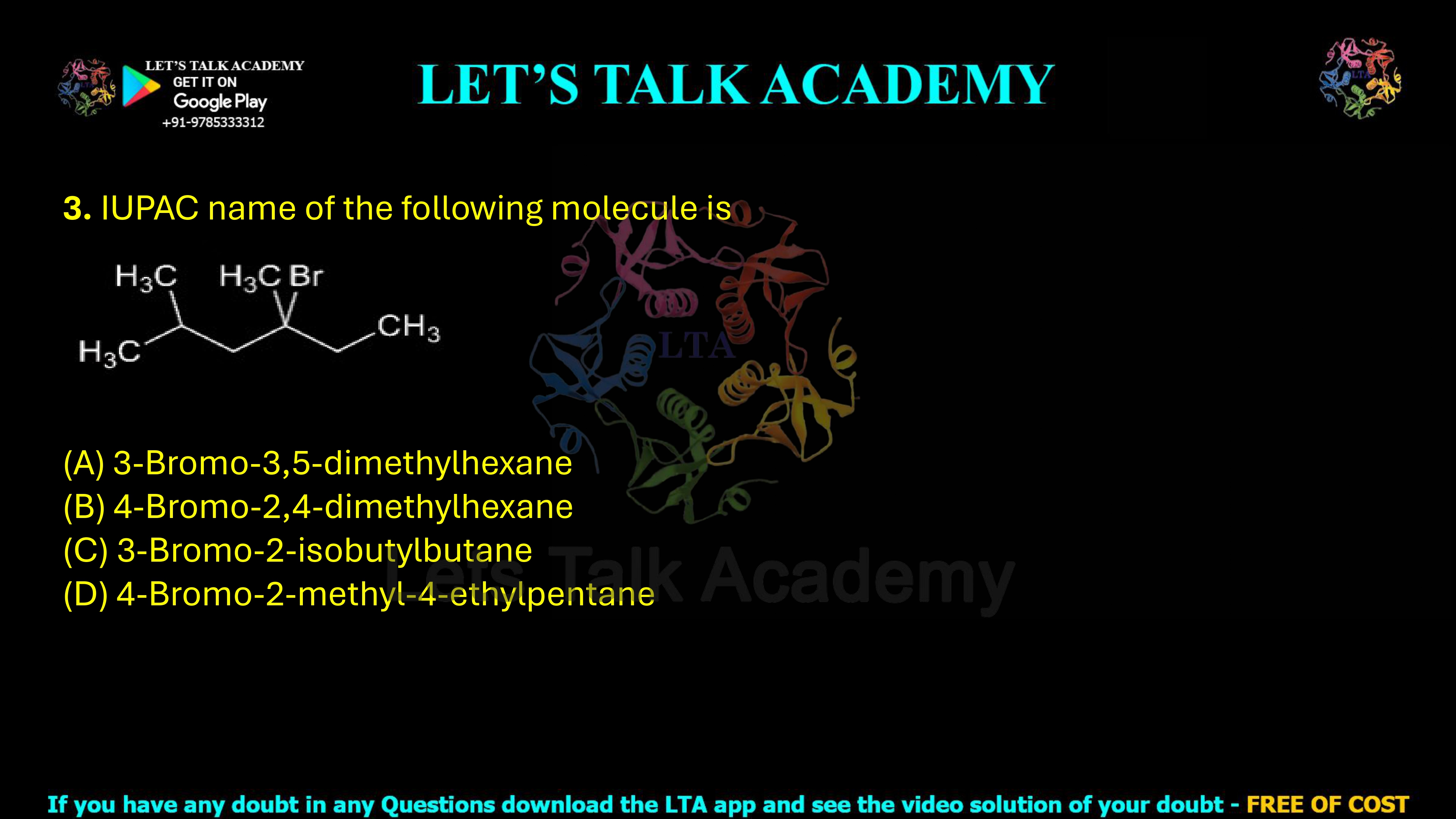
3. What is the correct IUPAC name of the given organic molecule?
(B) 4-Bromo-2,4-dimethylhexane
(C) 3-Bromo-2-isobutylbutane
(D) 4-Bromo-2-methyl-4-ethylpentane
IUPAC Name of the Following Molecule – Detailed Step-by-Step Solution
Correct Answer: (B) 4-Bromo-2,4-dimethylhexane
How to Find the IUPAC Name of the Given Molecule
To determine the IUPAC name of the following molecule, we must apply the standard rules of organic nomenclature in the correct order. The structure contains a branched carbon skeleton along with a bromine atom, so the naming process requires us to identify the longest continuous carbon chain, number that chain correctly, locate all substituents and finally arrange the substituent names according to IUPAC rules.
The most important point in this question is that the carbon skeleton should not be named simply by looking at the molecule from left to right. Instead, the complete structure must first be examined to identify the longest possible continuous chain of carbon atoms. After selecting the parent chain, the direction of numbering is decided by comparing the locants obtained from both ends.
Step-by-Step IUPAC Nomenclature of the Molecule
Step 1: Select the Longest Continuous Carbon Chain
On examining the given structure carefully, the longest continuous chain contains six carbon atoms. According to IUPAC nomenclature, a saturated hydrocarbon chain containing six carbon atoms is called hexane. Therefore, the parent hydrocarbon of the given compound is hexane.
This step immediately eliminates any name based on a five-carbon parent chain when a valid six-carbon continuous chain is available. The parent chain must always be chosen according to the longest-chain rule before the branches are named.
Step 2: Identify the Substituents Attached to the Parent Chain
After selecting the six-carbon parent chain, we can identify the groups attached to it. The molecule contains one bromo substituent, represented by Br, and two methyl substituents, represented by CH3 groups attached outside the selected parent chain.
Since two identical methyl groups are present, the prefix di- is used. Therefore, the methyl part of the final name will be written as dimethyl. The bromine atom is represented by the substituent name bromo.
Step 3: Number the Parent Chain Using the Lowest Set of Locants
The six-carbon parent chain can theoretically be numbered from either end. According to IUPAC rules, we must choose the direction that gives the lowest set of locants to all substituents at the first point of difference.
When the chain is numbered from the correct end, the two methyl groups are located at carbon numbers 2 and 4, while the bromine atom is located at carbon number 4. Therefore, the complete set of substituent locants is 2,4,4.
If the same chain is numbered from the opposite end, the substituent positions become 3,3,5. Comparing the two sets, 2,4,4 is lower than 3,3,5 at the first point of difference because 2 is lower than 3. Therefore, the correct numbering direction gives the locants 2,4,4.
Step 4: Write the Substituents in Alphabetical Order
In the final IUPAC name, different substituents are written in alphabetical order. The substituent names in this molecule are bromo and methyl. Since the letter “b” comes before “m” alphabetically, bromo must be written before dimethyl.
The multiplying prefix di- is not considered while deciding alphabetical order. Therefore, we compare “bromo” with “methyl,” not “bromo” with “dimethyl.” This gives the correct substituent sequence as 4-bromo-2,4-dimethyl.
Step 5: Construct the Complete IUPAC Name
Now all parts of the name can be combined. The bromine atom is present at carbon 4, giving 4-bromo. The two methyl groups are present at carbon 2 and carbon 4, giving 2,4-dimethyl. The parent chain contains six carbon atoms, so the parent name is hexane.
Combining these components according to IUPAC nomenclature rules gives:
4-Bromo-2,4-dimethylhexane
Therefore, Option (B) is the correct answer.
Explanation of Each Option
Option (A): 3-Bromo-3,5-dimethylhexane
This option identifies the correct six-carbon parent chain, but the numbering of the chain is incorrect. The locants 3,3,5 are obtained when the hexane chain is numbered from the wrong end. IUPAC rules require the direction that produces the lowest set of locants. Since 2,4,4 is lower than 3,3,5 at the first point of difference, this option is incorrect.
Option (B): 4-Bromo-2,4-dimethylhexane
This is the correct IUPAC name. The longest continuous chain contains six carbon atoms and is therefore named hexane. Numbering from the correct end places the methyl groups at carbon atoms 2 and 4 and the bromo substituent at carbon atom 4. The substituents are then written alphabetically, with bromo appearing before methyl. Hence, the correct name is 4-bromo-2,4-dimethylhexane.
Option (C): 3-Bromo-2-isobutylbutane
This option is incorrect because it selects a four-carbon chain as the parent structure even though a longer continuous chain of six carbon atoms is present. Under IUPAC nomenclature, the longest suitable continuous carbon chain must be selected as the parent chain. Therefore, the parent name must be hexane rather than butane. The use of an isobutyl substituent is unnecessary because the structure can be represented correctly using the longer six-carbon chain.
Option (D): 4-Bromo-2-methyl-4-ethylpentane
This option is also incorrect because it chooses pentane, a five-carbon chain, as the parent hydrocarbon. A continuous six-carbon chain can be identified in the molecule, so hexane must be selected as the parent chain. The apparent ethyl group becomes part of the longest chain when the structure is traced correctly. As a result, the remaining branches are two methyl groups rather than separate methyl and ethyl substituents.
Final Answer
The longest continuous carbon chain contains six carbon atoms, so the parent hydrocarbon is hexane. Correct numbering gives methyl substituents at carbon atoms 2 and 4 and a bromo substituent at carbon atom 4. Writing the substituents alphabetically gives the final IUPAC name:
4-Bromo-2,4-dimethylhexane
Correct Option: (B)


