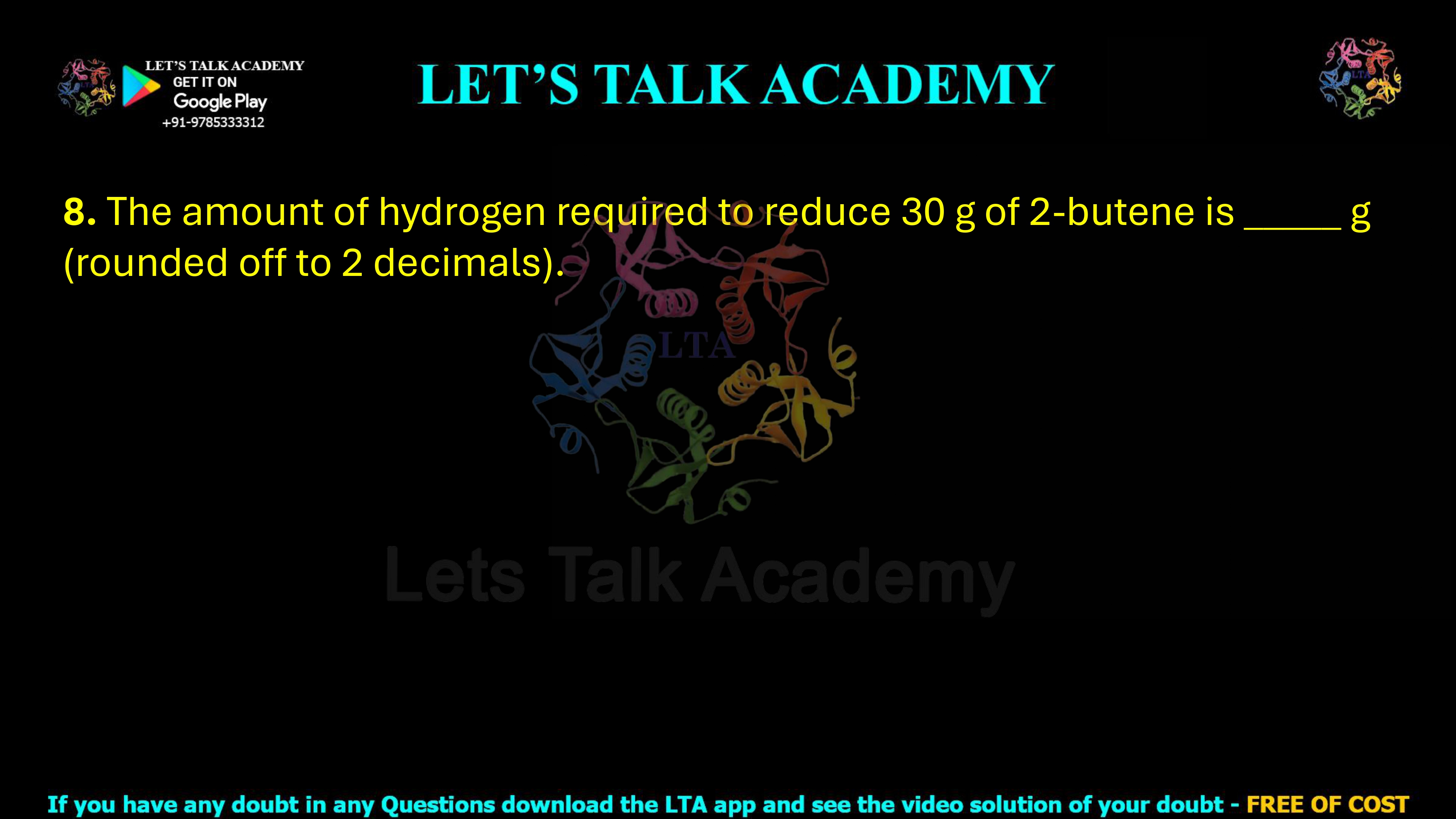
8. The amount of hydrogen required to reduce 30 g of 2-butene is _____ g (rounded off to 2 decimals).
What Amount of Hydrogen Is Required to Reduce 30 g of 2-Butene?
Correct Answer: 1.07 g
Detailed Solution for the Hydrogenation of 2-Butene
The given question asks us to calculate the amount of hydrogen required to reduce 30 g of 2-butene. This is a stoichiometry-based numerical problem involving the catalytic hydrogenation of an alkene. To solve it correctly, we need to write the hydrogenation reaction, determine the mole ratio between 2-butene and hydrogen, calculate the number of moles present in 30 g of 2-butene, and finally convert the required moles of hydrogen into grams.
2-Butene is an alkene with the molecular formula C4H8. It contains one carbon-carbon double bond. During reduction or catalytic hydrogenation, one molecule of hydrogen adds across this double bond, converting 2-butene into the corresponding saturated hydrocarbon, butane.
Step 1: Write the Hydrogenation Reaction of 2-Butene
The catalytic hydrogenation of 2-butene can be represented by the following balanced chemical equation:
C4H8 + H2 → C4H10
In structural form, the reaction can be written as:
CH3–CH=CH–CH3 + H2 → CH3–CH2–CH2–CH3
The balanced reaction clearly shows that 1 mole of 2-butene reacts with 1 mole of hydrogen. This 1:1 mole ratio is the key relationship required to solve the numerical problem.
Step 2: Calculate the Molar Mass of 2-Butene
The molecular formula of 2-butene is C4H8. Its molar mass is calculated by adding the masses of four carbon atoms and eight hydrogen atoms.
Molar mass of C4H8 = (4 × 12) + (8 × 1)
= 48 + 8
= 56 g mol−1
Therefore, 1 mole or 56 g of 2-butene requires 1 mole of hydrogen for complete reduction.
Step 3: Calculate the Number of Moles in 30 g of 2-Butene
The number of moles of a substance is calculated using the relationship:
Number of moles = Given mass ÷ Molar mass
For 30 g of 2-butene:
Moles of 2-butene = 30 ÷ 56
= 0.5357 mol
Therefore, 30 g of 2-butene contains approximately 0.5357 mole of 2-butene.
Step 4: Determine the Moles of Hydrogen Required
According to the balanced hydrogenation reaction:
1 mol of 2-butene requires 1 mol of H2
Therefore:
0.5357 mol of 2-butene requires 0.5357 mol of H2
The number of moles of hydrogen required is therefore 0.5357 mol.
Step 5: Convert the Required Moles of Hydrogen into Grams
The molar mass of molecular hydrogen, H2, is:
Molar mass of H2 = 2 × 1 = 2 g mol−1
The mass of hydrogen can now be calculated using the formula:
Mass = Number of moles × Molar mass
Mass of H2 = 0.5357 × 2
= 1.0714 g
When rounded off to two decimal places:
Mass of H2 = 1.07 g
Direct Stoichiometric Method
The same answer can also be obtained directly from the balanced chemical equation. Since 56 g of 2-butene requires 2 g of hydrogen, the amount of hydrogen required for 30 g of 2-butene can be calculated by direct proportion.
56 g of 2-butene requires 2 g of H2
30 g of 2-butene requires = (30 × 2) ÷ 56 g of H2
= 60 ÷ 56
= 1.0714 g
= 1.07 g (rounded off to two decimal places)
Why Does One Mole of 2-Butene Require One Mole of Hydrogen?
2-Butene contains only one carbon-carbon double bond. During catalytic hydrogenation, the pi bond of the C=C double bond is broken, and two hydrogen atoms are added across the two carbon atoms. Since one molecule of H2 provides exactly two hydrogen atoms, one mole of a monoalkene such as 2-butene requires exactly one mole of molecular hydrogen for complete reduction.
If a compound contained two carbon-carbon double bonds, complete hydrogenation would generally require two moles of hydrogen per mole of the compound. Similarly, a molecule containing three reducible double bonds would require three moles of hydrogen, provided all the double bonds undergo complete hydrogenation.
Understanding the Reduction of 2-Butene
The reduction of 2-butene is an addition reaction in which hydrogen is added across the carbon-carbon double bond. The unsaturated hydrocarbon 2-butene is converted into the saturated hydrocarbon butane. Catalysts such as nickel, palladium, or platinum are commonly used to facilitate this reaction.
The important point in this numerical problem is that the hydrogen requirement depends directly on the number of reducible carbon-carbon multiple bonds. Because 2-butene contains one C=C double bond, the stoichiometric relationship between 2-butene and hydrogen is 1:1.
Final Answer
The amount of hydrogen required to reduce 30 g of 2-butene is 1.07 g. The calculation is based on the fact that 56 g of 2-butene reacts with 2 g of hydrogen. Therefore, 30 g of 2-butene requires (30 × 2) ÷ 56 = 1.0714 g of hydrogen, which becomes 1.07 g when rounded off to two decimal places.


