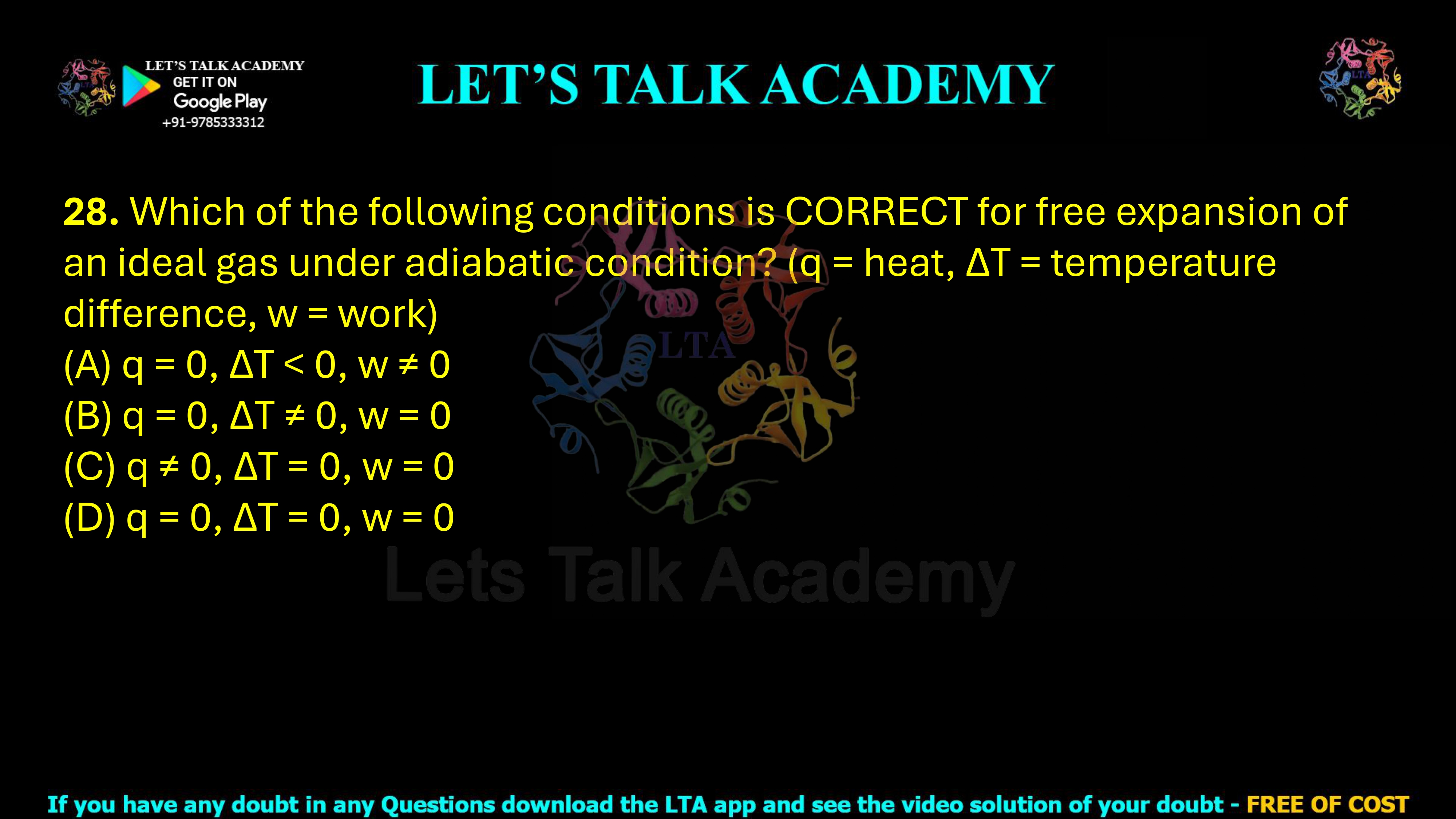
28. Which of the following conditions is correct for the free expansion of an ideal gas under adiabatic conditions? Here, q represents heat, ΔT represents temperature difference, and w represents work.
(A) q = 0, ΔT < 0, w ≠ 0
(B) q = 0, ΔT ≠ 0, w = 0
(C) q ≠ 0, ΔT = 0, w = 0
(D) q = 0, ΔT = 0, w = 0
Which Condition Is Correct for Free Expansion of an Ideal Gas Under Adiabatic Conditions?
Correct Answer: Option (D) – q = 0, ΔT = 0 and w = 0
Detailed Explanation of Free Expansion of an Ideal Gas
In the free expansion of an ideal gas under adiabatic conditions, the gas expands into a vacuum without exchanging heat with the surroundings and without performing work against any external pressure. As a result, the heat exchanged is zero and the work done is also zero. Applying the first law of thermodynamics then shows that the internal energy of the gas remains unchanged.
For an ideal gas, internal energy depends only on temperature. Therefore, if the internal energy does not change, the temperature also remains constant. Hence, the complete thermodynamic result for the given process is:
q = 0
w = 0
ΔU = 0
ΔT = 0
Therefore, Option (D) is the correct answer.
What Is Free Expansion of a Gas?
Free expansion is a process in which a gas expands into a region of vacuum. A typical experimental arrangement consists of an insulated container divided into two compartments by a partition. Initially, one compartment contains the gas while the other compartment is evacuated.
When the partition is removed, the gas spontaneously spreads into the empty compartment and occupies the larger available volume. Since the gas expands into a vacuum, there is no external pressure opposing the expansion.
This type of process is also commonly called Joule expansion. The essential feature of free expansion is that the gas expands against zero external pressure.
Why Is q Equal to Zero?
The question specifically states that the free expansion occurs under adiabatic conditions. An adiabatic process is one in which no heat is exchanged between the system and its surroundings.
Therefore:
q = 0
The value of q is zero because the system is thermally insulated. Heat cannot enter the gas from the surroundings, and heat cannot leave the gas and flow into the surroundings.
This immediately eliminates Option (C), because that option incorrectly states that q ≠ 0.
Why Is the Work Done Equal to Zero?
The thermodynamic work associated with expansion can be written as:
w = −PextΔV
where Pext represents the external pressure and ΔV represents the change in volume.
During free expansion, the gas expands into a vacuum. Therefore, the external pressure is:
Pext = 0
Substituting this value into the work equation gives:
w = −(0)ΔV
w = 0
Thus, even though the volume of the gas increases, the gas does not perform any thermodynamic expansion work because there is no opposing external pressure.
Why Does an Increase in Volume Not Always Mean Work Is Done?
It may initially seem that a gas must perform work whenever it expands. However, thermodynamic expansion work depends not only on the change in volume but also on the external pressure against which the expansion occurs.
If a gas pushes against a piston or against atmospheric pressure, it performs work because it must overcome an opposing force. In free expansion, however, the gas expands into an evacuated region where the external pressure is zero.
Therefore:
ΔV ≠ 0, but w = 0
This distinction is essential for understanding the thermodynamics of free expansion.
Application of the First Law of Thermodynamics
The first law of thermodynamics expresses the conservation of energy. Using the chemistry sign convention, it is written as:
ΔU = q + w
For the adiabatic free expansion:
q = 0
and:
w = 0
Substituting these values into the first law gives:
ΔU = 0 + 0
ΔU = 0
Therefore, the internal energy of the ideal gas remains unchanged during the adiabatic free expansion.
Why Is ΔT Equal to Zero for an Ideal Gas?
The next important step is to relate the change in internal energy to the change in temperature. For an ideal gas, internal energy is a function only of temperature. It does not depend directly on pressure or volume.
The change in internal energy of an ideal gas can be written as:
ΔU = nCVΔT
where n is the number of moles, CV is the molar heat capacity at constant volume, and ΔT is the change in temperature.
We have already established that:
ΔU = 0
Therefore:
0 = nCVΔT
Since n and CV are not zero:
ΔT = 0
Hence, the temperature of an ideal gas remains unchanged during adiabatic free expansion.
Complete Thermodynamic Derivation
The entire solution can be summarized mathematically. Because the process is adiabatic:
q = 0
Because the gas expands into a vacuum:
Pext = 0
Therefore:
w = −PextΔV = 0
Using the first law of thermodynamics:
ΔU = q + w
ΔU = 0 + 0 = 0
For an ideal gas:
ΔU = nCVΔT
Therefore:
ΔT = 0
Thus, the final relation is:
q = 0, ΔT = 0 and w = 0
Why Does the Temperature of an Ideal Gas Remain Constant?
The temperature of an ideal gas is directly related to its internal energy. In the ideal gas model, there are no intermolecular attractive or repulsive forces contributing to the internal energy. Therefore, the internal energy depends only on the average kinetic energy of the gas molecules and hence only on temperature.
During adiabatic free expansion, no heat enters or leaves the gas and no work is performed. Consequently, there is no change in the total internal energy. Since the internal energy of an ideal gas depends only on temperature, an unchanged internal energy means an unchanged temperature.
Therefore:
ΔU = 0 ⇒ ΔT = 0
Free Expansion Is Different from Reversible Adiabatic Expansion
Free expansion should not be confused with a reversible adiabatic expansion. Both processes have q = 0, but their work and temperature changes are different.
In a reversible adiabatic expansion, the gas expands against a finite external pressure and performs work on the surroundings. Since no heat enters the system, the energy required for this work comes from the internal energy of the gas. As a result, the internal energy decreases and the gas cools.
For reversible adiabatic expansion:
q = 0, w ≠ 0 and ΔT < 0
In free expansion, the external pressure is zero, so no work is done. Therefore:
q = 0, w = 0 and ΔT = 0
This difference is one of the most important concepts tested by the question.
Explanation of All Answer Options
Option (A): q = 0, ΔT < 0, w ≠ 0
Option (A) is incorrect for free expansion. The condition q = 0 is correct because the process is adiabatic. However, the gas expands into a vacuum, so the external pressure is zero and no work is performed. Therefore, w cannot be non-zero. Since q = 0 and w = 0, the internal energy and temperature of an ideal gas also remain unchanged.
Option (B): q = 0, ΔT ≠ 0, w = 0
Option (B) is incorrect. The values q = 0 and w = 0 are correct, but these conditions give ΔU = 0 according to the first law of thermodynamics. Since the internal energy of an ideal gas depends only on temperature, ΔU = 0 requires ΔT = 0. Therefore, the temperature cannot change.
Option (C): q ≠ 0, ΔT = 0, w = 0
Option (C) is incorrect because the process occurs under adiabatic conditions. By definition, an adiabatic process involves no heat exchange between the system and surroundings. Therefore, q must be zero and cannot be non-zero.
Option (D): q = 0, ΔT = 0, w = 0
Option (D) is correct. The process is adiabatic, so q = 0. The gas expands into a vacuum, so Pext = 0 and consequently w = 0. The first law then gives ΔU = 0, and because the internal energy of an ideal gas depends only on temperature, ΔT = 0.
Important Difference Between an Ideal Gas and a Real Gas
The conclusion ΔT = 0 applies specifically to an ideal gas. For an ideal gas, intermolecular forces are assumed to be absent, and internal energy depends only on temperature.
A real gas can behave differently during free expansion because intermolecular attractions and repulsions may affect its internal energy. Therefore, the temperature of a real gas may change during free expansion under certain conditions. The question explicitly specifies an ideal gas, so the correct conclusion is ΔT = 0.
Final Answer
The correct answer is Option (D): q = 0, ΔT = 0 and w = 0. Under adiabatic conditions, no heat is exchanged, so q = 0. During free expansion, the gas expands into a vacuum where the external pressure is zero, so w = 0. From the first law of thermodynamics, ΔU = q + w = 0. Since the internal energy of an ideal gas depends only on temperature, ΔU = 0 gives ΔT = 0. Therefore, the correct thermodynamic condition is q = 0, ΔT = 0 and w = 0.


