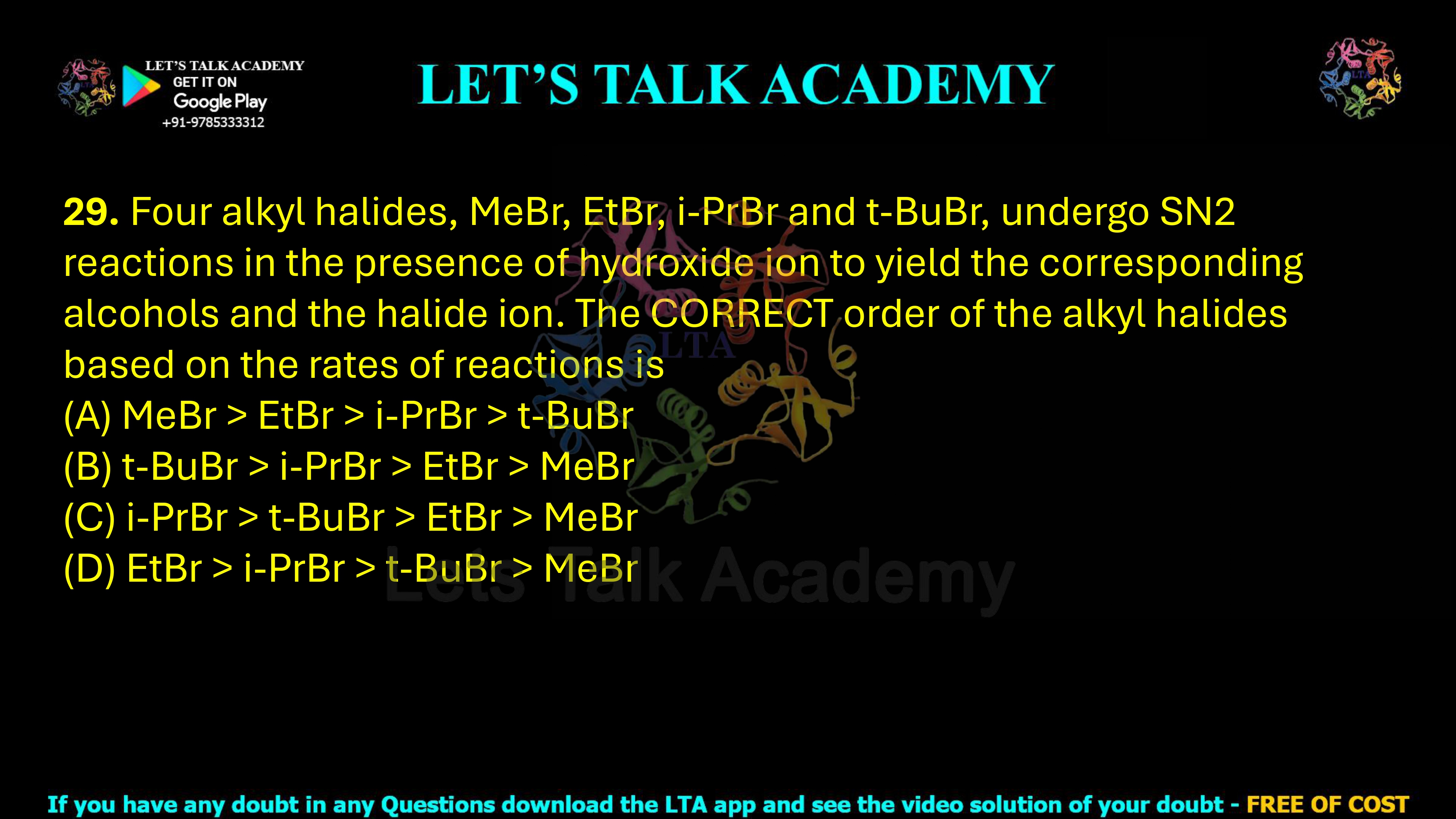
29. Four alkyl halides, MeBr, EtBr, i-PrBr and t-BuBr, undergo SN2 reactions in the presence of hydroxide ion to yield the corresponding alcohols and halide ion. The correct order of the alkyl halides based on the rates of reactions is:
(A) MeBr > EtBr > i-PrBr > t-BuBr
(B) t-BuBr > i-PrBr > EtBr > MeBr
(C) i-PrBr > t-BuBr > EtBr > MeBr
(D) EtBr > i-PrBr > t-BuBr > MeBr
Correct SN2 Reaction Rate Order of MeBr, EtBr, i-PrBr and t-BuBr
Correct Answer: Option (A) MeBr > EtBr > i-PrBr > t-BuBr
How to Determine the SN2 Reaction Rate Order of Alkyl Halides
To determine the SN2 reaction rate order of alkyl halides, the most important factor is the amount of steric hindrance around the carbon atom bonded to the leaving group. The SN2 reaction takes place through a direct backside attack by the nucleophile, so easy access to the electrophilic carbon is essential for a fast reaction.
In the given question, all four substrates contain the same leaving group, Br−, and all react with the same nucleophile, OH−. Therefore, the major difference in their reaction rates arises from the structure of the alkyl group and the degree of substitution around the carbon bonded to bromine.
As the number and size of alkyl groups around the reaction center increase, steric crowding increases. This makes backside attack by OH− increasingly difficult. Therefore, the general SN2 reactivity order is:
Methyl halide > Primary alkyl halide > Secondary alkyl halide >> Tertiary alkyl halide
Understanding the SN2 Reaction Mechanism
What Is an SN2 Reaction?
SN2 stands for bimolecular nucleophilic substitution. The letter “S” represents substitution, “N” represents nucleophilic and “2” indicates that the rate-determining process involves two reacting species: the alkyl halide and the nucleophile.
For an alkyl bromide reacting with hydroxide ion, the general reaction can be represented as:
R–Br + OH− → R–OH + Br−
The hydroxide ion acts as the nucleophile and attacks the carbon atom bonded to bromine. At the same time, the C–Br bond breaks and bromide ion leaves. Bond formation and bond breaking occur simultaneously in a single concerted step.
Why Backside Attack Is Essential in an SN2 Reaction
In an SN2 mechanism, the nucleophile cannot effectively approach the carbon from the same side as the leaving group. Instead, it approaches from the side opposite to the C–Br bond. This process is known as backside attack.
During the reaction, OH− approaches the electrophilic carbon from the back while Br− leaves from the opposite side. Because the nucleophile must physically reach the backside of the carbon atom, bulky alkyl groups around this carbon strongly reduce the rate of reaction.
Therefore, the less crowded the carbon attached to bromine, the faster the SN2 reaction.
Detailed Comparison of the Four Alkyl Halides
1. MeBr Has the Fastest SN2 Reaction Rate
MeBr is methyl bromide, represented as CH3Br. The carbon atom bonded to bromine is attached only to three hydrogen atoms and has no alkyl group surrounding the reaction center.
Because hydrogen atoms are very small, the backside of the carbon is highly accessible to the hydroxide ion. The nucleophile can approach the carbon with minimum steric resistance. Therefore, methyl bromide undergoes SN2 substitution more rapidly than all the other alkyl halides given in the question.
MeBr = Methyl halide = Least steric hindrance = Fastest SN2 reaction
2. EtBr Reacts More Slowly Than MeBr
EtBr is ethyl bromide, CH3CH2Br, and is a primary alkyl halide. The carbon bonded to bromine is attached to one alkyl group and two hydrogen atoms.
The presence of one methyl group produces greater steric crowding than in methyl bromide. Therefore, the hydroxide ion encounters slightly more resistance during backside attack. However, because the reaction center is still relatively accessible, primary alkyl halides generally undergo SN2 reactions readily.
Thus, EtBr reacts more slowly than MeBr but faster than the secondary and tertiary alkyl halides.
MeBr > EtBr
3. i-PrBr Reacts More Slowly Than EtBr
i-PrBr is isopropyl bromide, also called 2-bromopropane. It is a secondary alkyl halide because the carbon bonded to bromine is attached to two alkyl groups and one hydrogen atom.
The two methyl groups surrounding the electrophilic carbon create substantial steric hindrance. As a result, the hydroxide ion finds it more difficult to approach the carbon from the backside. This increases the energy barrier for the SN2 reaction and decreases the reaction rate.
Therefore, isopropyl bromide reacts more slowly than the primary alkyl halide EtBr.
EtBr > i-PrBr
4. t-BuBr Has the Lowest SN2 Reactivity
t-BuBr is tert-butyl bromide, a tertiary alkyl halide. The carbon atom bonded to bromine is directly attached to three methyl groups. These three bulky alkyl groups surround the reaction center and strongly block the backside approach of the hydroxide ion.
Because an SN2 reaction requires direct backside attack, this severe steric crowding makes the SN2 pathway extremely unfavourable for tert-butyl bromide. In standard organic chemistry comparisons, tertiary alkyl halides are considered essentially unreactive by the SN2 mechanism.
Therefore, among the four substrates listed in the question, t-BuBr has the lowest SN2 reaction rate.
i-PrBr > t-BuBr
Complete SN2 Reactivity Order
The structures can now be arranged according to increasing steric hindrance around the carbon bonded to bromine. Methyl bromide has no alkyl group attached to the reaction center, ethyl bromide is primary, isopropyl bromide is secondary and tert-butyl bromide is tertiary.
As steric hindrance increases, the rate of backside nucleophilic attack decreases. Therefore:
MeBr > EtBr > i-PrBr > t-BuBr
This is the standard order of SN2 reactivity for methyl, primary, secondary and tertiary alkyl halides when the nucleophile and leaving group are the same.
Role of Steric Hindrance in the SN2 Reaction
Steric hindrance is the dominant factor controlling the reaction rates in this question. The hydroxide ion must approach the carbon atom from the side opposite to bromine. Alkyl groups attached near this carbon occupy space and interfere with the incoming nucleophile.
In MeBr, the reaction center is almost completely exposed. In EtBr, one alkyl group causes a small amount of steric interference. In i-PrBr, two alkyl groups produce much greater crowding. In t-BuBr, three methyl groups effectively block the backside approach required for an SN2 reaction.
Therefore, increasing substitution at the carbon bearing the leaving group decreases SN2 reactivity.
SN2 Reaction Rate Law
The rate of an SN2 reaction depends on the concentrations of both the alkyl halide and the nucleophile. The rate law is:
Rate = k[Alkyl halide][OH−]
This bimolecular rate law is consistent with the one-step SN2 mechanism, in which the nucleophile and the alkyl halide participate together in the transition state. However, when the same nucleophile and comparable reaction conditions are used, the structural accessibility of the carbon undergoing substitution becomes the key factor in comparing different alkyl halides.
Explanation of Each Option
Option (A): MeBr > EtBr > i-PrBr > t-BuBr
This is the correct order. Steric hindrance increases from methyl bromide to primary ethyl bromide, then to secondary isopropyl bromide and finally to tertiary tert-butyl bromide. Since increasing steric hindrance decreases the rate of backside attack, the SN2 reaction rate follows exactly this order.
Option (B): t-BuBr > i-PrBr > EtBr > MeBr
This option gives the reverse of the correct SN2 order. Tertiary alkyl halides are the most sterically hindered and therefore do not undergo SN2 reactions readily, whereas methyl halides are the least hindered and react fastest.
Option (C): i-PrBr > t-BuBr > EtBr > MeBr
This option is incorrect because it places secondary and tertiary alkyl halides above primary and methyl halides. Greater substitution around the electrophilic carbon blocks the backside attack required for an SN2 reaction and therefore reduces the reaction rate.
Option (D): EtBr > i-PrBr > t-BuBr > MeBr
This option is incorrect because it places MeBr at the lowest position. Methyl bromide actually has the least steric hindrance and provides the easiest access for backside attack. Therefore, MeBr has the highest SN2 reactivity among the given alkyl halides.
Final Answer
The rate of an SN2 reaction decreases as steric hindrance around the carbon bonded to the leaving group increases. MeBr is the least hindered and reacts fastest, followed by the primary alkyl halide EtBr, the secondary alkyl halide i-PrBr and finally the highly hindered tertiary alkyl halide t-BuBr.
Therefore, the correct SN2 reaction rate order is:
MeBr > EtBr > i-PrBr > t-BuBr
Correct Option: (A)


