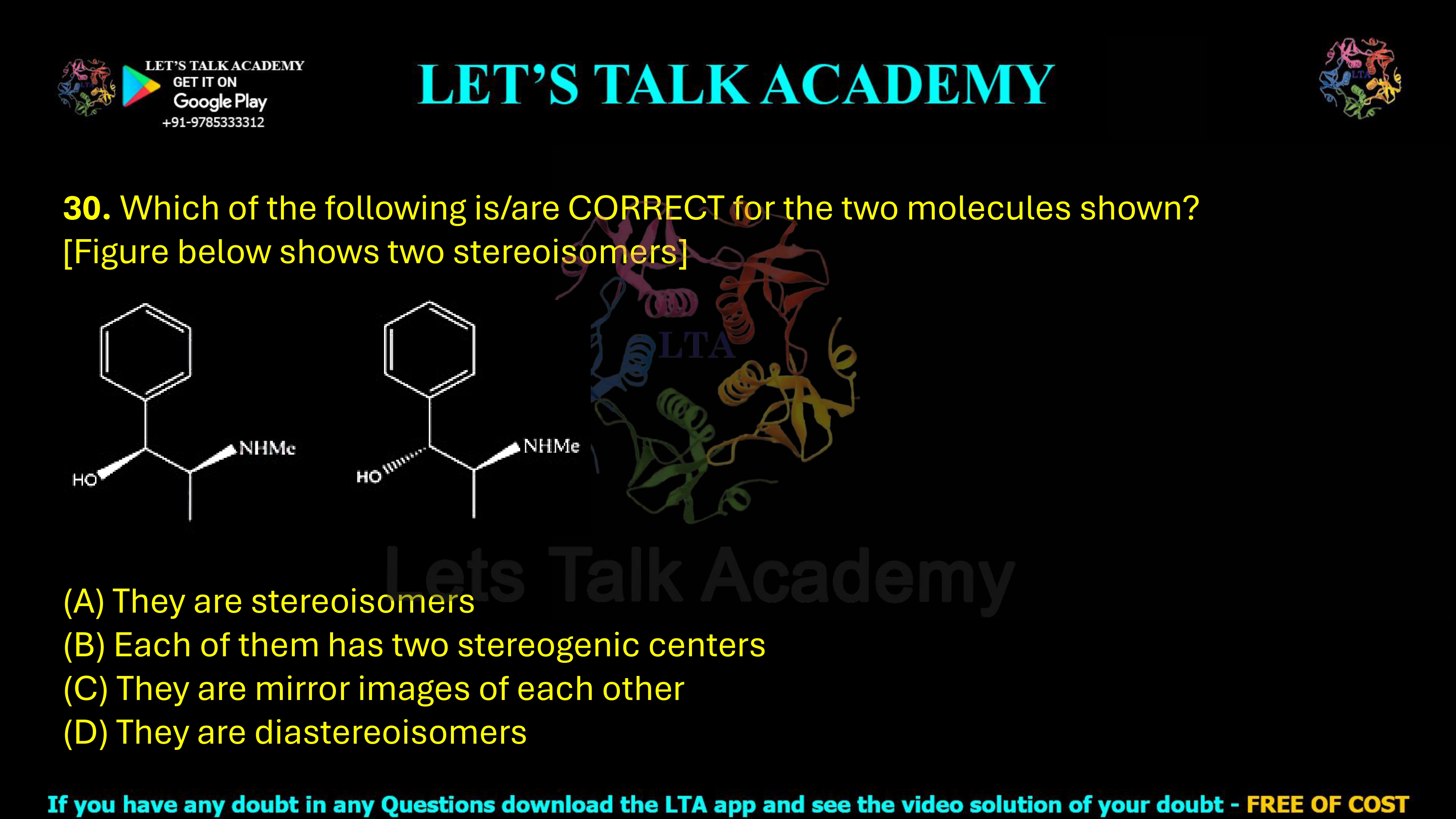
30. Which of the following is/are correct for the two molecules shown?
(A) They are stereoisomers
(B) Each of them has two stereogenic centers
(C) They are mirror images of each other
(D) They are diastereoisomers
Stereochemical Relationship Between the Two Given Molecules
Correct Answer: (A), (B) and (D)
The correct statements for the two given molecules are (A), (B), and (D). The molecules have the same molecular formula and the same connectivity of atoms, but they differ in the spatial arrangement around one of their stereogenic centers. Therefore, they are stereoisomers.
Each molecule contains two stereogenic carbon atoms. On comparing the two structures, the configuration at one stereogenic center is reversed, whereas the configuration at the other stereogenic center remains unchanged. Because they differ at some but not all stereogenic centers, the two molecules are diastereoisomers. They are not mirror images of each other, so statement (C) is incorrect.
Understanding the Structures of the Two Molecules
Both molecules have exactly the same sequence of bonded atoms. Each contains a phenyl group, a hydroxyl group, a methyl group, and an NHMe group attached to the same carbon framework. No sigma bond has been broken or formed while moving from one structure to the other.
The difference between the molecules is entirely three-dimensional. In the first structure, the OH bond at the left stereogenic carbon is shown as a solid wedge, whereas in the second structure the corresponding OH bond is shown as a hashed wedge. The stereochemical representation of the NHMe-containing center remains the same in both structures.
Therefore, the two compounds differ in configuration at only one of their two stereogenic centers. This observation is sufficient to classify them as diastereomers.
Step-by-Step Stereochemical Analysis
Step 1: Check Whether the Two Molecules Have the Same Connectivity
The first step in determining the relationship between two organic molecules is to compare their connectivity. If the atoms are connected differently, the compounds are constitutional isomers rather than stereoisomers.
In the given pair, both molecules have the same carbon skeleton and the same functional groups attached to the same positions. The connectivity can be represented generally as:
Phenyl–CH(OH)–CH(NHMe)–CH3
Since the connectivity is identical, the compounds are not constitutional isomers. Their difference arises only from the spatial orientation of groups, so a stereoisomeric relationship is possible.
Step 2: Identify the First Stereogenic Center
The first possible stereogenic center is the carbon atom bearing the OH group. This carbon is attached to four different groups: a hydroxyl group, a hydrogen atom, a phenyl group, and the neighboring substituted carbon chain.
These four substituents are different from one another. Therefore, the carbon bearing the OH group is a stereogenic center.
Groups attached to the first stereogenic carbon:
–OH
–H
–Phenyl group
–CH(NHMe)CH3 group
Since all four groups are different, this carbon satisfies the fundamental requirement for a stereogenic center.
Step 3: Identify the Second Stereogenic Center
The neighboring carbon bearing the NHMe group is also attached to four different substituents. These are the NHMe group, a hydrogen atom, a methyl group, and the adjacent carbon chain containing the OH and phenyl groups.
Groups attached to the second stereogenic carbon:
–NHMe
–H
–CH3
–CH(OH)(phenyl) group
Again, all four substituents are different. Therefore, this carbon is also a stereogenic center.
Consequently, each molecule contains two stereogenic centers. This proves that statement (B) is correct.
Comparison of the Two Stereogenic Centers
Configuration at the OH-Bearing Stereogenic Center
The most obvious difference between the two structures occurs at the carbon bearing the OH group. In the first molecule, the OH bond is represented by a solid wedge, indicating that the group projects toward the observer. In the second molecule, the OH bond is represented by a hashed wedge, indicating that the group projects behind the plane.
Since the remaining connectivity at this stereogenic center is unchanged, changing the OH bond from a solid wedge to a hashed wedge represents inversion of the configuration at this center.
Therefore, the two molecules have opposite configurations at the OH-bearing stereogenic center.
Configuration at the NHMe-Bearing Stereogenic Center
The second stereogenic center is the carbon bearing the NHMe group. In both molecules, the NHMe bond is shown with the same solid-wedge orientation, and the arrangement of the other groups around this center is unchanged.
Therefore, the configuration at the NHMe-bearing stereogenic center remains the same in both molecules.
The overall comparison can therefore be summarized as:
First stereogenic center: Different configuration
Second stereogenic center: Same configuration
This pattern is characteristic of diastereomers.
Why the Two Molecules Are Stereoisomers
Stereoisomers are compounds that have the same molecular formula and the same connectivity of atoms but differ in their three-dimensional arrangement. The two molecules shown in the question satisfy this definition perfectly.
Their atoms are connected in the same order, and the same functional groups are attached to the same carbon atoms. However, the spatial orientation at the OH-bearing stereogenic center is different. Therefore, the molecules are stereoisomers.
Hence, statement (A) is correct.
Why Each Molecule Has Two Stereogenic Centers
A stereogenic carbon is generally an sp3-hybridized carbon atom bonded to four different substituents. In each of the given molecules, the carbon bearing OH and the adjacent carbon bearing NHMe both satisfy this condition.
The OH-bearing carbon is bonded to OH, H, a phenyl group, and a substituted carbon chain. The NHMe-bearing carbon is bonded to NHMe, H, CH3, and the neighboring OH-containing carbon chain.
Therefore, both carbon atoms are stereogenic, giving a total of two stereogenic centers in each molecule.
Hence, statement (B) is correct.
Why the Two Molecules Are Not Mirror Images
For two compounds with multiple stereogenic centers to be non-superimposable mirror images or enantiomers, the configuration at every stereogenic center must be inverted, provided no internal symmetry creates a special meso situation.
In the present case, only the OH-bearing stereogenic center changes its configuration. The configuration of the NHMe-bearing stereogenic center remains the same. Therefore, the two molecules are not complete mirror images of one another.
A true mirror-image relationship would require inversion at both stereogenic centers. Since this does not occur, statement (C) is incorrect.
Why the Two Molecules Are Diastereoisomers
Diastereomers are stereoisomers that are not mirror images of each other. For molecules containing multiple stereogenic centers, diastereomers commonly arise when the configurations at one or more, but not all, stereogenic centers are different.
The given molecules contain two stereogenic centers. Their configuration differs at the carbon bearing the OH group but remains the same at the carbon bearing the NHMe group. Therefore, the two compounds differ at one out of two stereogenic centers.
This means that they are diastereoisomers.
Hence, statement (D) is correct.
Difference Between Enantiomers and Diastereomers
Enantiomers and diastereomers are both types of stereoisomers, but their relationships are different. Enantiomers are non-superimposable mirror images and have opposite configurations at all corresponding stereogenic centers. Diastereomers are stereoisomers that are not mirror images and usually differ in configuration at some, but not all, stereogenic centers.
If a molecule has two stereogenic centers, a comparison can be represented conceptually as follows:
(R,R) and (S,S) → Enantiomers
(R,S) and (S,R) → Enantiomers
(R,R) and (S,R) → Diastereomers
(R,R) and (R,S) → Diastereomers
The given pair follows the diastereomeric pattern because only one stereogenic center changes while the other remains unchanged.
Understanding Solid Wedge and Hashed Wedge Bonds
Wedge-and-dash notation is used to represent the three-dimensional orientation of bonds on a two-dimensional page. A normal straight line represents a bond lying approximately in the plane of the page. A solid wedge represents a bond projecting toward the observer, while a hashed wedge represents a bond extending behind the plane of the page.
In the given structures, the change from a solid-wedge OH bond in one molecule to a hashed-wedge OH bond in the other indicates inversion at the first stereogenic center. The unchanged solid-wedge orientation of the NHMe group indicates that the second stereogenic center retains its configuration.
Explanation of All Statements
Statement (A): They Are Stereoisomers
This statement is correct. Both molecules have the same molecular formula and the same connectivity, but they differ in the spatial arrangement around one stereogenic center. Therefore, they are stereoisomers.
Statement (B): Each of Them Has Two Stereogenic Centers
This statement is correct. The carbon bearing the OH group and the adjacent carbon bearing the NHMe group are each attached to four different substituents. Therefore, each molecule contains two stereogenic centers.
Statement (C): They Are Mirror Images of Each Other
This statement is incorrect. Only one stereogenic center has the opposite configuration, while the other stereogenic center has the same configuration in both molecules. Complete mirror images would require inversion of all corresponding stereogenic centers.
Statement (D): They Are Diastereoisomers
This statement is correct. The molecules are stereoisomers but not mirror images. They differ at one stereogenic center while retaining the same configuration at the other. Therefore, they are diastereoisomers.
Final Answer
Each of the two molecules contains two stereogenic centers: one carbon bearing the OH group and another carbon bearing the NHMe group. The molecules have the same molecular formula and the same connectivity, so they are stereoisomers.
On comparing their three-dimensional structures, the configuration at the OH-bearing stereogenic center is reversed, whereas the configuration at the NHMe-bearing stereogenic center remains unchanged. Therefore, the molecules differ at one but not all stereogenic centers.
Hence, the two molecules are diastereoisomers and are not mirror images of each other.
Correct Statements: (A), (B) and (D)


