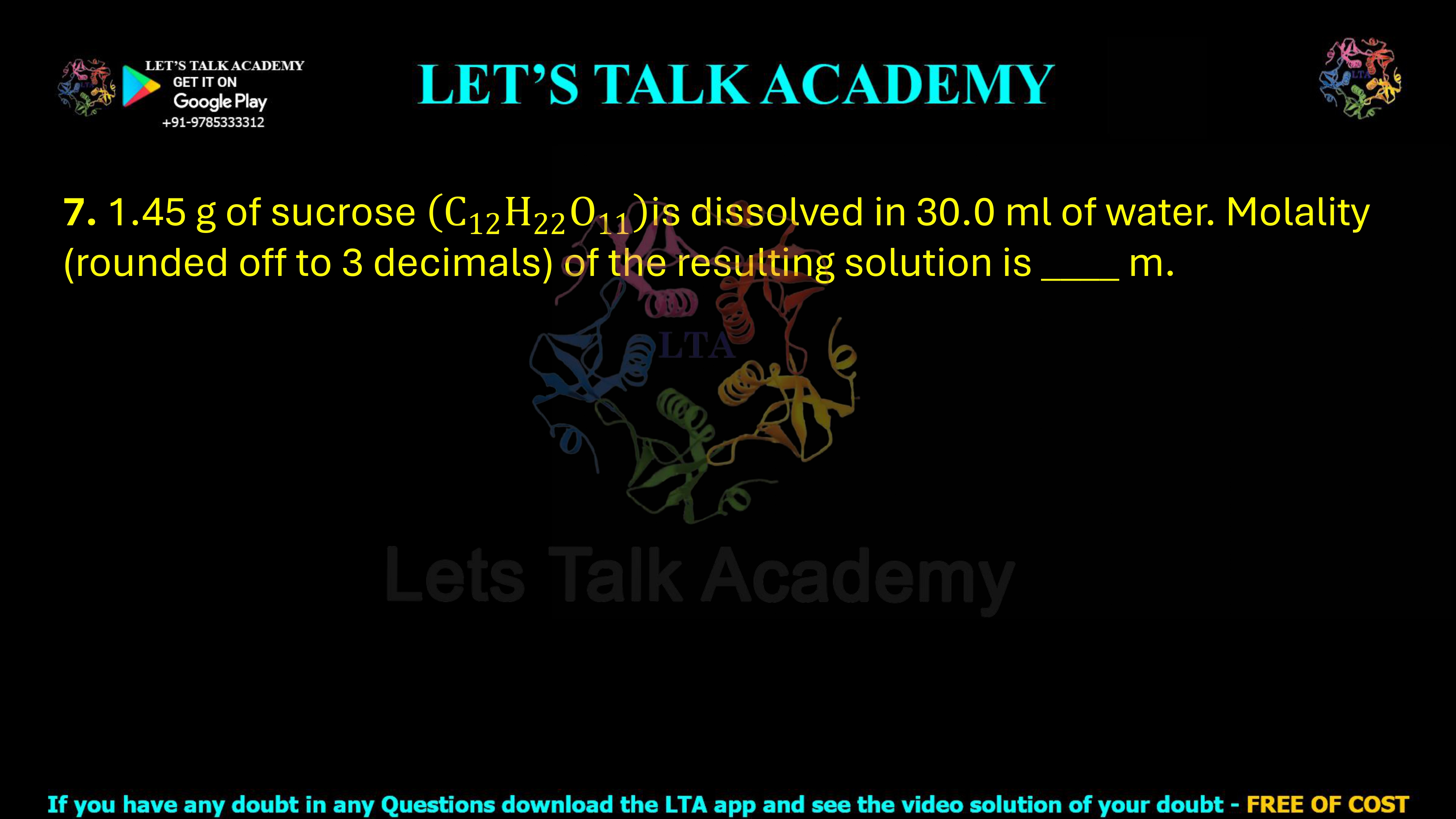
7. 1.45 g of sucrose (C12H22O11) is dissolved in 30.0 mL of water. Molality, rounded off to 3 decimals, of the resulting solution is _____ m.
How to Calculate the Molality of a Sucrose Solution
Correct Answer: 0.141 m
To calculate the molality of the sucrose solution, we need to determine two quantities: the number of moles of sucrose, which is the solute, and the mass of water in kilograms, which is the solvent. Molality is defined as the number of moles of solute dissolved per kilogram of solvent. It is important to use the mass of the solvent alone rather than the total mass or total volume of the solution.
Step-by-Step Solution of the Molality Problem
Step 1: Write the Formula for Molality
Molality is represented by the lowercase letter m and is calculated using the following relationship:
Molality (m) = Moles of solute / Mass of solvent in kg
In the given problem, sucrose is the solute and water is the solvent. Therefore, we must first calculate the moles of sucrose present in 1.45 g and then convert the given 30.0 mL of water into kilograms.
Step 2: Calculate the Molar Mass of Sucrose
The molecular formula of sucrose is C12H22O11. Its molar mass is calculated by adding the masses contributed by 12 carbon atoms, 22 hydrogen atoms, and 11 oxygen atoms.
Molar mass of sucrose = (12 × 12) + (22 × 1) + (11 × 16)
Molar mass of sucrose = 144 + 22 + 176
Molar mass of sucrose = 342 g mol−1
Therefore, one mole of sucrose has a mass of approximately 342 g.
Step 3: Calculate the Moles of Sucrose
The number of moles of a substance is calculated by dividing its given mass by its molar mass.
Moles of sucrose = Mass of sucrose / Molar mass of sucrose
Moles of sucrose = 1.45 / 342
Moles of sucrose = 0.0042398 mol
Thus, 1.45 g of sucrose contains approximately 0.00424 mol of sucrose molecules.
Step 4: Convert the Volume of Water into Mass
The problem gives 30.0 mL of water, but the formula for molality requires the mass of the solvent in kilograms. Since the density of water is approximately 1.00 g mL−1, the mass of 30.0 mL of water can be calculated directly.
Mass of water = Volume of water × Density of water
Mass of water = 30.0 mL × 1.00 g mL−1
Mass of water = 30.0 g
The mass must now be converted from grams to kilograms because molality is expressed in moles of solute per kilogram of solvent.
Mass of water = 30.0 / 1000 kg
Mass of water = 0.0300 kg
Step 5: Calculate the Molality of the Sucrose Solution
We now have all the values required to calculate the molality. The solution contains 0.0042398 mol of sucrose dissolved in 0.0300 kg of water.
Molality = Moles of sucrose / Mass of water in kg
Molality = 0.0042398 / 0.0300
Molality = 0.141326 m
The question asks for the answer rounded off to three decimal places. Therefore:
Molality = 0.141 m
Why the Mass of Water Is Used Instead of the Volume of Solution
A key feature of molality is that it depends on the mass of the solvent, not on the volume of the solution. In this question, the solvent is water, so the denominator must contain the mass of water expressed in kilograms. The 30.0 mL value can be converted into 30.0 g because the density of water is approximately 1.00 g mL−1.
The mass of sucrose must not be added to the mass of water when calculating molality. Adding the masses of sucrose and water would give the total mass of the solution, whereas the definition of molality specifically requires kilograms of solvent only.
Understanding the Difference Between Molality and Molarity
Molality and molarity are both measures of solution concentration, but they use different quantities in their denominators. Molality is the number of moles of solute per kilogram of solvent, whereas molarity is the number of moles of solute per litre of solution.
For this problem, the given 30.0 mL refers to the volume of water before the sucrose is dissolved. Therefore, this value should not be directly used as the volume of the final solution to calculate molarity. Instead, the volume of water is converted into the mass of the solvent, which is then used correctly in the molality formula.
Complete Calculation in One Expression
The complete calculation can also be written directly as:
Molality = (1.45 / 342) / (30.0 / 1000)
Molality = 0.141326 m
After rounding the result to three decimal places:
Molality = 0.141 m
Final Answer
The molar mass of sucrose, C12H22O11, is 342 g mol−1. Therefore, 1.45 g of sucrose corresponds to approximately 0.0042398 mol. Since 30.0 mL of water has a mass of approximately 30.0 g or 0.0300 kg, the molality is obtained by dividing 0.0042398 mol by 0.0300 kg.
Therefore, the molality of the resulting sucrose solution, rounded off to three decimal places, is 0.141 m.
Correct Answer: 0.141 m


