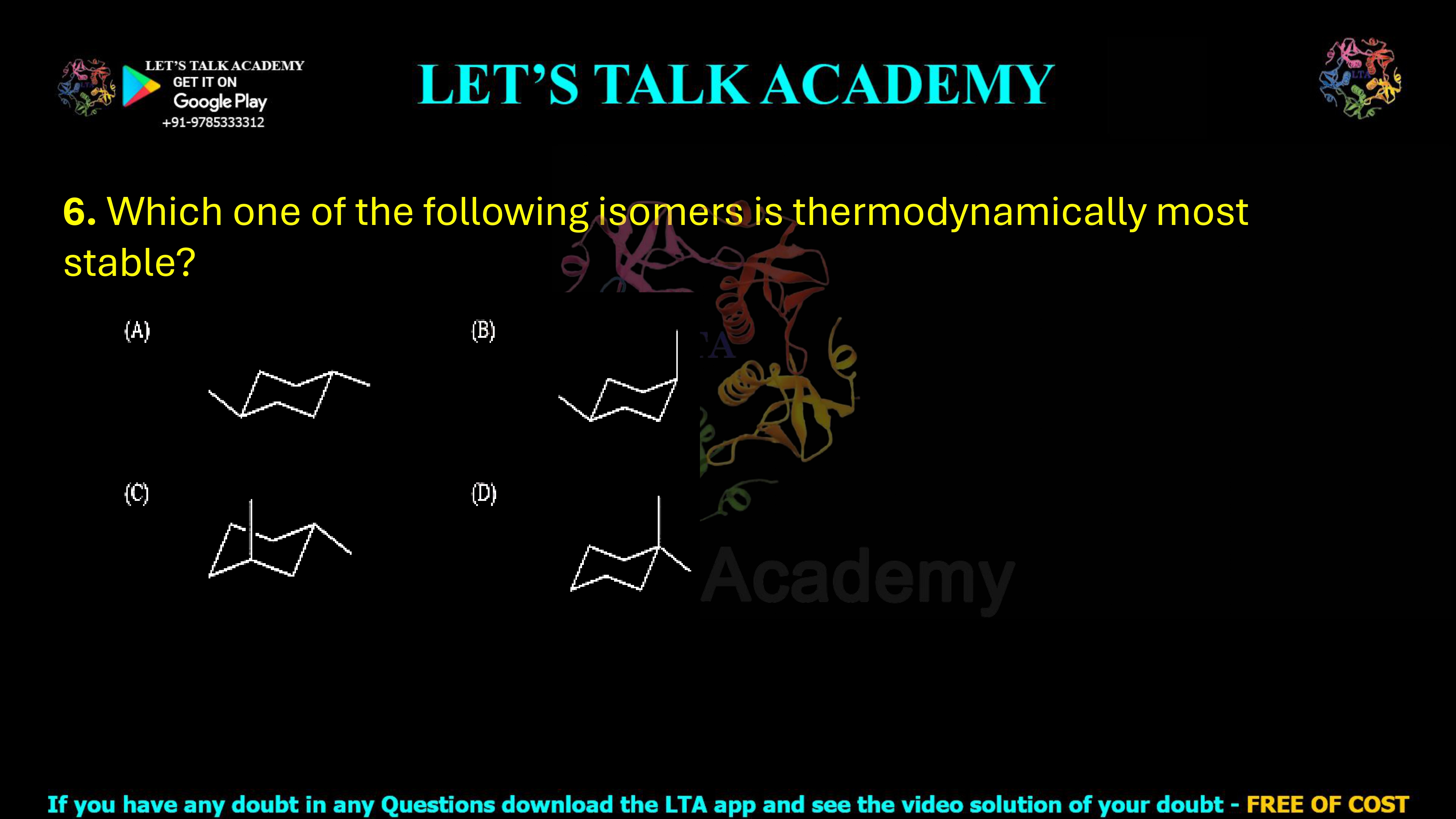
6. Which one of the following isomers is thermodynamically most stable?
Which One of the Following Isomers Is Thermodynamically Most Stable?
Correct Answer: Option (A)
How to Determine the Thermodynamically Most Stable Isomer
To identify which isomer is thermodynamically most stable, the first step is to examine the position of the substituents in each cyclohexane chair conformation. In a substituted cyclohexane ring, a substituent can occupy either an axial position or an equatorial position. These two positions do not have the same energy, and their arrangement strongly affects the thermodynamic stability of the molecule.
In general, substituents prefer the equatorial position because an equatorial substituent projects outward from the cyclohexane ring and experiences less steric crowding. An axial substituent, on the other hand, points approximately parallel to the vertical axis of the ring and can interact unfavourably with other axial hydrogen atoms or substituents located on the same side of the ring.
Therefore, when comparing the given isomers, the most stable structure will be the one that places the maximum number of substituents in equatorial positions and minimizes steric strain and unfavourable non-bonded interactions.
Why Equatorial Substituents Increase Cyclohexane Stability
Axial and Equatorial Positions in a Chair Conformation
The chair conformation is the most stable conformation of a cyclohexane ring because it minimizes both angle strain and torsional strain. Each carbon atom in the chair has one axial bond and one equatorial bond. Axial bonds are oriented alternately upward and downward, whereas equatorial bonds extend outward around the perimeter of the ring.
When a substituent occupies an axial position, it comes close to axial hydrogen atoms or other axial groups located two carbon atoms away. These repulsive interactions increase the potential energy of the molecule. In contrast, an equatorial substituent points away from the crowded region of the ring and therefore experiences much less steric repulsion.
Role of 1,3-Diaxial Interactions
The major reason why axial substituents are less stable is the presence of 1,3-diaxial interactions. An axial substituent interacts sterically with axial groups located at the 1,3-positions relative to it. These interactions are unfavourable because atoms are forced closer together than their preferred van der Waals distances.
As the size of the substituent increases, the energetic penalty for occupying an axial position also increases. Consequently, a structure containing bulky axial substituents is generally much less stable than an equivalent structure in which those substituents occupy equatorial positions.
Detailed Analysis of the Given Isomers
Option (A): Both Substituents Occupy Equatorial Positions
In Option (A), both substituents are arranged in equatorial positions. This arrangement is known as a diequatorial conformation. Because both groups extend outward from the cyclohexane ring, steric crowding is minimized and unfavourable 1,3-diaxial interactions are avoided.
This structure has the lowest steric strain among the given choices. Lower steric strain corresponds to lower potential energy, and a lower-energy isomer has greater thermodynamic stability. Therefore, the diequatorial arrangement shown in Option (A) is the thermodynamically most stable isomer.
Option (B): One Equatorial and One Axial Substituent
In Option (B), one substituent occupies an equatorial position while the other occupies an axial position. The equatorial substituent contributes relatively little steric strain, but the axial substituent experiences unfavourable 1,3-diaxial interactions.
As a result, this structure is less stable than Option (A), where both substituents are equatorial. Although Option (B) is more favourable than a structure containing multiple axial substituents, it does not achieve the minimum possible steric strain.
Option (C): Increased Steric Crowding Between Substituents
Option (C) shows an arrangement in which the substituents experience greater steric crowding. The spatial orientation of the groups brings them into less favourable positions around the cyclohexane framework, increasing non-bonded repulsive interactions.
Because thermodynamic stability increases as steric strain decreases, this crowded arrangement has a higher energy than the diequatorial structure shown in Option (A). Therefore, Option (C) cannot be the thermodynamically most stable isomer.
Option (D): Presence of an Axial Substituent
In Option (D), one of the substituents is clearly oriented in an axial position. This axial group experiences 1,3-diaxial repulsions with axial hydrogen atoms on the same side of the cyclohexane ring.
These additional steric interactions increase the energy of the molecule. Since Option (A) avoids such interactions by placing both substituents in equatorial positions, Option (D) is less thermodynamically stable than Option (A).
Relationship Between Energy and Thermodynamic Stability
Thermodynamic stability is directly related to the energy of a molecule. A lower-energy structure is more stable, whereas a higher-energy structure is less stable. In substituted cyclohexanes, steric interactions are one of the major factors controlling the relative energy of different conformations and stereoisomers.
The diequatorial arrangement minimizes steric repulsion because the substituents point outward from the cyclohexane ring. Since Option (A) has the least steric strain and the fewest unfavourable interactions, it has the lowest energy among the structures shown.
Final Answer
The thermodynamically most stable isomer is the structure in which the substituents occupy the most favourable equatorial positions. In Option (A), both substituents are equatorial, producing a diequatorial arrangement with minimum steric strain and minimum 1,3-diaxial interactions.
Therefore, the thermodynamically most stable isomer is Option (A).
Correct Option: (A)


