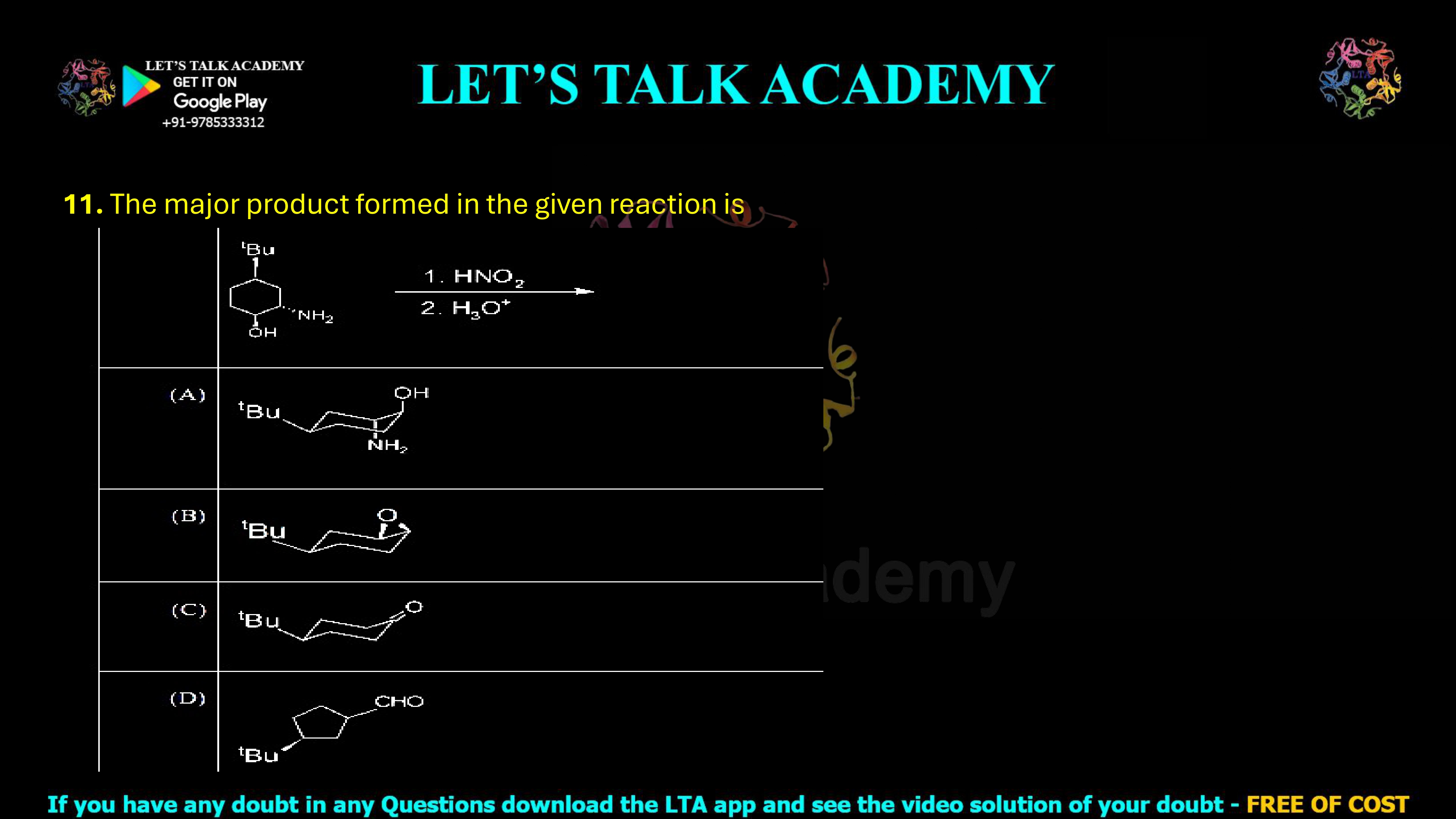
11. The given cyclic amino alcohol is treated first with HNO2 and then with H3O+. Which structure represents the major product formed in the reaction?
Major Product of the Reaction of a Cyclic Amino Alcohol with HNO2 and H3O+
Correct Answer: Option (B)
The major product formed in the given reaction is option (B). The reaction is controlled by the characteristic behavior of a vicinal amino alcohol toward nitrous acid. The primary amino group undergoes diazotization, the resulting unstable aliphatic diazonium intermediate loses molecular nitrogen, and the neighboring carbon-carbon bond migrates simultaneously with the formation of a carbonyl group. This transformation belongs to the family of semipinacol rearrangements and is closely related to the Tiffeneau–Demjanov rearrangement.
The most important point in this problem is that the migrating carbon-carbon bond is not selected merely by looking at which product appears more substituted or more stable. The three-dimensional conformation of the cyclic starting material controls the reaction. For efficient rearrangement, the migrating bond must have the proper stereoelectronic alignment with the bond that breaks during the loss of nitrogen. In the preferred conformation of the substrate, this requirement leads specifically to the bicyclic ketone shown in option (B).
Understanding the Reaction with HNO2
Step 1: Diazotization of the Primary Amino Group
The starting compound contains a primary aliphatic amino group, –NH2. Treatment with nitrous acid, HNO2, converts this amino group into an aliphatic diazonium intermediate. Unlike many aromatic diazonium salts, aliphatic diazonium compounds are highly unstable and readily eliminate nitrogen gas.
The transformation can be represented conceptually as:
–CH(NH2)– → –CH(N2+)– → loss of N2
Molecular nitrogen is an exceptionally stable molecule and therefore acts as an excellent leaving group. Its departure creates a strongly electron-deficient center adjacent to the carbon bearing the hydroxyl group. This arrangement provides the ideal structural requirement for a semipinacol-type rearrangement.
Step 2: Formation of the Electron-Deficient Center
As the diazonium group loses N2, positive character develops at the carbon that originally carried the amino group. A simple interpretation might suggest the formation of a completely free carbocation followed by an independent rearrangement. However, the more useful mechanistic description is a concerted or closely coupled process in which nitrogen departure, carbon-carbon bond migration, and carbonyl formation occur together.
The neighboring hydroxyl-bearing carbon is crucial at this stage. Its oxygen atom can form a carbonyl group while an adjacent carbon-carbon sigma bond migrates toward the electron-deficient carbon. The migrating bond therefore supplies electron density as the leaving group departs.
Semipinacol Rearrangement in the Given Cyclic System
How the Carbonyl Group Is Formed
During the rearrangement, the lone pair associated with oxygen participates in the formation of a C=O bond. At the same time, one of the carbon-carbon bonds attached to the hydroxyl-bearing carbon migrates to the neighboring carbon from which nitrogen is being lost.
These electronic movements occur in a coordinated manner. The carbon bearing the OH group becomes the carbonyl carbon of the product, while migration of the correctly aligned carbon-carbon bond reorganizes the ring framework. The acidic work-up with H3O+ then gives the neutral ketone.
Therefore, the reaction is not a simple replacement of NH2 by OH. It is a skeletal rearrangement in which the carbon framework changes as a new carbonyl compound is generated.
Why Stereoelectronic Control Determines the Major Product
Requirement for Proper Orbital Alignment
A key feature of the semipinacol rearrangement is the requirement for proper orbital overlap. The carbon-carbon bond that migrates must be suitably aligned with the orbital associated with the departing nitrogen-containing group. In cyclic molecules, this geometrical requirement can strongly favor one possible migration over another.
The bulky tert-butyl group shown in the starting material strongly influences the preferred conformation of the cyclohexane ring. Because a tert-butyl group has a very strong preference for an equatorial orientation, the molecule adopts the conformation in which the tert-butyl substituent remains equatorial. Once this preferred conformation is considered, the spatial relationships of the OH and NH2 groups become fixed.
In this conformation, only the carbon-carbon bond with the correct stereoelectronic orientation migrates efficiently during nitrogen loss. That migration produces the rearranged bicyclic ketone represented by option (B).
Role of the tert-Butyl Group
The tert-butyl group is not merely an inactive substituent in this question. Its large size effectively locks the cyclohexane system into the more stable chair conformation in which the tert-butyl group occupies an equatorial position. A ring flip that places tert-butyl in an axial position is energetically unfavorable because of severe steric interactions.
This conformational preference determines which carbon-carbon bond can achieve the required alignment for migration. Consequently, the reaction follows a stereoelectronically controlled pathway rather than producing all possible rearranged products in equal amounts.
Why Option (B) Is the Major Product
Option (B) represents the product obtained when the correctly aligned carbon-carbon bond migrates as nitrogen is expelled from the diazonium intermediate. Simultaneously, the carbon bearing the original hydroxyl group is converted into the carbonyl carbon.
This pathway satisfies the geometrical requirement for the semipinacol rearrangement and is compatible with the preferred conformation imposed by the bulky tert-butyl substituent. The resulting skeletal reorganization gives the bicyclic ketone structure shown in option (B).
Therefore, option (B) is not selected simply because it is a ketone. It is selected because its formation follows directly from the required stereoelectronic alignment of the migrating sigma bond during the loss of N2.
Explanation of All Options
Option (A)
Option (A) is incorrect because it retains both the amino and hydroxyl functionalities in a form inconsistent with the action of nitrous acid. The primary amino group reacts with HNO2 and cannot remain unchanged in the final major product. Diazotization followed by the rapid loss of nitrogen initiates rearrangement, so the starting amino alcohol framework is not retained as shown in this option.
Option (B)
Option (B) is the correct answer. It results from diazotization of the primary amino group, loss of molecular nitrogen, migration of the properly aligned carbon-carbon bond, and simultaneous formation of the carbonyl group. The preferred chair conformation, controlled largely by the equatorial tert-butyl group, provides the required stereoelectronic arrangement for this pathway.
Option (C)
Option (C) represents a different carbonyl skeleton and would require an alternative bond migration. Although such a structure may appear plausible if only skeletal connectivity is considered, the corresponding migrating bond does not have the favored stereoelectronic relationship in the preferred conformation of the starting compound. Therefore, this pathway is not the major one.
Option (D)
Option (D) contains an aldehyde attached to a different rearranged carbon skeleton. Formation of this product would require a different type of skeletal reorganization that does not follow the favored semipinacol migration dictated by the geometry of the starting amino alcohol. Consequently, option (D) is not the major product.
Role of H3O+ in the Reaction
The second step involving H3O+ provides acidic aqueous conditions for conversion of the rearranged oxygen-containing intermediate into the stable neutral carbonyl product. The essential carbon skeleton is established during the rearrangement triggered by diazotization and nitrogen loss, while the acidic work-up completes formation of the ketone.
Thus, the sequence of HNO2 followed by H3O+ converts the vicinal amino alcohol into a rearranged carbonyl compound rather than giving a simple substitution product.
Overall Reaction Pathway
The complete reaction can be understood as a sequence in which the primary amine first undergoes diazotization. The unstable aliphatic diazonium group then eliminates N2. At the same time, the appropriately oriented neighboring carbon-carbon bond migrates and the hydroxyl-bearing carbon develops a carbonyl group. Acidic work-up finally gives the stable rearranged ketone.
The overall sequence is:
Amino alcohol → diazonium intermediate → loss of N2 with stereoelectronically controlled C–C bond migration → rearranged ketone
Final Answer
Treatment of the cyclic amino alcohol with HNO2 converts the primary amino group into an unstable diazonium intermediate. Loss of molecular nitrogen triggers a semipinacol-type rearrangement in which the properly aligned carbon-carbon bond migrates while the neighboring hydroxyl-bearing carbon forms a carbonyl group.
The bulky tert-butyl substituent controls the preferred cyclohexane conformation, and this conformational restriction determines the bond that can migrate with the required stereoelectronic alignment. The resulting rearranged bicyclic ketone corresponds to option (B).
Correct Answer: Option (B)


