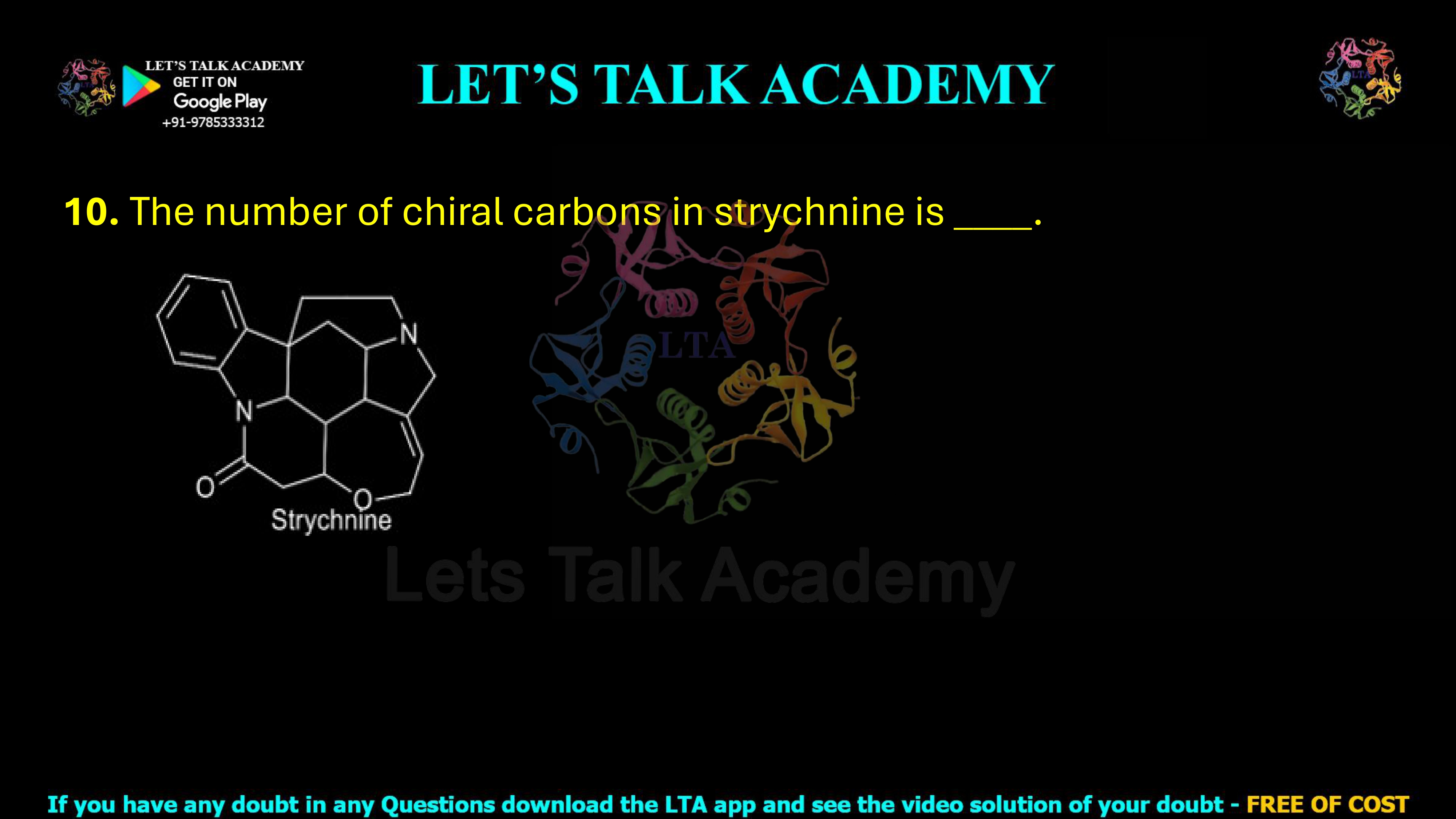
10. The number of chiral carbons in strychnine is _____.
How Many Chiral Carbons Are Present in Strychnine?
Correct Answer: 6 Chiral Carbons
The number of chiral carbons in strychnine is 6. Strychnine is a structurally complex natural alkaloid containing several fused and bridged rings. Although its structure contains many tetrahedral carbon atoms, every sp3-hybridized carbon is not automatically a chiral carbon. A carbon atom is counted as a chiral center only when it is tetrahedral and attached to four different atoms or four different groups.
Careful examination of the complete strychnine skeleton shows that six carbon atoms satisfy this requirement. These stereogenic carbons are mainly located at important ring junctions and bridgehead positions where the four paths extending from a carbon atom through the complex polycyclic framework are different. Therefore, the correct answer is 6.
Understanding Chiral Carbons in Strychnine
What Is a Chiral Carbon Atom?
A chiral carbon, also called an asymmetric carbon or carbon stereogenic center, is generally an sp3-hybridized carbon atom attached to four different substituents. If any two substituents attached to a tetrahedral carbon are identical, that carbon is not a chiral center.
In simple open-chain molecules, identifying four different groups is usually straightforward. In complex cyclic compounds such as strychnine, however, the process requires more careful structural analysis. Two bonds from the same carbon may enter different parts of a ring system, and these two ring paths must be traced separately. If the paths are constitutionally different, they count as different substituent groups.
Why Strychnine Is a Challenging Molecule for Chirality Analysis
Strychnine has a highly rigid and compact polycyclic framework. Its structure contains multiple fused rings, bridged rings, nitrogen-containing rings, an aromatic region, a carbonyl group, an ether linkage, and a carbon-carbon double bond. This complexity makes the identification of chiral carbons more difficult than in simple organic molecules.
A common visual approach is to count every carbon located at a ring junction. That method is not reliable because a ring-junction carbon is chiral only when its four attached substituent paths are different. Similarly, a tetrahedral carbon may appear asymmetric in a two-dimensional drawing but still fail the four-different-groups test.
Step-by-Step Method to Count Chiral Carbons in Strychnine
Step 1: Exclude All sp2-Hybridized Carbon Atoms
The first step is to remove carbon atoms that cannot be conventional chiral carbons. Carbon atoms present in the benzene ring are sp2-hybridized and have trigonal planar geometry. The carbon atoms of the carbon-carbon double bond are also sp2-hybridized, and the carbonyl carbon is trigonal planar as well.
These planar carbon atoms are not counted as chiral carbons. Therefore, only the tetrahedral sp3-hybridized carbon atoms need to be examined further.
Step 2: Exclude CH2 Carbon Atoms
A carbon atom containing two identical hydrogen atoms cannot be a chiral carbon because it does not have four different substituents. Therefore, ordinary methylene groups represented as CH2 are excluded from the count.
Strychnine contains several methylene carbon atoms as part of its ring and bridge systems. Even though these carbon atoms may be located in a complicated three-dimensional environment, the presence of two identical hydrogen atoms means that they do not satisfy the fundamental condition required for a chiral carbon.
Step 3: Examine Each Remaining Tetrahedral Carbon
After excluding the sp2 carbon atoms and the obvious CH2 groups, the remaining tetrahedral carbon atoms must be checked individually. For each carbon, all four attached groups or structural paths are compared.
In a polycyclic molecule, two bonds entering different directions of the ring framework can represent different groups. The paths are followed atom by atom until the first point of difference is found. If all four groups attached to the carbon are different, that carbon is stereogenic.
Step 4: Identify the Stereogenic Ring-Junction and Bridgehead Carbons
The stereogenic carbon atoms in strychnine occur primarily at rigid ring-junction and bridgehead positions. At these locations, each carbon is connected to four different structural environments because the paths through the polycyclic framework are not equivalent.
Applying the four-different-groups test to the complete structure gives a total of six asymmetric carbon atoms. These six carbon atoms are responsible for the highly defined three-dimensional stereochemical architecture of the strychnine molecule.
Why the Answer Is 6 and Not the Total Number of Tetrahedral Carbons
The total number of sp3-hybridized carbon atoms in a molecule is not equal to the total number of chiral carbons. Hybridization is only the first screening condition. A tetrahedral carbon becomes a chiral carbon only when all four substituents attached to it are different.
In strychnine, several sp3 carbon atoms are achiral because they contain two hydrogen atoms or because the required four-different-substituent condition is not satisfied. After all such carbon atoms are excluded, only six carbon atoms remain as true chiral centers.
Role of Ring Junctions in Strychnine Stereochemistry
Ring-junction carbons are particularly important when analyzing the stereochemistry of complex natural products. At a ring junction, a carbon may be connected to two different paths through one part of the molecule and additional different groups through another part of the structure. When all four of these paths are different, the carbon becomes a chiral center.
Strychnine contains an unusually rigid network of fused and bridged rings. This rigidity fixes the spatial arrangement of its stereogenic carbons and gives the molecule a highly specific three-dimensional structure. The six chiral carbons therefore play a major role in defining the overall stereochemistry of strychnine.
Why Nitrogen Atoms Are Not Counted in This Question
The question specifically asks for the number of chiral carbons. Therefore, only carbon atoms are included in the final count. The nitrogen atoms present in strychnine must not be added to the answer simply because they occur in a three-dimensional environment.
For this reason, the correct approach is to inspect only the carbon framework, identify the tetrahedral carbon atoms, and apply the four-different-substituents test to each possible candidate.
Final Answer
To determine the number of chiral carbons in strychnine, the planar sp2-hybridized carbons are first excluded. Carbon atoms containing two identical hydrogen atoms are also removed from consideration. The remaining tetrahedral carbons are then examined by comparing the four groups or ring paths attached to each carbon.
This structural analysis shows that strychnine contains 6 chiral carbon atoms.
Correct Answer: 6


