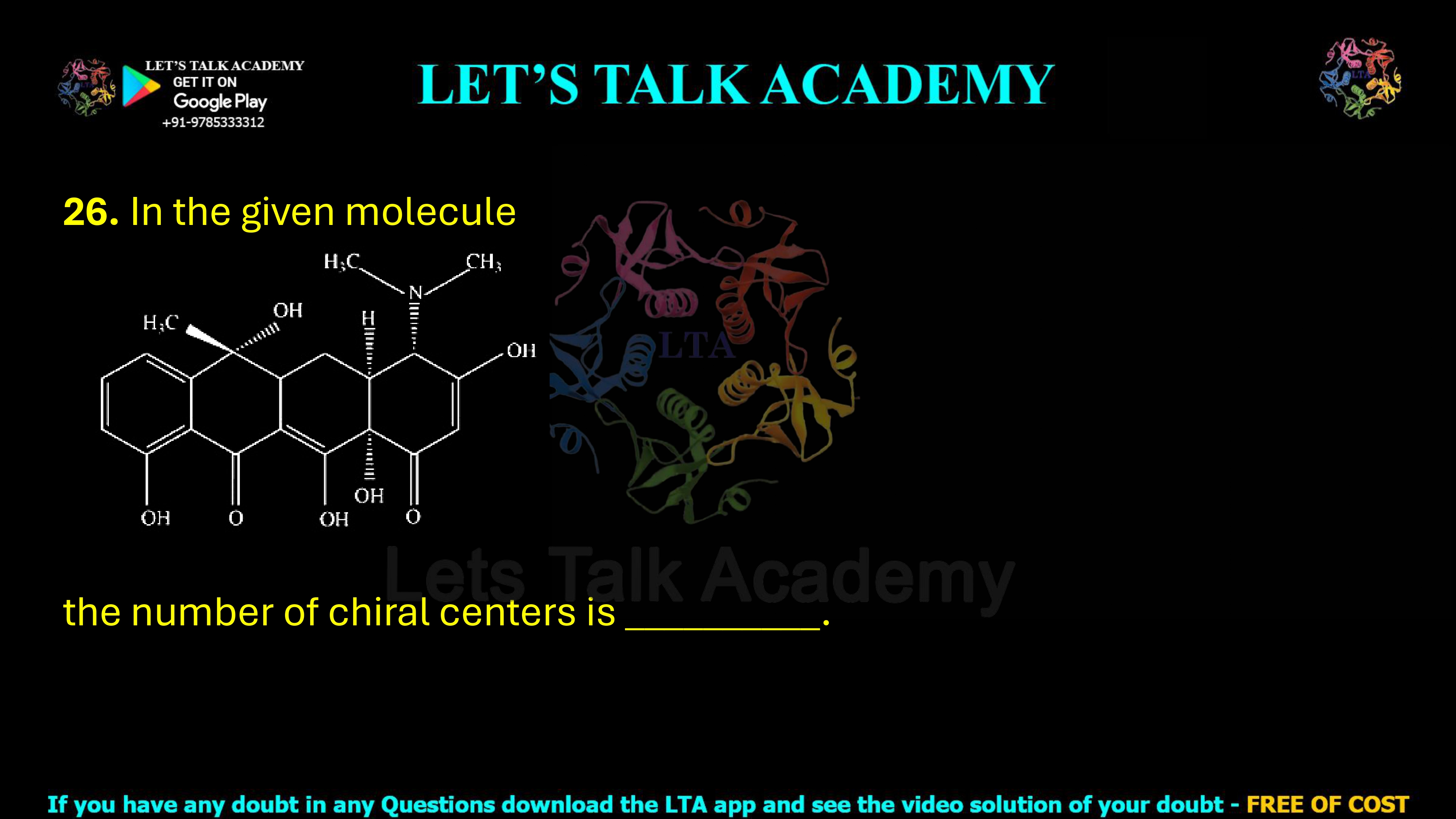
26. In the given molecule, the number of chiral centers is ________.
Number of Chiral Centers in the Given Molecule – Detailed Step-by-Step Solution
Correct Answer: 6
How to Count the Number of Chiral Centers in the Given Molecule
To determine the number of chiral centers in the given molecule, every tetrahedral carbon atom must be examined carefully. A chiral center, also called a stereogenic center or asymmetric carbon atom, is generally an sp3-hybridized carbon attached to four different groups. If the interchange of two groups attached to that carbon produces a stereoisomer, the carbon behaves as a stereogenic center.
The given structure is a complex fused polycyclic molecule containing several hydroxyl groups, carbonyl groups, a dimethylamino substituent and multiple ring junctions. The presence of many carbon atoms does not mean that every carbon is chiral. Only those tetrahedral carbon atoms that possess four different substituent environments can be counted as chiral centers.
Careful analysis of the complete molecular structure shows that there are six stereogenic carbon atoms. Therefore, the number of chiral centers in the given molecule is 6.
Step-by-Step Identification of Chiral Centers
Step 1: Exclude All sp²-Hybridized Carbon Atoms
The first step is to eliminate carbon atoms that cannot normally act as conventional chiral centers. The molecule contains several carbon-carbon double bonds, carbonyl groups and an aromatic ring. The carbon atoms involved in these structural features are sp2-hybridized and have trigonal planar geometry.
A conventional carbon chiral center must be tetrahedral. Therefore, the carbon atoms of the aromatic ring, the alkene carbon atoms and the carbonyl carbon atoms are not counted as chiral centers.
This initial elimination makes the analysis easier because only the remaining sp3-hybridized carbon atoms need to be examined individually.
Step 2: Examine the Tetrahedral Carbon Atoms
After excluding all planar sp2 carbon atoms, the remaining tetrahedral carbon atoms are analysed. For each possible center, the four groups attached to the carbon must be compared. A carbon is chiral only when all four attached groups are different from one another.
In a complex fused-ring system, two bonds extending into different directions of the ring may appear similar at first sight. However, they can represent different substituent pathways because the two paths around the ring encounter different atoms, functional groups or substitution patterns. Therefore, such a carbon can be chiral even when two of its bonds are both connected to carbon atoms.
Step 3: Identify the Stereogenic Carbons Shown by Wedge and Dash Bonds
The molecular structure contains several solid wedge and hashed wedge bonds. These bonds indicate the three-dimensional orientation of groups relative to the plane of the molecular framework. A solid wedge represents a bond projecting toward the observer, whereas a hashed or dashed wedge represents a bond directed behind the plane.
These stereochemical bonds help identify the tetrahedral centers that possess defined three-dimensional configurations. The carbon atoms carrying the methyl, hydroxyl, hydrogen and dimethylamino-related stereochemical arrangements must therefore be examined as potential chiral centers.
When each of these tetrahedral carbons is tested using the four-different-groups criterion, the molecule is found to contain a total of six chiral carbon atoms.
Why the Fused-Ring Junction Carbons Can Be Chiral
One of the most important parts of this question is the analysis of the fused-ring junctions. In cyclic and polycyclic molecules, a carbon atom may be attached to two carbon chains that initially appear identical. However, the two directions around the fused ring often lead to different structural environments.
If the two ring paths are different, they count as two different substituents. When the same tetrahedral carbon is also attached to two other different groups, it has four distinct substituent environments and becomes a chiral center.
The given molecule contains stereogenic ring-junction carbon atoms of this type. Ignoring these ring-junction centers would lead to an incorrect count of the total number of chiral centers.
Application of the Four Different Groups Rule
The correct way to confirm each possible chiral center is to apply the four-different-groups rule systematically. Consider a tetrahedral carbon atom as the central point and compare all four groups attached to it. If no two groups are identical, the carbon is stereogenic.
For simple molecules, the four groups may be visibly different, such as H, OH, CH3 and an alkyl chain. In a fused cyclic molecule, however, two groups may both begin with carbon atoms. In such cases, the comparison must continue outward along each pathway until the first point of difference is found.
Using this method for every eligible sp3 carbon in the given molecule gives a final count of six chiral centers.
Why the Nitrogen Atom Is Not Included in the Chiral Center Count
The molecule also contains a nitrogen atom bonded to two methyl groups. This nitrogen is not counted as an additional chiral center in the present question. The two methyl groups attached to nitrogen are identical, so the nitrogen does not possess four different substituent environments.
Therefore, the required answer is based on the stereogenic carbon atoms present in the molecular framework, and the nitrogen atom does not increase the final count.
Why Double-Bonded and Carbonyl Carbons Are Not Chiral Centers
The molecule contains several C=C and C=O bonds. Carbon atoms involved in these double bonds have sp2 hybridization and approximately trigonal planar geometry. They do not possess the tetrahedral arrangement required for an ordinary asymmetric carbon center.
Therefore, none of the aromatic carbon atoms, alkene carbon atoms or carbonyl carbon atoms are included in the final count. Only the tetrahedral stereogenic carbon atoms with four different substituent environments are counted.
Total Number of Chiral Centers
After analysing the entire molecule, excluding the sp2-hybridized atoms and checking the remaining tetrahedral carbon atoms for four different substituent environments, the total number of stereogenic centers is:
Number of chiral centers = 6
The wedge and dash representations in the structure are consistent with the presence of multiple stereogenic centers, while careful analysis of the fused-ring framework confirms the complete count.
Final Answer
A chiral carbon must be sp3-hybridized and attached to four different substituent groups or four different structural pathways. In the given complex fused-ring molecule, careful examination of all eligible tetrahedral carbon atoms gives a total of six chiral centers.
Therefore, the number of chiral centers in the given molecule is 6.
Correct Answer: 6


