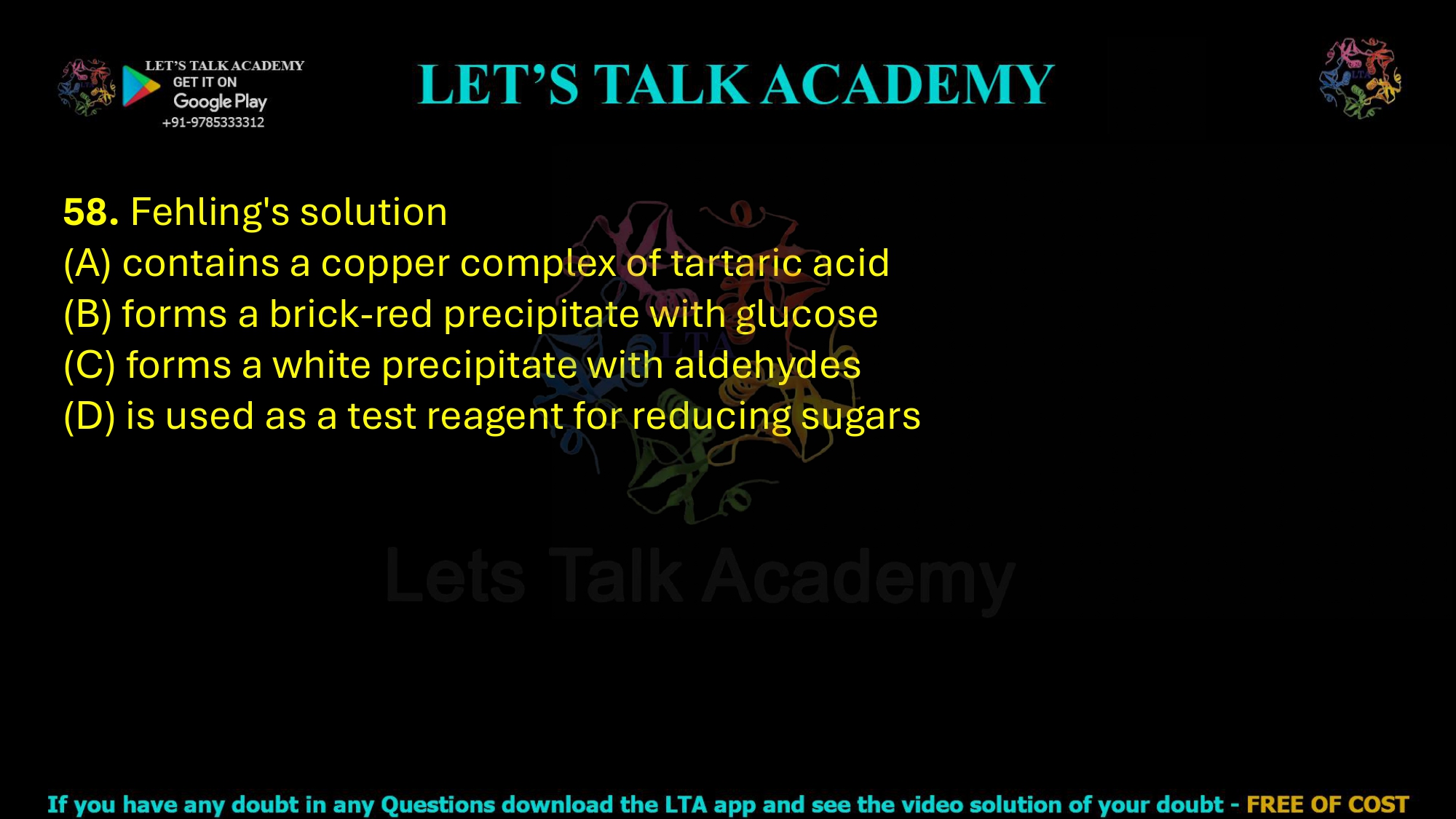
58. Fehling’s solution
(A) contains a copper complex of tartaric acid
(B) forms a brick-red precipitate with glucose
(C) forms a white precipitate with aldehydes
(D) is used as a test reagent for reducing sugars
Fehling’s Solution – Composition, Principle, Uses
Understanding how Fehling’s solution works is more important than simply memorizing the color change. A clear knowledge of the copper complex, oxidation-reduction process, and the nature of reducing sugars enables students to solve conceptual questions with confidence.
Understanding Fehling’s Solution
Fehling’s solution is a freshly prepared alkaline reagent obtained by mixing two separate solutions known as Fehling’s A and Fehling’s B.
Fehling’s A is an aqueous solution of copper(II) sulfate (CuSO4), which provides Cu2+ ions.
Fehling’s B is an alkaline solution containing sodium potassium tartrate (Rochelle salt) and sodium hydroxide. The tartrate ion forms a stable complex with Cu2+, preventing the precipitation of copper hydroxide in the strongly alkaline medium.
The active reagent therefore contains a deep-blue copper(II)-tartrate complex, which acts as the oxidizing agent during the test.
Principle of Fehling’s Test
Fehling’s solution detects compounds capable of reducing Cu2+ ions to Cu+. Aldehydes and reducing sugars readily undergo oxidation under alkaline conditions, while Cu2+ is reduced to cuprous oxide (Cu2O).
Cuprous oxide is insoluble and appears as a characteristic brick-red precipitate, which indicates a positive Fehling’s test.
This reaction is an oxidation-reduction process in which the organic compound is oxidized and copper(II) ions are reduced.
Explanation of Every Option
Option (A): Contains a Copper Complex of Tartaric Acid
This statement is correct. Fehling’s solution contains a copper(II)-tartrate complex formed between Cu2+ ions and tartrate ions derived from sodium potassium tartrate (Rochelle salt). This complex keeps copper ions dissolved in the alkaline solution and allows the reagent to function effectively.
Option (B): Forms a Brick-Red Precipitate with Glucose
This statement is also correct. Glucose is a reducing sugar because it possesses a free aldehyde group in its open-chain form. During the reaction, glucose reduces Cu2+ ions to Cu2O, producing the characteristic brick-red precipitate.
Option (C): Forms a White Precipitate with Aldehydes
This statement is incorrect. Fehling’s solution never produces a white precipitate with aldehydes. Instead, aldehydes reduce Cu2+ ions to brick-red cuprous oxide (Cu2O). A white precipitate is associated with entirely different qualitative tests and not with Fehling’s reagent.
Option (D): Is Used as a Test Reagent for Reducing Sugars
This statement is correct. One of the principal applications of Fehling’s solution is the identification of reducing sugars such as glucose, fructose (after enolization), lactose, and maltose. Non-reducing sugars such as sucrose do not give a positive Fehling’s test unless they are first hydrolyzed.
Which Option Should Be Marked?
If this question is asked as a single-correct-answer MCQ, the expected answer is generally:
Correct Option: (D)
This is because Fehling’s solution is classically identified by its most important analytical application—its use as a reagent for detecting reducing sugars.
However, from a strictly chemical perspective, Options (A), (B), and (D) are all scientifically correct, while only Option (C) is incorrect. In many standard examinations, the question is intended to emphasize the primary use of Fehling’s solution, making Option (D) the expected answer.
Difference Between Fehling’s Solution and Tollens’ Reagent
Students often confuse Fehling’s solution with Tollens’ reagent because both detect aldehydes. Fehling’s solution produces a brick-red precipitate of cuprous oxide (Cu2O), whereas Tollens’ reagent produces a silver mirror due to deposition of metallic silver on the test tube wall. Both reactions involve oxidation of aldehydes, but the oxidizing agents are different.
Final Answer
Expected Correct Option: (D)
Fehling’s solution is widely used as a qualitative test reagent for reducing sugars.


