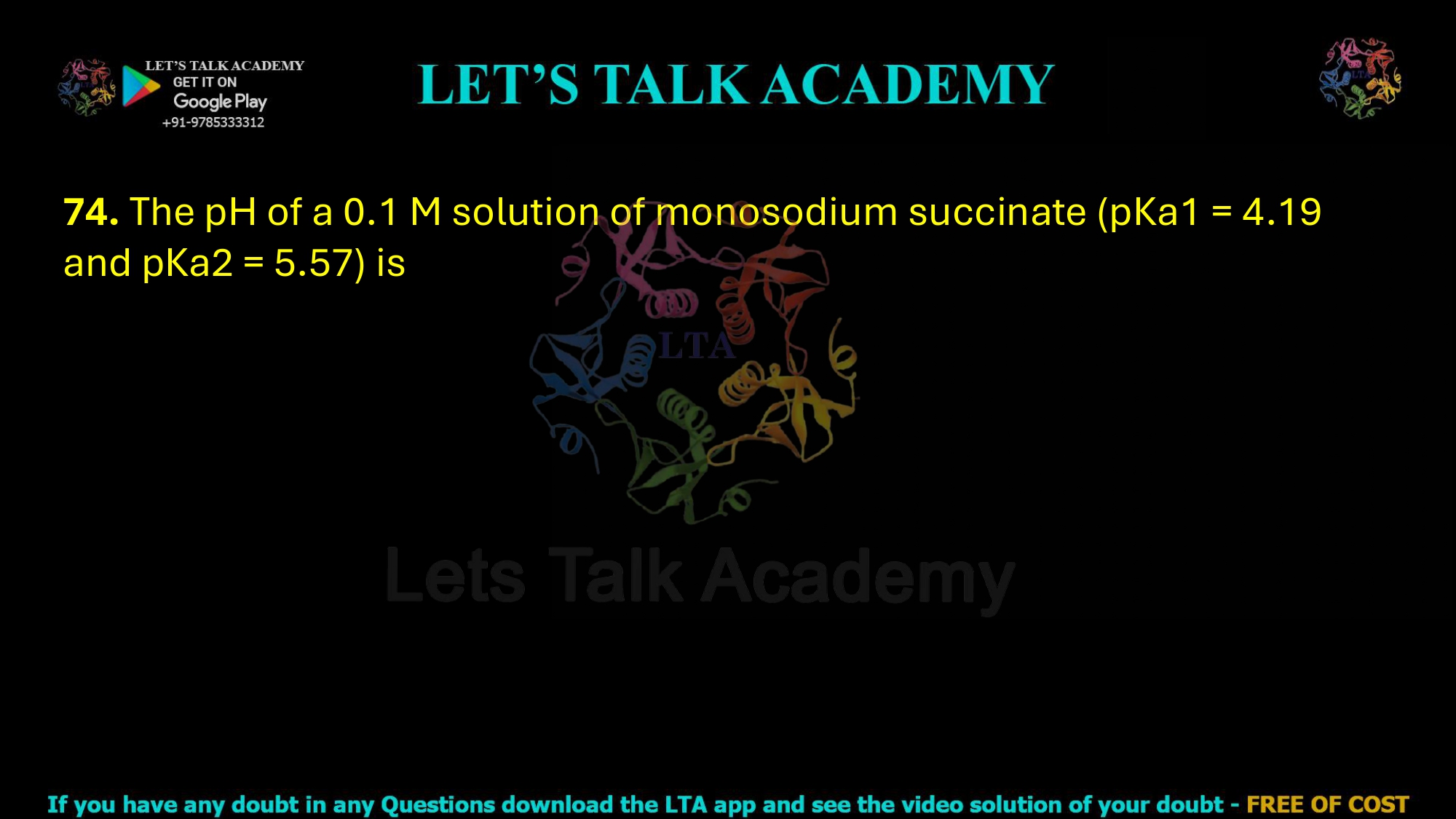
74. The pH of a 0.1 M solution of monosodium succinate (pKa1 = 4.19 and pKa2 = 5.57) is
How to Calculate the pH of a 0.1 M Monosodium Succinate Solution
Questions involving the pH of amphiprotic salts are among the most conceptual numerical problems in Physical Chemistry. Unlike strong acids, strong bases, or even ordinary weak acids, amphiprotic ions possess the unique ability to act both as an acid and as a base. Because of this dual behavior, their pH cannot be calculated using the simple weak acid or weak base equations. Instead, a special relationship involving the two dissociation constants of the parent acid is used.
In this problem, the solution contains monosodium succinate, which is the partially neutralized salt of succinic acid. Since the hydrogen succinate ion can both donate and accept a proton, it behaves as an amphiprotic species. This allows us to use one of the most elegant formulas in acid-base chemistry.
Understanding the Nature of Monosodium Succinate
Succinic acid is a diprotic acid because it contains two acidic hydrogen atoms. Its ionization occurs in two successive steps.
First dissociation
H2Suc ⇌ H+ + HSuc−
Second dissociation
HSuc− ⇌ H+ + Suc2−
Monosodium succinate contains the hydrogen succinate ion (HSuc−).
This ion occupies the intermediate stage between the fully protonated acid and the fully deprotonated ion.
Therefore, it can behave in two different ways.
As an acid:
HSuc− ⇌ H+ + Suc2−
As a base:
HSuc− + H2O ⇌ H2Suc + OH−
Because it can both donate and accept protons, it is called an amphiprotic ion.
Formula for the pH of an Amphiprotic Salt
For any amphiprotic species obtained from a diprotic acid, the pH is given by
pH = ½ (pKa1 + pKa2)
This formula is extremely important and is frequently used in competitive examinations because it allows rapid calculation without solving lengthy equilibrium equations.
Substituting the Given Values
Given
pKa1 = 4.19
pKa2 = 5.57
Therefore,
pH = ½ (4.19 + 5.57)
pH = ½ (9.76)
pH = 4.88
Final Calculation
pH = 4.88
Why Does This Formula Work?
Many students memorize the formula without understanding its origin. The hydrogen succinate ion exists exactly between the two stages of ionization of succinic acid. Since it can both lose a proton and gain a proton, its equilibrium behavior depends equally on the first and second dissociation constants.
When the complete equilibrium equations are solved, the hydrogen ion concentration becomes approximately equal to the geometric mean of the two acid dissociation constants.
Mathematically,
[H+] = √(Ka1 × Ka2)
Taking the negative logarithm of both sides gives
pH = ½ (pKa1 + pKa2)
This derivation explains why the average of the two pKa values gives the pH of the amphiprotic salt.
Why the Concentration Does Not Appear in the Formula
One of the most surprising features of this calculation is that the concentration of the amphiprotic salt does not appear in the final equation.
For dilute solutions, the concentration terms cancel during the equilibrium derivation. Consequently, the pH depends almost entirely on the intrinsic acid strengths represented by Ka1 and Ka2.
This makes the formula extremely useful because lengthy ICE table calculations become unnecessary.
Concept Behind Amphiprotic Salts
An amphiprotic species is formed whenever a polyprotic acid loses one proton but still retains another acidic hydrogen.
Common examples include:
- NaHCO3 (Sodium bicarbonate)
- NaHSO4 (Sodium hydrogen sulfate)
- NaH2PO4 (Sodium dihydrogen phosphate)
- NaHC2O4 (Sodium hydrogen oxalate)
- Monosodium succinate
All these salts can both donate and accept protons, making them amphiprotic in nature.
Correct Answer
Correct Answer: 4.88


