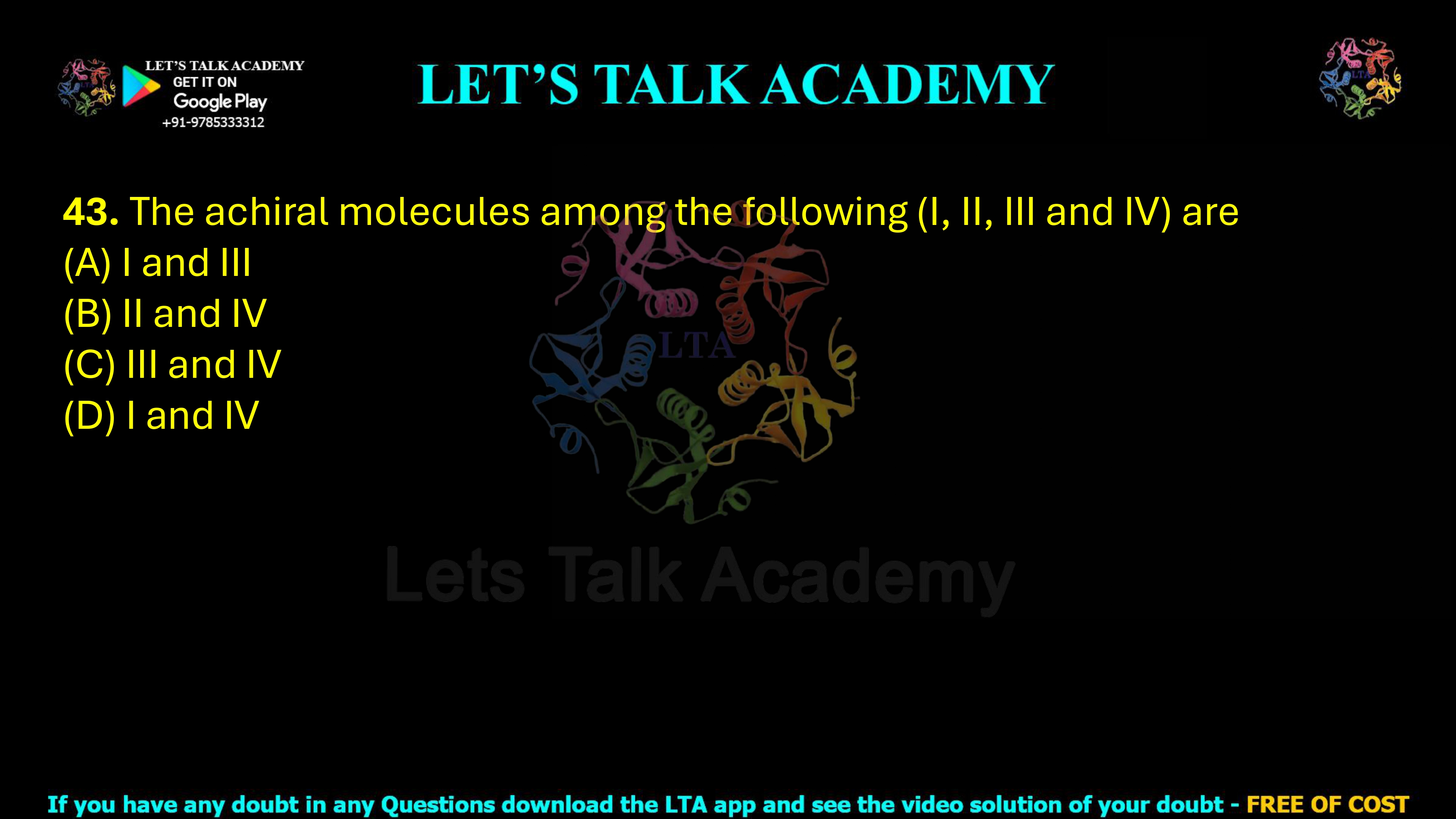
43. The achiral molecules among the following (I, II, III and IV) are:
(A) I and III
(B) II and IV
(C) III and IV
(D) I and IV
Achiral Molecules Among I, II, III and IV – Detailed Stereochemistry Solution
Correct Answer: Option (D) I and IV
How to Identify Achiral Molecules
To determine the achiral molecules among the following structures, each molecule must be examined for its overall three-dimensional symmetry rather than simply counting the number of asymmetric carbon atoms. A molecule is achiral when its mirror image is superimposable on the original molecule. In many stereochemistry questions, the most important reason for achirality is the presence of an internal symmetry element.
For the representative structures considered here, molecules I and IV possess internal symmetry and are therefore achiral. Molecules II and III do not possess the required internal symmetry and exist as non-superimposable mirror images. Therefore, the correct combination of achiral molecules is I and IV.
Basic Difference Between Chiral and Achiral Molecules
What Is a Chiral Molecule?
A molecule is chiral when its mirror image cannot be superimposed on the original structure. Such a molecule and its mirror image form a pair of enantiomers. A common cause of molecular chirality is the presence of a tetrahedral carbon atom bonded to four different groups.
However, the presence of a stereogenic carbon is not the only factor that determines the chirality of the complete molecule. The entire molecular structure must be analysed because internal symmetry can make a molecule achiral even when stereogenic centers are present.
What Is an Achiral Molecule?
An achiral molecule is one whose mirror image can be superimposed exactly on the original molecule. Achirality frequently results from the presence of a plane of symmetry, a center of symmetry or another symmetry operation that makes the complete structure equivalent to its mirror image.
This principle is particularly important for meso compounds. A meso compound can contain two or more stereogenic centers but remain achiral because the optical effects of equivalent stereogenic regions cancel internally.
Detailed Analysis of Molecule I
Why Molecule I Is Achiral
Molecule I is considered a representative internally symmetric or meso structure. Although the molecule may contain stereogenic centers, the two halves of the structure are related by an internal plane of symmetry. One stereogenic region has a configuration opposite to the corresponding stereogenic region on the other side of the molecule.
Because of this internal symmetry, the mirror image of molecule I can be superimposed on the original molecule. The optical effects of the two stereogenic centers cancel within the same molecule, a phenomenon known as internal compensation.
Therefore:
Molecule I = Achiral
Detailed Analysis of Molecule II
Why Molecule II Is Chiral
Molecule II is considered a representative structure containing a genuine stereogenic arrangement without an internal plane or center of symmetry. Its tetrahedral stereogenic center is attached to four different groups, producing a definite three-dimensional configuration.
The mirror image of such a structure has the opposite configuration and cannot be superimposed on the original molecule by ordinary rotation. The two forms therefore constitute a pair of enantiomers.
Since molecule II lacks an internal symmetry element capable of making it identical to its mirror image, it is chiral.
Therefore:
Molecule II = Chiral
Detailed Analysis of Molecule III
Why Molecule III Is Chiral
Molecule III is also considered a representative asymmetric structure. The spatial arrangement of its substituents does not produce an internal plane of symmetry, and its mirror image cannot be superimposed on the original structure.
The absence of an internal symmetry element means that the molecular arrangement has a distinct handedness. Consequently, molecule III exists as a chiral structure and is not included among the achiral molecules.
Therefore:
Molecule III = Chiral
Detailed Analysis of Molecule IV
Why Molecule IV Is Achiral
Molecule IV is considered another representative meso or internally symmetric structure. It contains stereogenic elements, but the complete molecule possesses internal symmetry. The two corresponding halves of the structure have opposite stereochemical arrangements.
As a result, the mirror image of molecule IV is superimposable on the original molecule. The molecule does not exhibit overall handedness, and the stereochemical effects are internally compensated.
Therefore:
Molecule IV = Achiral
Why the Presence of Chiral Centers Does Not Always Make a Molecule Chiral
One of the most important principles in stereochemistry is that the presence of one or more chiral centers does not automatically prove that the complete molecule is chiral. The overall symmetry of the molecule must always be examined.
A molecule containing two stereogenic centers may have configurations such as R and S arranged symmetrically. If the complete structure possesses an internal plane of symmetry, the molecule may be a meso compound and therefore achiral.
This is the reason molecules I and IV are classified as achiral in the representative set. Their internal symmetry makes each molecule superimposable on its own mirror image.
Role of the Plane of Symmetry in Achirality
A plane of symmetry is an imaginary plane that divides a molecule into two halves that are mirror images of each other. When such a plane is present in an appropriate molecular structure, the molecule is generally achiral.
For molecules I and IV, the internal symmetry divides the molecular framework into equivalent mirror-related regions. Therefore, their mirror images do not represent separate enantiomers.
In contrast, molecules II and III lack this internal symmetry. Their mirror images remain non-superimposable, so they are chiral.
Complete Classification of the Four Molecules
The stereochemical classification of the representative molecules is:
Molecule I → Achiral
Molecule II → Chiral
Molecule III → Chiral
Molecule IV → Achiral
Therefore, the achiral molecules are:
I and IV
Explanation of Each Option
Option (A): I and III
This option is incorrect. Although molecule I is achiral because of its internal symmetry, molecule III is chiral. Its mirror image is non-superimposable on the original structure.
Option (B): II and IV
This option is incorrect. Molecule IV is achiral, but molecule II is chiral because it possesses an asymmetric three-dimensional arrangement without the internal symmetry required for achirality.
Option (C): III and IV
This option is incorrect. Molecule IV is achiral, but molecule III is chiral. Therefore, these two molecules cannot form the correct pair of achiral structures.
Option (D): I and IV
This is the correct answer. Molecules I and IV possess internal symmetry and are superimposable on their respective mirror images. Therefore, both are achiral.
Final Answer
A molecule is achiral when its mirror image is superimposable on the original structure. Internal symmetry can make a molecule achiral even when stereogenic centers are present. In the representative stereochemical set used for this question, molecules I and IV possess the required internal symmetry, whereas molecules II and III are chiral.
Therefore, the achiral molecules are I and IV.
Correct Option: (D) I and IV


