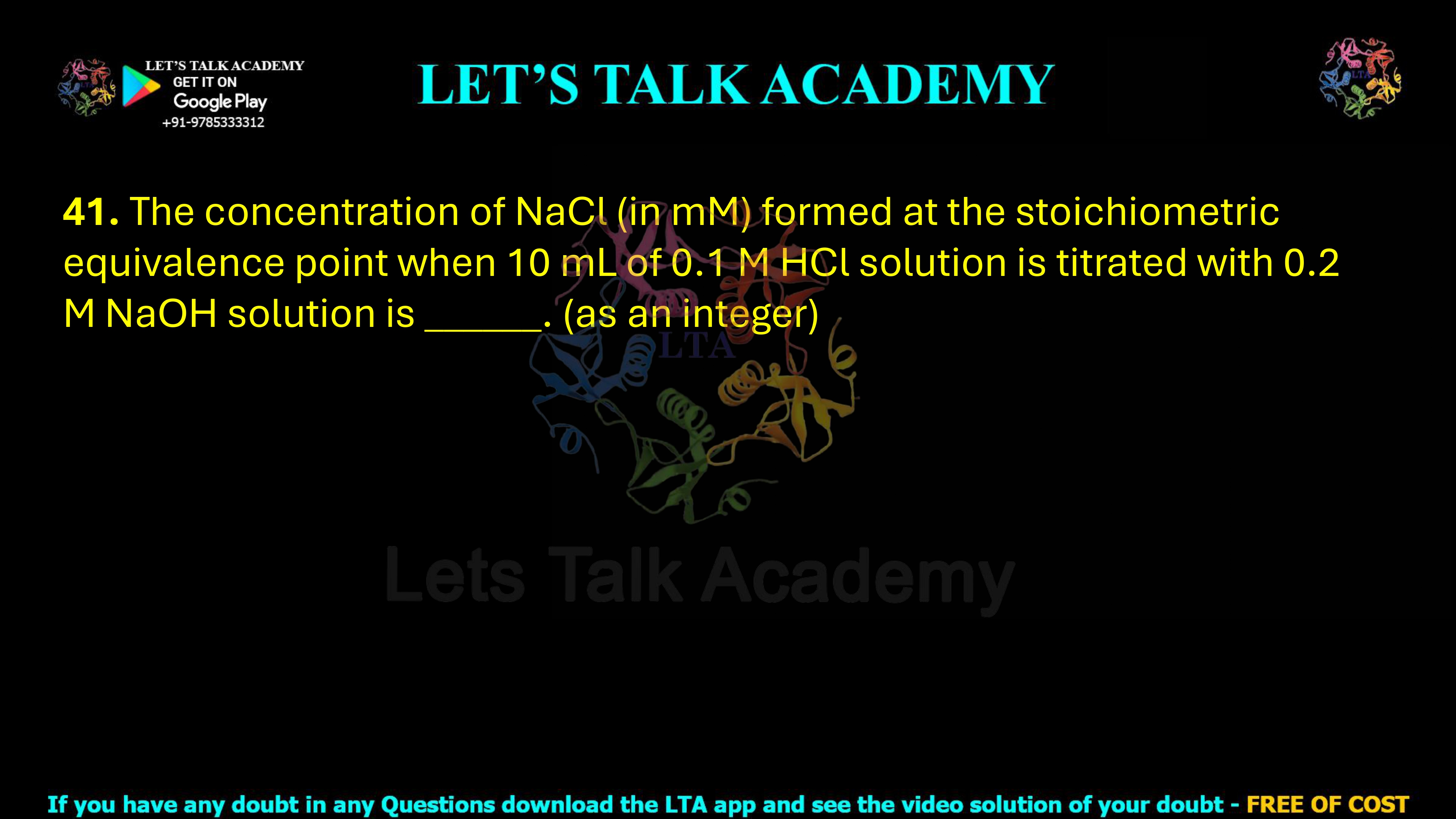
41. The concentration of NaCl, in mM, formed at the stoichiometric equivalence point when 10 mL of 0.1 M HCl solution is titrated with 0.2 M NaOH solution is _____, as an integer.
Concentration of NaCl at the Stoichiometric Equivalence Point
Correct Answer: 67
The concentration of NaCl at the equivalence point is approximately 66.67 mM, which is reported as 67 mM because the question asks for the answer as an integer. The calculation requires three main steps: finding the initial moles of HCl, calculating the volume of 0.2 M NaOH needed to reach the stoichiometric equivalence point, and determining the concentration of the NaCl formed in the total final volume.
At the equivalence point, HCl and NaOH have reacted completely in a 1:1 molar ratio. The initial 0.001 mol of HCl therefore reacts with 0.001 mol of NaOH and forms exactly 0.001 mol of NaCl. However, the final concentration of NaCl must be calculated using the combined volume of the original HCl solution and the added NaOH solution. The total volume at equivalence is 15 mL, giving a NaCl concentration of 0.06667 M or 66.67 mM.
Understanding the HCl and NaOH Titration
What Happens at the Stoichiometric Equivalence Point?
Hydrochloric acid is a strong acid, while sodium hydroxide is a strong base. Both substances dissociate essentially completely in aqueous solution. When HCl is titrated with NaOH, hydrogen ions from the acid react with hydroxide ions from the base to form water.
The complete molecular equation is:
HCl + NaOH → NaCl + H2O
The corresponding net ionic equation is:
H+ + OH− → H2O
At the stoichiometric equivalence point, the number of moles of NaOH added is exactly equal to the initial number of moles of HCl. Neither reactant remains in stoichiometric excess. The solution contains NaCl and water, and the amount of NaCl formed is determined directly from the amount of HCl initially present.
Step-by-Step Calculation of NaCl Concentration
Step 1: Identify the Given Data
The question provides the following information:
Volume of HCl = 10 mL = 0.010 L
Concentration of HCl = 0.1 M
Concentration of NaOH = 0.2 M
The required quantity is the concentration of NaCl in millimolar, or mM, at the stoichiometric equivalence point.
Step 2: Calculate the Initial Moles of HCl
The number of moles of a solute is calculated using the relation:
Number of moles = Molarity × Volume in litres
Substituting the concentration and volume of HCl:
Moles of HCl = 0.1 mol L−1 × 0.010 L
Moles of HCl = 0.001 mol
Therefore, the original HCl solution contains 1.0 × 10⁻³ mol of HCl.
Step 3: Use the Reaction Stoichiometry
The balanced neutralization equation is:
HCl + NaOH → NaCl + H2O
The stoichiometric coefficients of HCl, NaOH, and NaCl are all equal to one. Therefore, one mole of HCl reacts with one mole of NaOH and produces one mole of NaCl.
Since the initial amount of HCl is 0.001 mol:
Moles of NaOH required = 0.001 mol
and:
Moles of NaCl formed = 0.001 mol
Thus, at the equivalence point, exactly 0.001 mol of NaCl is present in the solution.
Step 4: Calculate the Volume of NaOH Required for Equivalence
The NaOH solution has a concentration of 0.2 M. The volume required to provide 0.001 mol of NaOH can be calculated from:
Volume = Number of moles / Molarity
Therefore:
Volume of NaOH = 0.001 / 0.2
Volume of NaOH = 0.005 L
Converting litres into millilitres:
0.005 L × 1000 = 5 mL
Therefore, 5 mL of 0.2 M NaOH must be added to reach the stoichiometric equivalence point.
Calculation of the Total Volume at Equivalence
The final solution contains the original 10 mL of HCl solution together with the 5 mL of NaOH solution added during the titration.
Therefore:
Total volume = Volume of HCl + Volume of NaOH
Total volume = 10 mL + 5 mL
Total volume = 15 mL
Converting the total volume into litres:
15 mL = 0.015 L
This total volume must be used when calculating the final concentration of NaCl.
Calculation of the NaCl Concentration
Step 5: Calculate the Molar Concentration of NaCl
The concentration of NaCl is calculated using:
[NaCl] = Moles of NaCl / Total volume of solution
Substituting the calculated values:
[NaCl] = 0.001 mol / 0.015 L
[NaCl] = 0.06667 mol L−1
Therefore, the molar concentration of NaCl at the equivalence point is approximately 0.06667 M.
Step 6: Convert Molar Concentration into Millimolar
The question asks for the concentration in mM. The relationship between molar and millimolar concentration is:
1 M = 1000 mM
Therefore:
0.06667 M × 1000 = 66.67 mM
Thus:
[NaCl] = 66.67 mM
Since the answer is required as an integer:
66.67 ≈ 67
Therefore, the required answer is 67.
Why the Total Volume Must Be Used
A crucial part of this calculation is using the final total volume rather than the original 10 mL volume of the HCl solution. During the titration, 5 mL of NaOH solution is added before the equivalence point is reached. The NaCl produced is therefore distributed throughout the combined 15 mL solution.
Using only the original 10 mL volume would incorrectly give:
0.001 mol / 0.010 L = 0.1 M = 100 mM
This value is incorrect because it ignores the additional volume introduced by the NaOH solution. The correct final volume is 15 mL, giving the actual NaCl concentration of 66.67 mM.
Why the Volume of NaOH Is Only 5 mL
The HCl solution has a concentration of 0.1 M, whereas the NaOH solution has a concentration of 0.2 M. Therefore, the NaOH solution is twice as concentrated as the HCl solution.
Since the neutralization reaction occurs in a 1:1 molar ratio, a solution that is twice as concentrated requires only half the volume to provide the same number of moles.
Thus:
10 mL of 0.1 M HCl requires 5 mL of 0.2 M NaOH
This can also be verified using the equivalence relation:
MHClVHCl = MNaOHVNaOH
Substituting the values:
0.1 × 10 = 0.2 × VNaOH
Therefore:
VNaOH = 5 mL
Direct Calculation Using Millimoles
The problem can also be solved efficiently using millimoles and millilitres. Since:
mM × mL = µmol
or equivalently:
M × mL = mmol
the initial amount of HCl can be calculated directly as:
Millimoles of HCl = 0.1 × 10 = 1 mmol
Therefore, 1 mmol of NaOH is required and 1 mmol of NaCl is formed.
The volume of 0.2 M NaOH required is:
Volume of NaOH = 1 mmol / 0.2 mmol mL−1 = 5 mL
The total volume is:
10 + 5 = 15 mL
Therefore:
[NaCl] = 1 mmol / 15 mL
[NaCl] = 0.06667 mmol mL−1
Since 1 mmol mL−1 equals 1000 mM:
[NaCl] = 66.67 mM ≈ 67 mM
Complete Calculation in One Expression
The complete calculation can be written compactly as:
n(HCl) = 0.1 × 0.010 = 0.001 mol
V(NaOH) = 0.001 / 0.2 = 0.005 L = 5 mL
Vtotal = 10 + 5 = 15 mL = 0.015 L
[NaCl] = 0.001 / 0.015 = 0.06667 M
[NaCl] = 66.67 mM ≈ 67 mM
Final Answer
The initial 10 mL of 0.1 M HCl contains 0.001 mol of HCl. At the stoichiometric equivalence point, an equal amount of NaOH is required. Since the NaOH concentration is 0.2 M, 5 mL of NaOH solution is needed.
The neutralization reaction produces 0.001 mol of NaCl, and the total solution volume at equivalence is 10 mL + 5 mL = 15 mL. Therefore, the NaCl concentration is 0.001/0.015 = 0.06667 M, which is equal to 66.67 mM.
Rounded to the nearest integer, the concentration of NaCl formed at the stoichiometric equivalence point is 67 mM.
Correct Answer: 67


