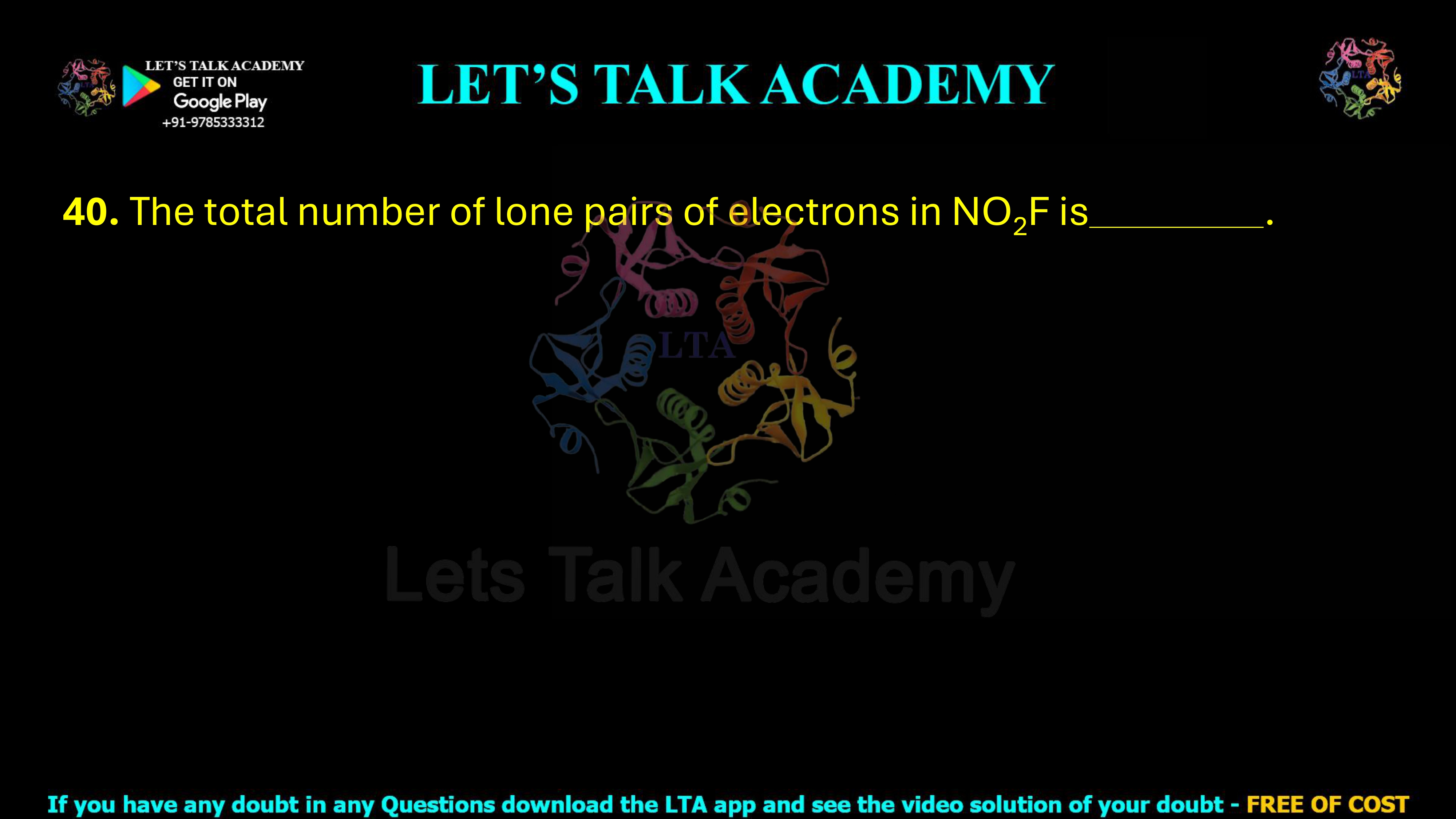
40. The total number of lone pairs of electrons in NO2F is _____.
Total Number of Lone Pairs of Electrons in NO2F
Correct Answer: 8
The total number of lone pairs in NO2F is 8. To determine this correctly, the Lewis structure of NO2F must first be drawn using the total number of valence electrons. Nitrogen acts as the central atom and is bonded to two oxygen atoms and one fluorine atom.
The most suitable Lewis structure contains one N=O double bond, one N–O single bond, and one N–F single bond. In this structure, fluorine contains three lone pairs, the double-bonded oxygen contains two lone pairs, and the single-bonded oxygen contains three lone pairs. Therefore, the total number of lone pairs is 3 + 2 + 3 = 8.
Understanding the Lewis Structure of NO2F
What Is NO2F?
NO2F is commonly known as nitryl fluoride. It contains one nitrogen atom, two oxygen atoms, and one fluorine atom. To determine the total number of lone pairs, it is essential to identify the correct bonding arrangement and distribute all the valence electrons according to the octet rule.
Nitrogen is less electronegative than both oxygen and fluorine, so nitrogen occupies the central position in the Lewis structure. The basic atomic arrangement is therefore:
O–N–O
with the fluorine atom also directly bonded to the central nitrogen atom.
Step-by-Step Calculation of Lone Pairs in NO2F
Step 1: Calculate the Total Number of Valence Electrons
The first step is to calculate the total number of valence electrons contributed by all the atoms present in NO2F.
Nitrogen belongs to Group 15 and contributes 5 valence electrons. Each oxygen atom belongs to Group 16 and contributes 6 valence electrons. Since two oxygen atoms are present, their total contribution is 12 electrons. Fluorine belongs to Group 17 and contributes 7 valence electrons.
Therefore:
Valence electrons from N = 5
Valence electrons from 2 O atoms = 2 × 6 = 12
Valence electrons from F = 7
The total number of valence electrons is:
Total valence electrons = 5 + 12 + 7 = 24 electrons
Thus, the complete Lewis structure of NO2F must contain exactly 24 valence electrons.
Step 2: Place Nitrogen as the Central Atom
Nitrogen is selected as the central atom because it is less electronegative than oxygen and fluorine. Fluorine almost always forms only one bond and therefore occupies a terminal position.
The initial skeletal structure contains three single bonds:
N–O, N–O, and N–F
These three sigma bonds use:
3 bonds × 2 electrons = 6 electrons
After forming the three initial bonds, 18 of the original 24 valence electrons remain to be distributed.
Step 3: Complete the Octets of the Terminal Atoms
The remaining electrons are first placed around the terminal oxygen and fluorine atoms to complete their octets. However, if all three connections remain single bonds, the central nitrogen atom does not achieve a complete octet.
To provide nitrogen with an octet, one lone pair from one oxygen atom is converted into an additional bonding pair. This creates one N=O double bond.
The resulting Lewis structure can be represented as:
O=N+(F)–O−
One oxygen is double bonded to nitrogen, the other oxygen is single bonded to nitrogen, and fluorine is connected to nitrogen through a single bond.
Counting the Lone Pairs on Each Atom
Lone Pairs on the Double-Bonded Oxygen Atom
The oxygen atom involved in the N=O double bond forms two bonding pairs with nitrogen. To complete its octet, it contains four nonbonding electrons.
Four nonbonding electrons correspond to:
4 nonbonding electrons ÷ 2 = 2 lone pairs
Therefore, the double-bonded oxygen atom has 2 lone pairs.
Lone Pairs on the Single-Bonded Oxygen Atom
The oxygen atom connected to nitrogen through a single bond requires six nonbonding electrons to complete its octet. These six electrons are arranged as three electron pairs.
Therefore:
6 nonbonding electrons ÷ 2 = 3 lone pairs
Thus, the single-bonded oxygen atom has 3 lone pairs.
Lone Pairs on the Fluorine Atom
Fluorine has seven valence electrons and forms one single bond with nitrogen. One electron from fluorine participates in the N–F bond, leaving six nonbonding electrons around fluorine.
Therefore:
6 nonbonding electrons ÷ 2 = 3 lone pairs
Thus, fluorine has 3 lone pairs.
Lone Pairs on the Central Nitrogen Atom
In the preferred Lewis structure, nitrogen forms one double bond and two single bonds. The N=O double bond contains two shared electron pairs, while the N–O and N–F single bonds each contain one shared electron pair.
Therefore, four bonding pairs surround nitrogen, giving it a complete octet. No electrons remain as a lone pair on the central nitrogen atom.
Thus, nitrogen has 0 lone pairs.
Total Number of Lone Pairs in NO2F
The lone pairs on all atoms can now be added:
Double-bonded oxygen = 2 lone pairs
Single-bonded oxygen = 3 lone pairs
Fluorine = 3 lone pairs
Nitrogen = 0 lone pairs
Therefore:
Total number of lone pairs = 2 + 3 + 3 + 0
Total number of lone pairs = 8
Verification Using the Total Valence Electron Count
The answer can be verified by counting the electrons present in bonds and lone pairs. The Lewis structure contains one double bond and two single bonds.
The electrons used in bonding are:
One N=O double bond = 4 electrons
One N–O single bond = 2 electrons
One N–F single bond = 2 electrons
Therefore:
Total bonding electrons = 4 + 2 + 2 = 8 electrons
Since NO2F contains 24 total valence electrons:
Nonbonding electrons = 24 − 8 = 16 electrons
Every lone pair contains two electrons. Therefore:
Number of lone pairs = 16 ÷ 2 = 8
This electron-counting method independently confirms that the total number of lone pairs in NO2F is 8.
Formal Charges in the Lewis Structure of NO2F
The preferred Lewis structure contains formal charges on the central nitrogen atom and the single-bonded oxygen atom. Formal charge is calculated using:
Formal charge = Valence electrons − Nonbonding electrons − ½(Bonding electrons)
The double-bonded oxygen has a formal charge of zero, while the single-bonded oxygen has a formal charge of −1. The nitrogen atom has a formal charge of +1, and fluorine has a formal charge of zero.
Therefore, the formal charges are:
Double-bonded O = 0
Single-bonded O = −1
N = +1
F = 0
The positive and negative formal charges cancel, giving an overall neutral NO2F molecule.
Resonance Structures of NO2F
The two oxygen atoms can exchange their bonding roles through resonance. In one resonance structure, the first oxygen forms the N=O double bond while the second oxygen forms an N–O single bond. In the other resonance structure, the positions of the double and single bonds are reversed.
The resonance relationship can be represented as:
O=N+(F)–O− ↔ −O–N+(F)=O
In either resonance structure, one oxygen has two lone pairs, the other oxygen has three lone pairs, and fluorine has three lone pairs. Therefore, resonance does not change the total number of lone pairs.
The total remains:
2 + 3 + 3 = 8 lone pairs
Why Nitrogen Does Not Have a Lone Pair in NO2F
Nitrogen is surrounded by one double bond and two single bonds. These bonds account for four shared electron pairs around nitrogen, which means that nitrogen already has eight electrons in its valence shell.
Adding a lone pair to nitrogen would exceed the octet allowed for a second-period element. Nitrogen cannot expand its octet because it does not have energetically accessible valence d orbitals. Therefore, the central nitrogen atom has no lone pair in the valid Lewis structure.
Direct Electron Method for Finding the Answer
A shorter calculation can be used after identifying the correct Lewis structure. NO2F contains 24 total valence electrons. Its Lewis structure contains one double bond and two single bonds, so 8 electrons are involved in bonding.
Therefore:
Electrons present as lone pairs = 24 − 8 = 16
Since each lone pair contains two electrons:
Total lone pairs = 16/2 = 8
This provides a direct and reliable calculation of the required answer.
Final Answer
NO2F contains a total of 24 valence electrons. Its preferred Lewis structure contains one N=O double bond, one N–O single bond, and one N–F single bond. The double-bonded oxygen has two lone pairs, the single-bonded oxygen has three lone pairs, fluorine has three lone pairs, and nitrogen has no lone pair.
Therefore:
Total number of lone pairs = 2 + 3 + 3 + 0 = 8
Correct Answer: 8


