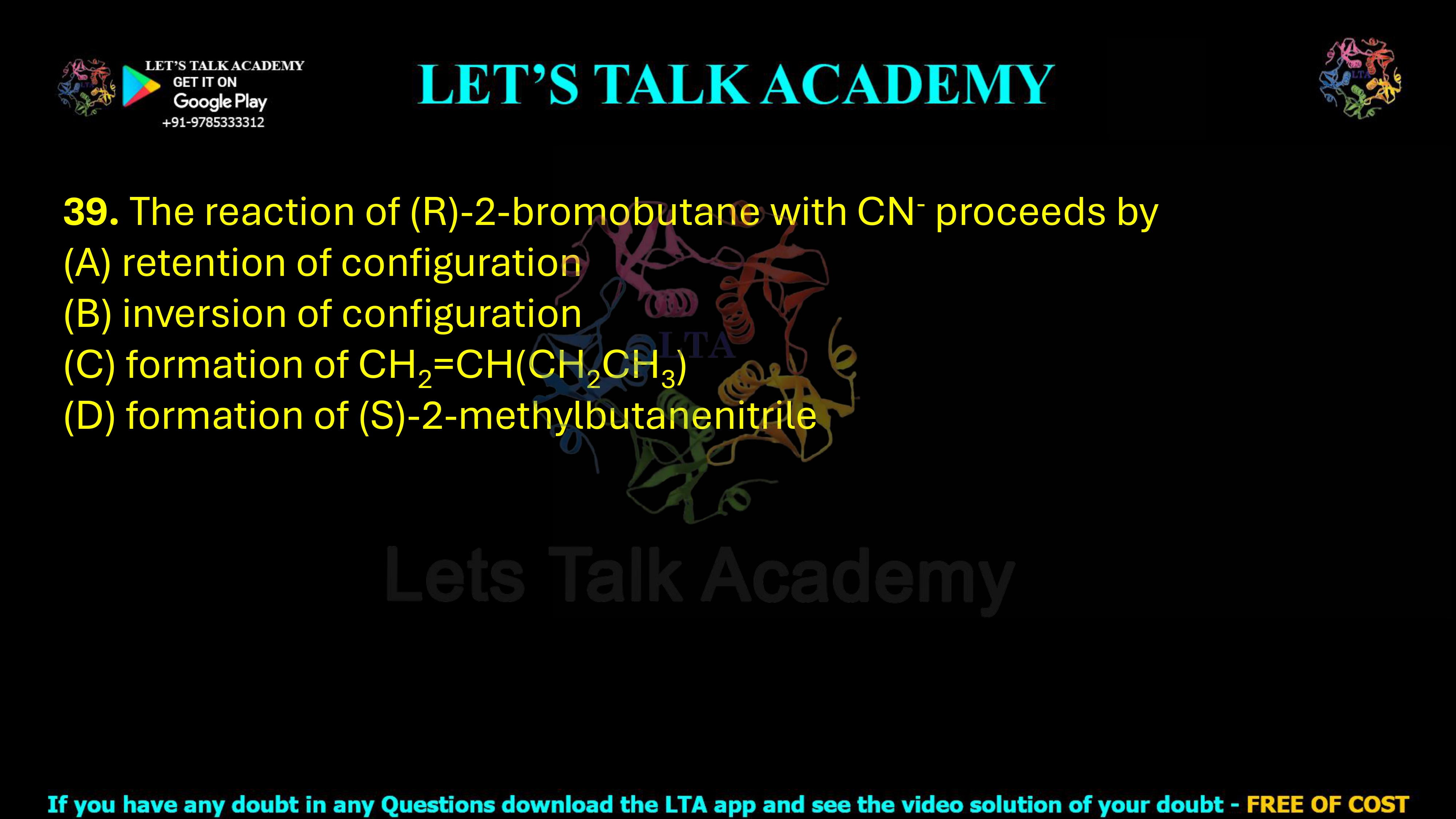
39. The reaction of (R)-2-bromobutane with CN⁻ proceeds by:
(A) Retention of configuration
(B) Inversion of configuration
(C) Formation of CH₂=CH(CH₂CH₃)
(D) Formation of (S)-2-methylbutanenitrile
Reaction of (R)-2-Bromobutane with CN⁻ – SN2 Mechanism and Stereochemical Inversion
Correct Answer: Option (B) Inversion of Configuration
The reaction of (R)-2-bromobutane with CN⁻ proceeds through an SN2 nucleophilic substitution mechanism. The cyanide ion is a strong nucleophile and attacks the chiral carbon atom from the side opposite to the carbon–bromine bond. This backside attack causes complete inversion of the three-dimensional arrangement around the stereogenic carbon atom. Therefore, the reaction proceeds by inversion of configuration, making Option (B) the fundamental mechanistic answer.
The stereochemical product formed by this inversion is (S)-2-methylbutanenitrile. Therefore, Option (D) describes the product obtained as a consequence of the SN2 inversion, while Option (B) directly answers how the reaction proceeds.
Understanding the Reaction of (R)-2-Bromobutane with CN⁻
(R)-2-Bromobutane is a secondary alkyl halide containing a chiral carbon atom at carbon-2. Its structure can be represented as:
CH₃–CH(Br)–CH₂CH₃
The second carbon atom is attached to four different groups: Br, H, CH₃, and CH₂CH₃. Therefore, it is a stereogenic or chiral centre. The starting compound has the (R)-configuration.
When this compound reacts with CN⁻, the cyanide ion acts as a nucleophile. It attacks the carbon atom bonded to bromine and replaces the bromide ion. Since the reaction occurs through an SN2 mechanism, bond formation with CN and bond breaking with Br occur simultaneously in a single concerted step.
Why Does the Reaction Follow the SN2 Mechanism?
The cyanide ion, CN⁻, is a strong nucleophile because it carries a negative charge and can readily donate an electron pair to an electrophilic carbon atom. In (R)-2-bromobutane, the carbon bonded to bromine is electron deficient because the C–Br bond is polarized toward the more electronegative bromine atom.
The nucleophile attacks this electrophilic carbon while the C–Br bond breaks. Bromide is a good leaving group, so it can leave with the bonding electron pair. The entire substitution occurs in one concerted step without the formation of a carbocation intermediate.
The overall reaction can be written as:
(R)-CH₃–CH(Br)–CH₂CH₃ + CN⁻ → CH₃–CH(CN)–CH₂CH₃ + Br⁻
The organic product is named 2-methylbutanenitrile. Because the substitution occurs with stereochemical inversion, the product has the opposite spatial arrangement at the chiral centre.
SN2 Mechanism and Backside Attack
Attack of CN⁻ from the Opposite Side
The most important feature of an SN2 reaction is backside attack. The CN⁻ nucleophile cannot effectively attack from the same side as the bromine atom because the leaving group blocks that direction and the required orbital overlap is not favourable.
Instead, CN⁻ approaches the stereogenic carbon from the side exactly opposite to the C–Br bond. As the new carbon–carbon bond begins to form, the carbon–bromine bond begins to break.
This simultaneous process can be represented as:
CN⁻ + (R)-CH₃–CH(Br)–CH₂CH₃ → [Transition State] → CH₃–CH(CN)–CH₂CH₃ + Br⁻
There is no intermediate in this reaction. Only a high-energy transition state is formed temporarily during the conversion of reactants into products.
Inversion of the Tetrahedral Arrangement
During backside attack, the arrangement of groups around the chiral carbon turns inside out. The geometry changes in a manner similar to the inversion of a tetrahedral centre, producing the opposite spatial arrangement.
This stereochemical inversion is known as Walden inversion. Therefore, an SN2 reaction occurring at a chiral carbon generally gives inversion of configuration at the reacting stereogenic centre.
Why Is Option (A) Retention of Configuration Incorrect?
Retention of configuration would mean that the spatial arrangement of the groups around the chiral carbon remains unchanged after substitution. However, a normal SN2 reaction does not proceed through front-side attack. The nucleophile attacks exclusively from the side opposite to the leaving group, causing inversion of the tetrahedral arrangement.
Since CN⁻ attacks (R)-2-bromobutane from the backside, retention of configuration does not occur. Therefore, Option (A) is incorrect.
Why Is Option (B) Inversion of Configuration Correct?
Option (B) correctly describes the stereochemical course of the reaction. The CN⁻ ion attacks from the side opposite to the bromine atom, while Br⁻ leaves simultaneously. This backside attack reverses the spatial arrangement around the chiral carbon.
Thus:
Backside attack → SN2 mechanism → Walden inversion → Inversion of configuration
Therefore, inversion of configuration is the correct mechanistic answer.
Why Is Option (C) Formation of CH₂=CH(CH₂CH₃) Incorrect?
Option (C) represents an alkene product and would require an elimination reaction rather than a nucleophilic substitution reaction. Elimination is generally favoured by a strong base that removes a β-hydrogen while the leaving group departs.
In the present reaction, CN⁻ behaves predominantly as a strong nucleophile. It attacks the carbon bearing bromine and replaces Br⁻. Therefore, substitution is favoured, and the corresponding nitrile is formed instead of the alkene shown in Option (C).
Understanding the Formation of (S)-2-Methylbutanenitrile
The product formed after replacement of Br by CN is:
CH₃–CH(CN)–CH₂CH₃
When naming a nitrile, the carbon atom of the –C≡N group is included in the parent carbon chain. Therefore, the product is named 2-methylbutanenitrile.
The substitution occurs with inversion at the chiral carbon. In this particular reaction, the priority relationships in the product lead to the (S)-configuration. Therefore, the stereochemical product is (S)-2-methylbutanenitrile.
This means that Option (D) correctly identifies the product resulting from the reaction. However, because the question asks how the reaction “proceeds by”, the direct mechanistic answer is Option (B), inversion of configuration.
CIP Priority Order in the Starting Compound
In (R)-2-bromobutane, the four groups attached to the stereogenic carbon are assigned priorities according to the Cahn–Ingold–Prelog rules.
The priority order is:
Br > CH₂CH₃ > CH₃ > H
Bromine receives the highest priority because it has the highest atomic number among the directly attached atoms. Between the ethyl and methyl groups, the ethyl group receives higher priority because the next set of attached atoms gives it precedence over the methyl group. Hydrogen has the lowest priority.
The starting compound is given as the (R)-enantiomer.
CIP Priority Order in the Product
After substitution, bromine is replaced by the cyano group. The groups attached to the stereogenic carbon in the product are CN, CH₂CH₃, CH₃, and H.
The priority order is:
CN > CH₂CH₃ > CH₃ > H
For CIP priority assignment, the carbon of the cyano group is treated according to the multiple-bond rule as being attached to nitrogen atoms. This gives the cyano group higher priority than the ethyl and methyl groups.
Because the SN2 reaction causes inversion of the spatial arrangement and the relevant priority relationship remains consistent, the product is assigned the (S)-configuration.
Rate Expression for the SN2 Reaction
The term SN2 means substitution nucleophilic bimolecular. The rate of the reaction depends on the concentrations of both the alkyl halide and the nucleophile.
Rate = k[(R)-2-bromobutane][CN⁻]
This bimolecular rate law supports the concerted nature of the reaction. Both the substrate and the nucleophile participate in the rate-determining transition state.
Final Answer
The reaction of (R)-2-bromobutane with CN⁻ occurs through an SN2 mechanism. The cyanide ion attacks the chiral carbon from the side opposite to the C–Br bond, causing Walden inversion at the stereogenic centre.
(R)-2-Bromobutane + CN⁻ → (S)-2-Methylbutanenitrile + Br⁻
Therefore, the reaction proceeds by inversion of configuration.
Correct Answer: Option (B) Inversion of Configuration


