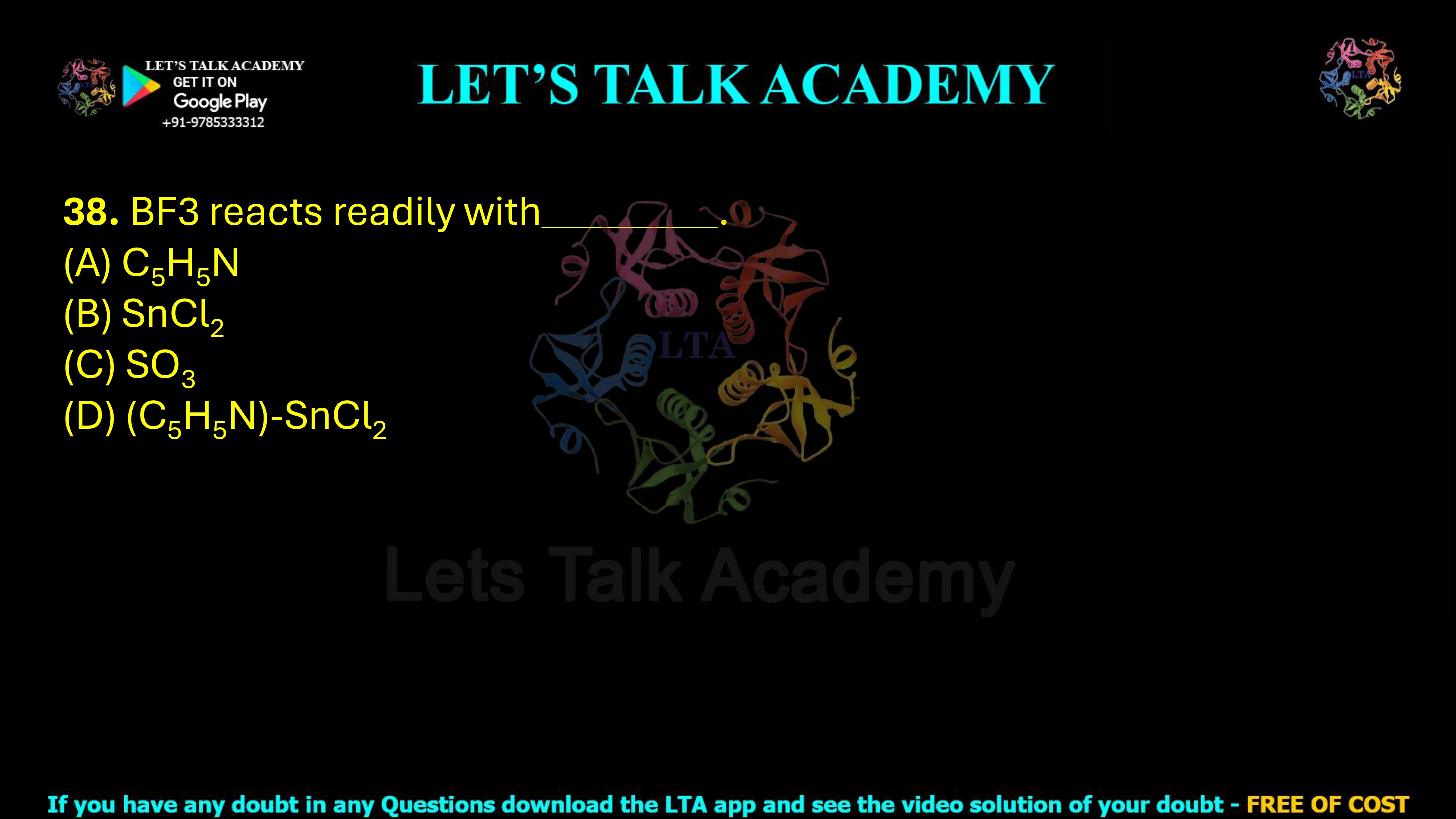
38. BF3 reacts readily with:
(A) C5H5N
(B) SnCl2
(C) SO3
(D) (C5H5N)-SnCl2
BF₃ Reacts Readily With Which Compound? Detailed Lewis Acid-Base Explanation
Correct Answer: Option (A) C5H5N
Why Does BF₃ React Readily With C₅H₅N?
To determine which compound BF3 reacts readily with, we must analyse the reaction using Lewis acid-base theory. Boron trifluoride, BF3, is an electron-deficient molecule and behaves as a Lewis acid. Therefore, it reacts readily with a species capable of donating an electron pair, known as a Lewis base.
Among the given compounds, C5H5N is pyridine. The nitrogen atom of pyridine possesses an available lone pair of electrons that can be donated to the electron-deficient boron atom of BF3. This electron-pair donation produces a stable Lewis acid-base adduct through the formation of a coordinate covalent bond.
Therefore, BF3 reacts readily with pyridine, C5H5N, making Option (A) the correct answer.
Understanding the Lewis Acidic Nature of BF₃
Why Is BF₃ an Electron-Deficient Molecule?
In BF3, the central boron atom has three valence electrons. It forms three covalent bonds with three fluorine atoms. As a result, only six electrons are directly present around the boron atom in the conventional Lewis structure.
Most main-group atoms tend to achieve an octet of eight electrons in their valence shell. However, boron in BF3 has an incomplete octet and can accept an additional pair of electrons from a suitable donor molecule.
According to Lewis acid-base theory, an electron-pair acceptor is called a Lewis acid. Therefore:
BF3 = Electron-pair acceptor = Lewis acid
The vacant orbital associated with the boron centre allows BF3 to accept a lone pair from a suitable Lewis base.
Why Pyridine Is a Lewis Base
Availability of the Nitrogen Lone Pair in C₅H₅N
C5H5N is pyridine, a six-membered aromatic heterocyclic compound containing one nitrogen atom. The nitrogen atom possesses a lone pair of electrons that is available for donation to an electron-deficient species.
The lone pair on pyridine nitrogen does not form part of the aromatic π-electron sextet. Therefore, the nitrogen can donate this electron pair without destroying the aromatic character of the pyridine ring.
According to Lewis theory:
C5H5N = Electron-pair donor = Lewis base
Because BF3 requires an electron pair and pyridine can supply an electron pair, the two compounds react readily with each other.
Formation of the BF₃-Pyridine Adduct
Coordinate Bond Formation Between Nitrogen and Boron
When pyridine approaches BF3, the lone pair of electrons on the nitrogen atom is donated to the electron-deficient boron atom. The resulting bond can be represented as:
C5H5N: + BF3 → C5H5N→BF3
In this reaction, both electrons used to form the new N→B bond originate from the nitrogen atom. A bond formed by the donation of both bonding electrons from one atom is called a coordinate covalent bond or dative bond.
The boron atom accepts the electron pair, while the nitrogen atom donates it. Thus, the reaction is a classic example of Lewis acid-base adduct formation.
Detailed Explanation of Each Option
Option (A): C₅H₅N
C5H5N is pyridine and contains an available lone pair of electrons on nitrogen. This lone pair can be donated directly to the electron-deficient boron atom of BF3. As a result, a stable Lewis acid-base adduct is formed.
The interaction can be represented as:
BF3 + C5H5N → C5H5N→BF3
Therefore, Option (A) is correct.
Option (B): SnCl₂
SnCl2 is not the best electron-pair donor for the electron-deficient BF3 in this comparison. The direct and characteristic reaction expected for BF3 is with a strong Lewis base possessing an easily available lone pair.
Pyridine provides a clearly available nitrogen lone pair and therefore forms a stable donor-acceptor complex with BF3 much more readily. Hence, SnCl2 is not the correct choice.
Option (C): SO₃
SO3 is itself an electron-deficient species and is commonly classified as a Lewis acid. It tends to accept electron pairs from Lewis bases rather than act as the suitable electron-pair donor required by BF3.
Since both BF3 and SO3 primarily behave as Lewis acids, SO3 does not provide the favourable Lewis acid-base combination represented by BF3 and pyridine. Therefore, this option is incorrect.
Option (D): (C₅H₅N)-SnCl₂
In the pyridine-SnCl2 complex represented by (C5H5N)-SnCl2, the donor site of pyridine is already involved in coordination with the tin centre. Its lone pair is therefore not as freely available for direct donation to BF3 as it is in free pyridine.
Free C5H5N provides the most direct and readily available electron-pair donor among the given choices. Therefore, Option (D) is not the correct answer.
Lewis Acid-Base Theory Behind the Reaction
According to Lewis acid-base theory, an acid is a species that accepts an electron pair, while a base is a species that donates an electron pair. This definition explains the reaction between BF3 and pyridine without requiring proton transfer.
In this reaction:
BF3 → Lewis acid because it accepts an electron pair
C5H5N → Lewis base because it donates an electron pair
The electron pair moves from the nitrogen atom of pyridine toward the boron atom of BF3, producing a donor-acceptor complex. The reaction occurs readily because the electron-rich and electron-deficient species complement each other.
Why the Lone Pair of Pyridine Is Available for Bond Formation
The aromatic ring of pyridine contains six π electrons. Five carbon atoms each contribute one electron, while the nitrogen atom contributes one electron from a p orbital to the aromatic π system. The nitrogen lone pair occupies a different orbital and does not participate in the aromatic sextet.
Therefore, the nitrogen lone pair remains available for donation to Lewis acids such as BF3. This explains why pyridine behaves as a Lewis base while retaining its aromatic character during coordinate bond formation.
Final Answer
BF3 is an electron-deficient molecule and acts as a Lewis acid. It reacts readily with an electron-pair donor. Pyridine, C5H5N, contains an available lone pair on nitrogen and acts as a Lewis base.
The nitrogen lone pair is donated to the boron atom to form a coordinate covalent bond:
C5H5N: + BF3 → C5H5N→BF3
Therefore, BF3 reacts readily with C5H5N.
Correct Option: (A) C5H5N


