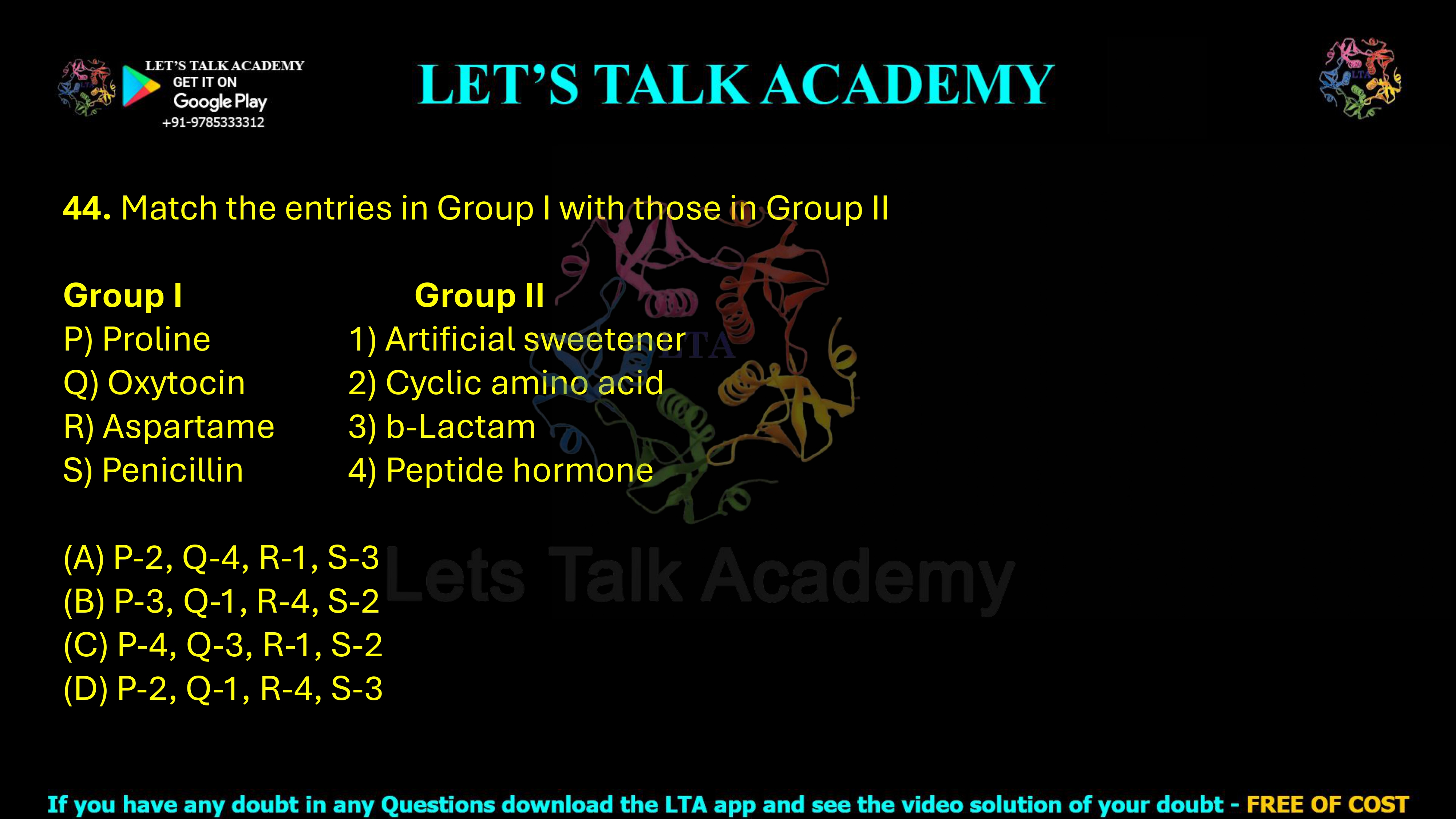
44. Match the entries in Group I with those in Group II.
Group I
P) Proline
Q) Oxytocin
R) Aspartame
S) Penicillin
Group II
1) Artificial sweetener
2) Cyclic amino acid
3) β-Lactam
4) Peptide hormone
(A) P-2, Q-4, R-1, S-3
(B) P-3, Q-1, R-4, S-2
(C) P-4, Q-3, R-1, S-2
(D) P-2, Q-1, R-4, S-3
Match Proline, Oxytocin, Aspartame and Penicillin with Their Correct Groups – Detailed Solution
Correct Answer: Option (A) P-2, Q-4, R-1, S-3
The correct matching is Proline → Cyclic amino acid, Oxytocin → Peptide hormone, Aspartame → Artificial sweetener, and Penicillin → β-lactam. Therefore, the correct combination is P-2, Q-4, R-1, S-3, which corresponds to Option (A).
Each compound in Group I belongs to a distinct and well-known chemical or biological category. Proline is recognized by its characteristic cyclic structure, oxytocin is a peptide hormone, aspartame is widely used as an artificial sweetener, and penicillin contains the important β-lactam ring responsible for its classification as a β-lactam antibiotic.
Understanding the Correct Matching
The most effective way to solve this match-the-following question is to identify the defining structural or biological feature of each compound. The four correct associations are:
P) Proline → 2) Cyclic amino acid
Q) Oxytocin → 4) Peptide hormone
R) Aspartame → 1) Artificial sweetener
S) Penicillin → 3) β-Lactam
Thus, the final matching sequence is:
P-2, Q-4, R-1, S-3
Why Is Proline Matched with a Cyclic Amino Acid?
Structural Characteristic of Proline
Proline is matched with 2) Cyclic amino acid. Proline is one of the standard amino acids found in proteins, but its structure is different from that of most other amino acids. In proline, the side chain bends back and becomes bonded to the nitrogen atom, producing a five-membered ring.
This cyclic structure makes proline structurally rigid. While most amino acids contain a relatively free amino group, the nitrogen atom of proline is incorporated into its ring structure. For this reason, proline is commonly described as a cyclic amino acid.
The rigid ring of proline restricts rotation around the peptide backbone. This property strongly influences protein folding and secondary structure. Proline is often found in bends and turns of proteins and can disrupt regular α-helical structures because of its unusual cyclic geometry.
Therefore:
P) Proline → 2) Cyclic amino acid
Why Is Oxytocin Matched with a Peptide Hormone?
Peptide Nature of Oxytocin
Oxytocin is matched with 4) Peptide hormone. Oxytocin is a biologically active hormone composed of amino acids joined together through peptide bonds. More specifically, it is a nonapeptide because it contains nine amino acid residues.
Oxytocin performs important physiological functions in the human body. It plays a major role in stimulating uterine contractions during childbirth and promoting milk ejection during breastfeeding. Its hormonal activity and peptide composition place it clearly in the category of peptide hormones.
The structure of oxytocin also contains a disulfide linkage between two cysteine residues. This bond contributes to the characteristic cyclic portion of the molecule, but its correct classification in the given question is based on its biological role as a peptide hormone.
Therefore:
Q) Oxytocin → 4) Peptide hormone
Why Is Aspartame Matched with an Artificial Sweetener?
Aspartame as a Sugar Substitute
Aspartame is matched with 1) Artificial sweetener. Aspartame is a low-calorie artificial sweetening agent used as a substitute for ordinary sugar in various food and beverage products.
Chemically, aspartame is derived from two amino acids, aspartic acid and phenylalanine. Despite being related structurally to amino acids, its most important practical classification is as an artificial sweetener.
Aspartame produces an intense sweet taste, which means only a relatively small quantity is required to provide sweetness. This property explains its use in products where sweetness is desired without using a large amount of conventional sugar.
Therefore:
R) Aspartame → 1) Artificial sweetener
Why Is Penicillin Matched with β-Lactam?
The β-Lactam Ring in Penicillin
Penicillin is matched with 3) β-Lactam. Penicillins are an important group of antibiotics characterized by the presence of a β-lactam ring in their molecular structure.
A β-lactam is a four-membered cyclic amide. This highly strained ring is essential for the antibacterial activity of penicillin. The β-lactam ring interacts with bacterial enzymes involved in the formation of the cell wall, thereby interfering with proper bacterial cell-wall synthesis.
Because the β-lactam ring is the defining structural feature of penicillin, penicillin is classified as a β-lactam antibiotic.
Therefore:
S) Penicillin → 3) β-Lactam
Complete Explanation of the Matching Sequence
The first entry, Proline, is identified from its ring-containing amino acid structure and is therefore matched with cyclic amino acid. The second entry, Oxytocin, consists of amino acid residues connected by peptide bonds and functions as a hormone, so it is matched with peptide hormone.
The third entry, Aspartame, is widely recognized as a synthetic sugar substitute and is therefore matched with artificial sweetener. The fourth entry, Penicillin, contains the characteristic four-membered β-lactam ring and is consequently matched with β-lactam.
The complete matching is therefore:
Proline → Cyclic amino acid
Oxytocin → Peptide hormone
Aspartame → Artificial sweetener
Penicillin → β-Lactam
Analysis of All Given Options
Option (A): P-2, Q-4, R-1, S-3
This option correctly matches all four entries. Proline is a cyclic amino acid, oxytocin is a peptide hormone, aspartame is an artificial sweetener, and penicillin belongs to the β-lactam class. Therefore, Option (A) is correct.
Option (B): P-3, Q-1, R-4, S-2
This option is incorrect because proline is not a β-lactam, oxytocin is not an artificial sweetener, aspartame is not a peptide hormone, and penicillin is not classified as a cyclic amino acid.
Option (C): P-4, Q-3, R-1, S-2
This option correctly identifies aspartame as an artificial sweetener but incorrectly matches the remaining entries. Proline is not a peptide hormone, oxytocin is not a β-lactam, and penicillin is not a cyclic amino acid.
Option (D): P-2, Q-1, R-4, S-3
This option correctly matches proline with cyclic amino acid and penicillin with β-lactam. However, it incorrectly interchanges oxytocin and aspartame. Oxytocin is a peptide hormone, whereas aspartame is an artificial sweetener.
Final Answer
The correct matching of Group I with Group II is:
P) Proline → 2) Cyclic amino acid
Q) Oxytocin → 4) Peptide hormone
R) Aspartame → 1) Artificial sweetener
S) Penicillin → 3) β-Lactam
Therefore, the correct sequence is P-2, Q-4, R-1, S-3.
Correct Answer: Option (A)


