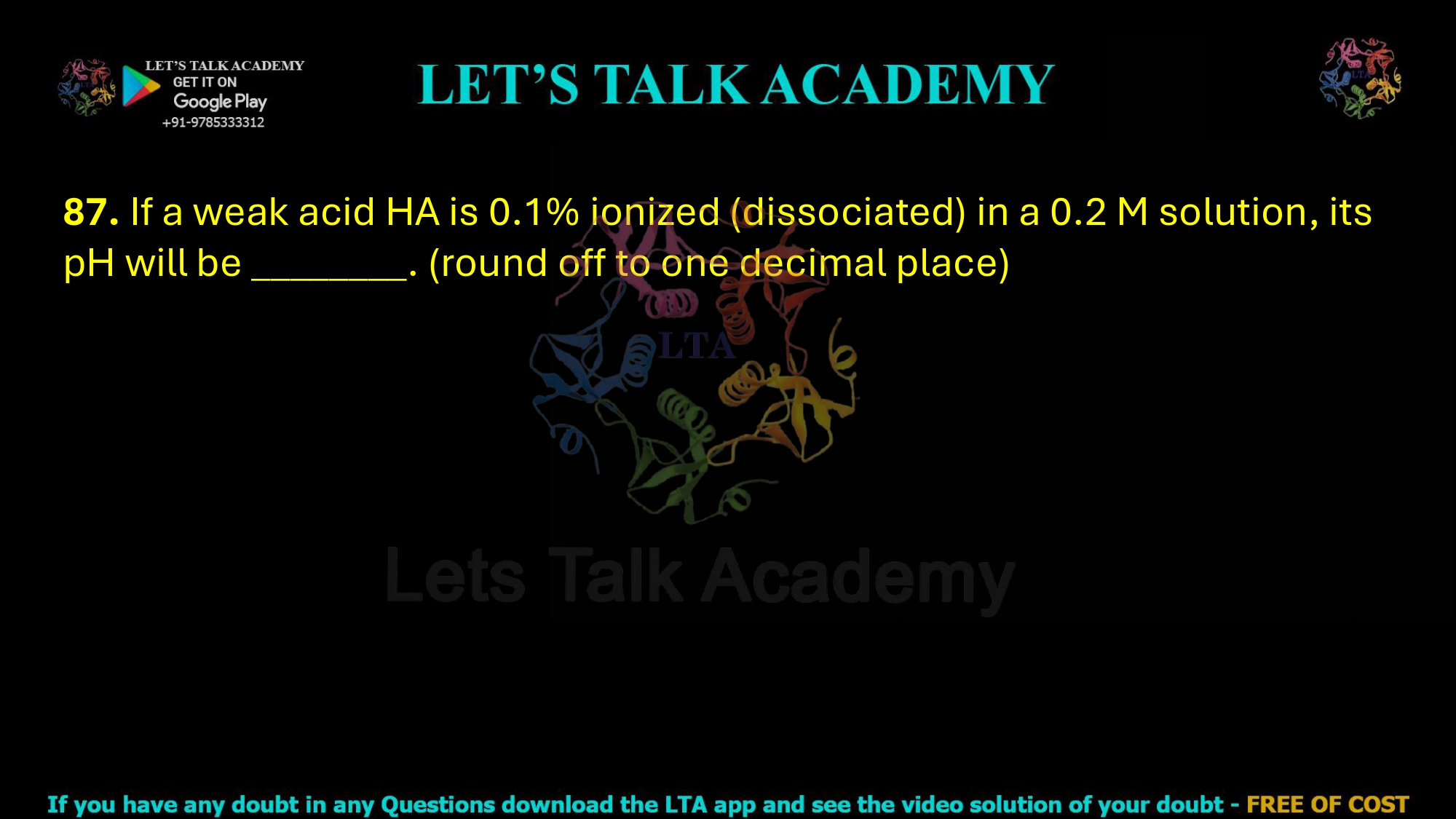
87. If a weak acid HA is 0.1% ionized (dissociated) in a 0.2 M solution, its pH will be ________. (round off to one decimal place)
pH of a Weak Acid with 0.1% Ionization
In this question, instead of providing the acid dissociation constant (Ka), the examiner directly provides the percentage ionization of the weak acid. This allows us to determine the hydrogen ion concentration without using equilibrium calculations. Students who understand the relationship between percentage ionization and hydrogen ion concentration can solve such questions within a minute.
Given Data
- Concentration of weak acid (HA) = 0.2 M
- Percentage ionization = 0.1%
- Find the pH of the solution.
Concept Behind the Question
Weak acids do not dissociate completely in water. Unlike strong acids such as hydrochloric acid or nitric acid, only a small fraction of weak acid molecules release hydrogen ions into the solution. This partial dissociation is known as percentage ionization or percentage dissociation.
The percentage ionization tells us exactly what fraction of the original acid molecules has dissociated into hydrogen ions and conjugate base ions. Once the percentage ionization is known, the concentration of hydrogen ions can be calculated directly without using the acid dissociation constant (Ka).
The mathematical relationship is extremely simple:
Degree of ionization (α) = Percentage ionization / 100
After determining the degree of ionization, the hydrogen ion concentration is obtained using:
[H+] = C × α
where C is the initial concentration of the acid.
Finally, the pH is calculated using the standard definition:
pH = –log[H+]
Step 1: Calculate the Degree of Ionization
The weak acid is 0.1% ionized.
Therefore, the degree of ionization is
α = 0.1 / 100 = 0.001
This means that only one-thousandth of the acid molecules actually dissociate into hydrogen ions, which clearly demonstrates why weak acids produce much lower hydrogen ion concentrations than strong acids.
Step 2: Calculate the Hydrogen Ion Concentration
The concentration of hydrogen ions is calculated using
[H+] = C × α
Substituting the given values,
[H+] = 0.2 × 0.001
[H+] = 2 × 10⁻⁴ M
This value represents the actual concentration of hydrogen ions responsible for the acidity of the solution.
Step 3: Calculate the pH
The pH is defined as the negative logarithm of the hydrogen ion concentration.
pH = –log[H+]
Substituting the calculated hydrogen ion concentration,
pH = –log(2 × 10⁻⁴)
Using logarithmic properties,
pH = –(log 2 + log 10−4)
pH = –(0.3010 − 4)
pH = 3.699
After rounding to one decimal place,
pH = 3.7
Why is the pH Not Extremely Low?
Many students assume that a 0.2 M acid solution should always have a very low pH. This assumption is only true for strong acids that dissociate almost completely. Weak acids ionize only partially, so only a small fraction of the acid molecules contribute hydrogen ions to the solution.
Since only 0.1% of the acid molecules dissociate in this problem, the hydrogen ion concentration becomes much smaller than the initial acid concentration. Consequently, the pH is significantly higher than that of a strong acid having the same molarity.
Physical Significance of Percentage Ionization
Percentage ionization provides a direct measure of the strength of dissociation of an acid under given conditions. A higher percentage ionization indicates that more acid molecules release hydrogen ions, resulting in a lower pH and stronger acidic behavior.
Conversely, a very small percentage ionization indicates that the acid remains largely undissociated. Such acids exhibit relatively higher pH values despite having moderate concentrations.
This relationship explains why acetic acid, carbonic acid, formic acid, and many organic acids behave differently from strong mineral acids like hydrochloric acid or sulfuric acid.
Importance of This Question in Competitive Examinations
Questions involving weak acids and percentage ionization appear regularly in CSIR NET, GATE Chemistry, IIT JAM, MSc entrance examinations, and other competitive chemistry tests. Examiners often provide percentage ionization instead of Ka because it tests conceptual understanding of acid dissociation and logarithmic calculations simultaneously.
Students should be comfortable converting percentage ionization into degree of ionization and then calculating hydrogen ion concentration before determining the pH. Once these steps become familiar, such numerical problems can be solved very quickly.
Key Takeaways
Percentage Ionization Must Always Be Divided by 100
Before performing any calculation, convert the percentage ionization into decimal form by dividing it by 100.
Hydrogen Ion Concentration Depends on the Degree of Ionization
The concentration of hydrogen ions is not equal to the initial acid concentration for weak acids. Only the ionized fraction contributes hydrogen ions.
Weak Acids Produce Higher pH Than Strong Acids
Even at the same concentration, weak acids exhibit much higher pH values because they dissociate only partially in aqueous solution.
Logarithmic Calculations Are Essential
Accurate use of logarithms is necessary while calculating pH. Students should be comfortable using the logarithmic identities involved in pH calculations.
Conclusion
This problem beautifully demonstrates the relationship between percentage ionization and pH of a weak acid. By converting the given percentage ionization into the degree of ionization, calculating the hydrogen ion concentration, and applying the pH equation, we obtain the final answer as 3.7.
Final Answer
The pH of the weak acid solution is:
3.7


