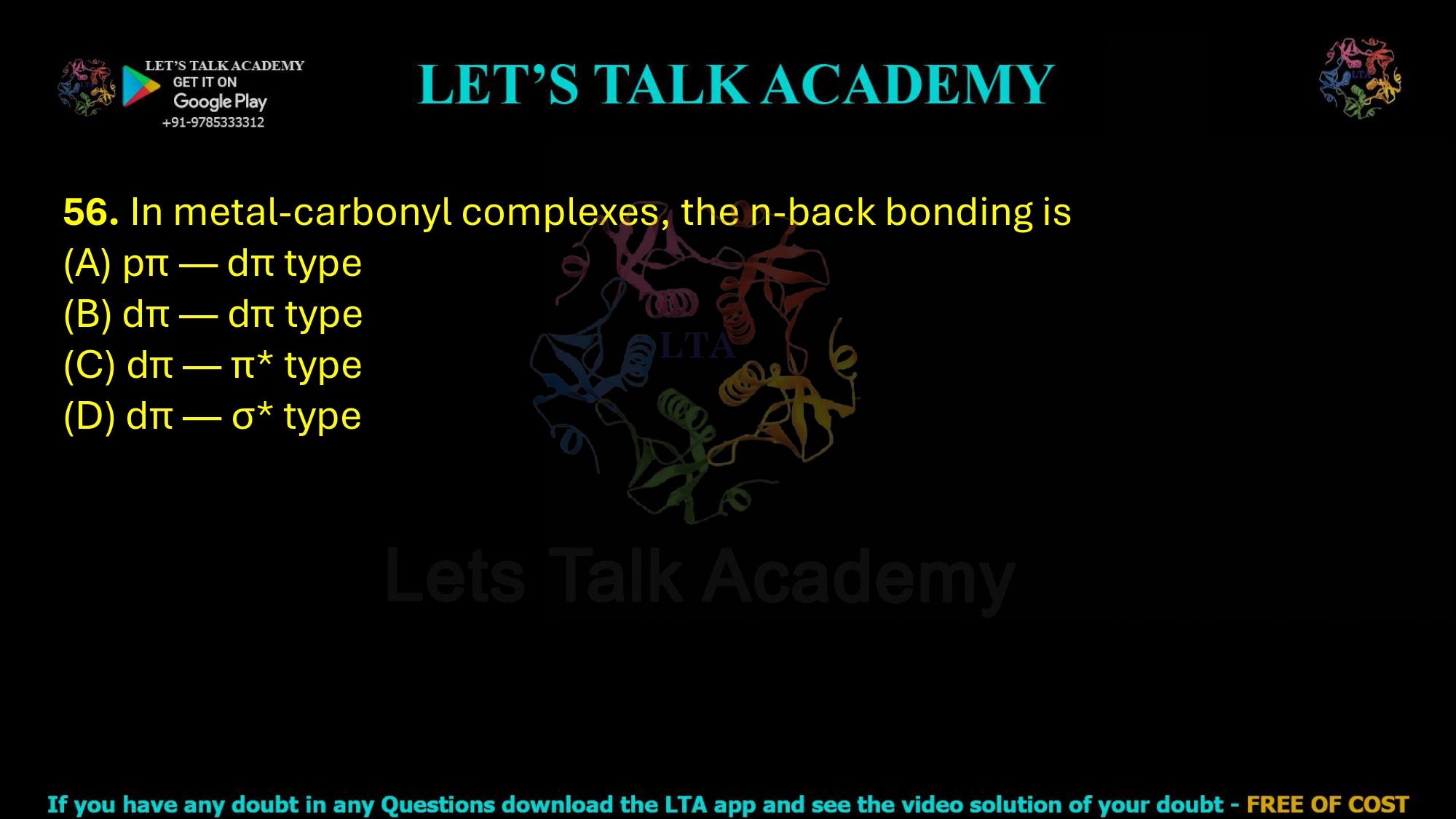
56. In metal-carbonyl complexes, the n-back bonding is
(A) pπ — dπ type
(B) dπ — dπ type
(C) dπ — π* type
(D) dπ — σ* type
π-Back Bonding in Metal Carbonyl Complexes – Complete Explanation with Molecular Orbital Theory
In a metal carbonyl complex, carbon monoxide (CO) acts as a unique ligand. It not only donates electron density to the metal but also accepts electron density back from the metal through its empty antibonding orbitals. This two-way electron flow is known as synergic bonding, making the metal–CO bond exceptionally strong.
Understanding Metal–Carbonyl Bonding
The bonding between a transition metal and carbon monoxide consists of two simultaneous interactions that strengthen each other.
The first interaction is σ-donation, in which the lone pair present on the carbon atom of CO is donated into an empty orbital of the metal. This forms a strong sigma bond between the ligand and the metal.
The second interaction is π-back donation, also called π-back bonding. In this process, electrons from the filled dπ orbitals of the metal are donated into the empty π* (pi antibonding) molecular orbitals of carbon monoxide.
Because both interactions occur simultaneously and reinforce each other, the phenomenon is known as synergic bonding.
Nature of π-Back Bonding
During π-back bonding, the transition metal acts as an electron donor, while the carbon monoxide ligand behaves as an electron acceptor.
The electrons move from
Filled metal dπ orbitals → Empty ligand π* antibonding orbitals
Therefore, the correct interaction is
dπ → π*
This interaction strengthens the metal–carbon bond while simultaneously weakening the carbon–oxygen bond because electrons are added into the antibonding orbital of CO.
Consequences of π-Back Bonding
The presence of π-back bonding produces several important experimental observations. The metal–carbon bond becomes stronger and shorter because of increased electron sharing between the metal and carbon atom.
At the same time, the C–O bond becomes weaker and slightly longer because electrons occupy the antibonding π* orbital of carbon monoxide.
As a result, the C–O stretching frequency observed in infrared spectroscopy decreases compared with free carbon monoxide. This decrease in IR stretching frequency is one of the strongest experimental evidences for π-back bonding.
Explanation of Every Option
Option (A): pπ – dπ Type
This option is incorrect. This type of interaction generally describes π-bonding between p orbitals of ligands and d orbitals of metals in compounds involving halides or oxygen-containing ligands. In metal carbonyl complexes, back donation specifically involves the ligand’s antibonding π* molecular orbital rather than a filled p orbital.
Option (B): dπ – dπ Type
This option is incorrect because carbon monoxide does not possess occupied d orbitals capable of participating in dπ–dπ overlap. Carbon monoxide is composed only of carbon and oxygen atoms, whose valence orbitals are s and p orbitals.
Option (C): dπ – π* Type
This is the correct answer. The filled dπ orbitals of the transition metal donate electron density into the empty π* antibonding molecular orbitals of carbon monoxide. This back donation strengthens the metal–carbon bond while weakening the carbon–oxygen bond, producing the characteristic properties of metal carbonyl complexes.
Option (D): dπ – σ* Type
This option is incorrect because the σ* antibonding orbital of carbon monoxide is much higher in energy and is not involved in normal metal–ligand bonding. Back donation specifically occurs into the lower-energy π* antibonding orbital.
Why Carbon Monoxide is an Excellent Ligand
Carbon monoxide is classified as both a strong σ-donor and a strong π-acceptor ligand. The lone pair on carbon forms a strong sigma bond with the metal, while the empty π* orbitals efficiently accept electron density from the metal through back bonding. This dual behavior produces exceptionally stable transition metal carbonyl complexes and explains why CO occupies a high position in the spectrochemical series.
Final Answer
Correct Option: (C)
π-Back Bonding = dπ → π*


