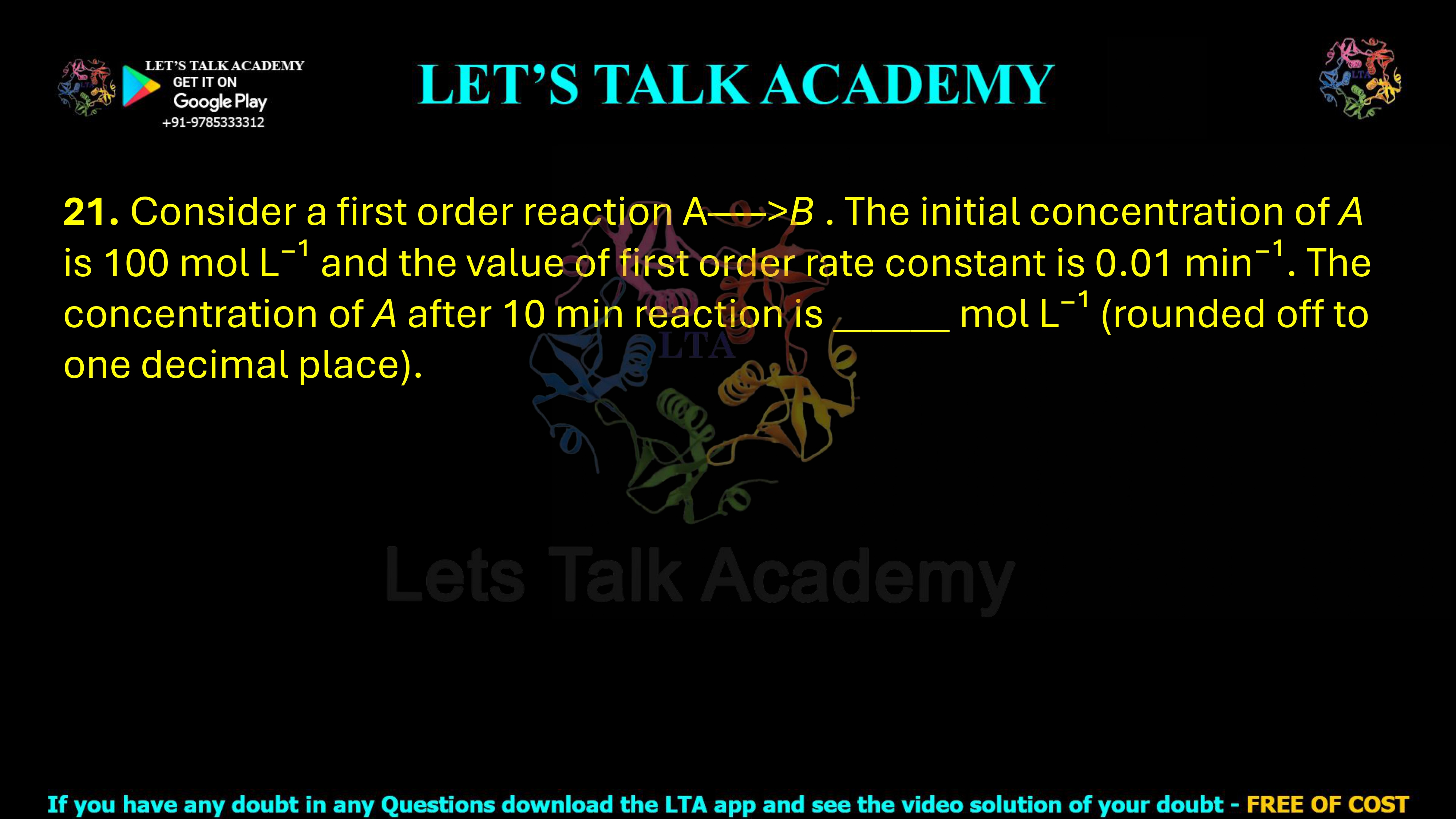
21. Consider a first order reaction A → B. The initial concentration of A is 100 mol L−1 and the value of the first order rate constant is 0.01 min−1. The concentration of A after 10 min reaction is _____ mol L−1, rounded off to one decimal place.
How to Calculate Concentration After 10 Minutes in a First Order Reaction
Correct Answer: 90.5 mol L−1
The first order reaction concentration calculation can be performed using the integrated rate law for a first order reaction. In the given reaction A → B, the concentration of reactant A decreases exponentially with time. The initial concentration of A is 100 mol L−1, the rate constant is 0.01 min−1, and the reaction time is 10 minutes.
Substituting these values into the first order integrated rate equation gives the concentration of A after 10 minutes as approximately 90.4837 mol L−1. After rounding to one decimal place, the required answer is 90.5 mol L−1.
Understanding the First Order Reaction
What Is a First Order Reaction?
A first order reaction is a chemical reaction in which the rate of reaction is directly proportional to the concentration of one reactant raised to the first power. For the reaction A → B, the rate law can be written as:
Rate = k[A]
Here, k is the first order rate constant and [A] is the concentration of reactant A at a particular time. As the concentration of A decreases during the reaction, the reaction rate also decreases proportionally.
The unit of a first order rate constant is inverse time. Since the given rate constant is 0.01 min−1, the time must be used in minutes. The given reaction time of 10 minutes is already in the correct unit, so no time conversion is required.
Step-by-Step Solution of the First Order Reaction Problem
Step 1: Write the Integrated Rate Law
For a first order reaction, the concentration of the reactant remaining after time t is calculated using the exponential form of the integrated rate law:
[A]t = [A]0e−kt
In this equation, [A]0 represents the initial concentration of A, [A]t represents the concentration of A after time t, k is the first order rate constant, and t is the reaction time.
This equation shows that the concentration of a reactant undergoing first order decay decreases exponentially rather than linearly with time.
Step 2: Identify the Given Values
The values provided in the question are:
Initial concentration, [A]0 = 100 mol L−1
Rate constant, k = 0.01 min−1
Time, t = 10 min
Since the rate constant is expressed in min−1 and the reaction time is given in minutes, the units are consistent and can be directly substituted into the first order rate equation.
Step 3: Substitute the Values into the First Order Equation
Using the equation:
[A]t = [A]0e−kt
Substituting the given values:
[A]t = 100 × e−(0.01)(10)
Multiplying the rate constant and time:
kt = 0.01 × 10 = 0.1
Therefore:
[A]t = 100 × e−0.1
Step 4: Calculate the Exponential Value
The value of e−0.1 is approximately:
e−0.1 ≈ 0.904837
Therefore:
[A]t = 100 × 0.904837
[A]t = 90.4837 mol L−1
The question asks for the answer rounded off to one decimal place. Therefore:
[A]t = 90.5 mol L−1
Alternative Solution Using the Logarithmic First Order Rate Equation
The same problem can also be solved using the logarithmic form of the integrated first order rate law:
ln([A]0/[A]t) = kt
Substituting the given values:
ln(100/[A]t) = 0.01 × 10
Therefore:
ln(100/[A]t) = 0.1
Taking the exponential on both sides:
100/[A]t = e0.1
Rearranging the equation:
[A]t = 100/e0.1
Since e0.1 ≈ 1.10517:
[A]t = 100/1.10517 = 90.4837 mol L−1
After rounding to one decimal place:
[A]t = 90.5 mol L−1
Why the Concentration Decreases Exponentially
In a first order reaction, the reaction rate at any instant depends on the concentration of the reactant remaining at that instant. At the beginning of the reaction, the concentration of A is high, so the reaction proceeds at a relatively higher rate. As A is consumed, its concentration decreases and the reaction rate also becomes lower.
Because the rate continuously changes with the concentration of A, equal amounts of reactant are not consumed in equal time intervals. Instead, an equal fraction of the reactant is consumed during equal time intervals. This behavior produces the exponential concentration-time relationship represented by [A]t = [A]0e−kt.
Fraction of Reactant A Remaining After 10 Minutes
The fraction of reactant remaining in a first order reaction is given by:
[A]t/[A]0 = e−kt
For the given reaction:
[A]t/[A]0 = e−0.1 = 0.904837
This means that approximately 90.48% of the original reactant A remains after 10 minutes. Since the initial concentration is 100 mol L−1, the remaining concentration is approximately 90.48 mol L−1.
Concentration of A Consumed During the Reaction
The amount of A consumed can be calculated by subtracting the final concentration from the initial concentration:
Concentration consumed = [A]0 − [A]t
Concentration consumed = 100 − 90.4837
Concentration consumed = 9.5163 mol L−1
Therefore, approximately 9.52 mol L−1 of A has reacted during the first 10 minutes, while approximately 90.48 mol L−1 remains unreacted.
Importance of Matching the Units of Rate Constant and Time
The exponent kt in the first order equation must always be dimensionless. Therefore, the unit of time must correspond to the time unit used in the rate constant. In this question, k is given in min−1 and t is given in minutes.
Thus:
(0.01 min−1)(10 min) = 0.1
The minute units cancel, leaving a dimensionless exponent. This confirms that the values have been substituted using consistent units.
Complete Calculation in One Expression
The complete first order concentration calculation can be written directly as:
[A]t = 100 × e−(0.01 × 10)
[A]t = 100 × e−0.1
[A]t = 100 × 0.904837
[A]t = 90.4837 mol L−1
Rounded off to one decimal place:
[A]t = 90.5 mol L−1
Final Answer
For the first order reaction A → B, the concentration of reactant A after time t is calculated using the integrated rate equation [A]t = [A]0e−kt. Substituting the initial concentration of 100 mol L−1, rate constant of 0.01 min−1, and reaction time of 10 minutes gives a concentration of 90.4837 mol L−1.
Therefore, the concentration of A after 10 minutes, rounded off to one decimal place, is 90.5 mol L−1.
Correct Answer: 90.5 mol L−1


