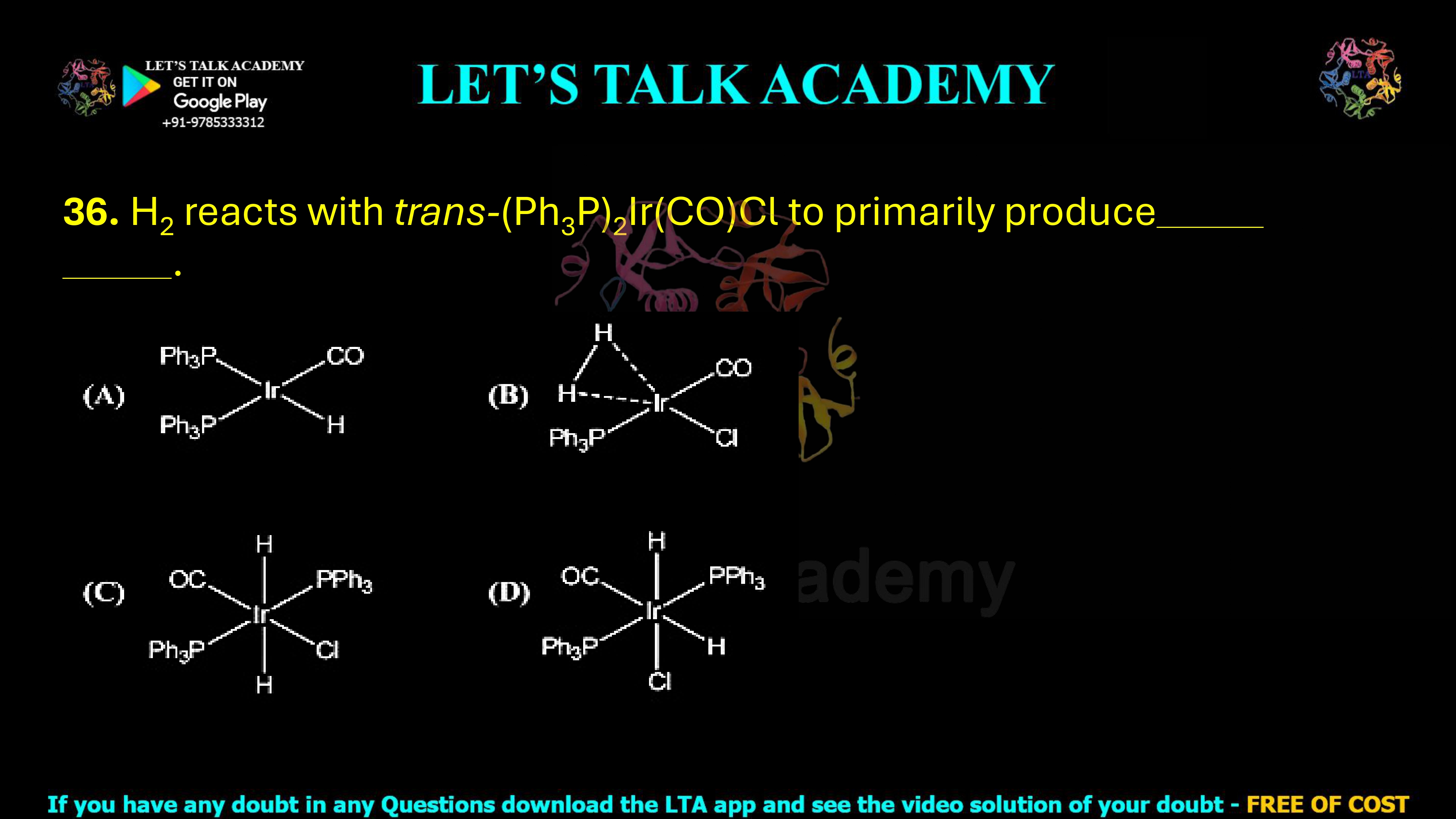
36. H2 reacts with trans-(Ph3P)2Ir(CO)Cl to primarily produce _____.
Primary Product Formed When H2 Reacts with trans-(Ph3P)2Ir(CO)Cl
Correct Answer: Option (D)
The complex trans-(Ph3P)2Ir(CO)Cl is the well-known Vaska’s complex. It is a square-planar, 16-electron Ir(I) complex that readily undergoes oxidative addition reactions. When molecular hydrogen, H2, reacts with Vaska’s complex, the H–H bond is cleaved and both hydrogen atoms are added to the iridium center as hydride ligands.
The reaction converts the four-coordinate Ir(I) complex into a six-coordinate Ir(III) dihydride complex. The two newly introduced hydride ligands occupy cis positions in the primary oxidative-addition product. Among the structures shown, option (D) correctly represents the octahedral iridium(III) dihydride product formed by oxidative addition of H2.
Understanding Vaska’s Complex
Structure of trans-(Ph3P)2Ir(CO)Cl
Vaska’s complex has the formula trans-[IrCl(CO)(PPh3)2]. The central iridium atom is bonded to one chloride ligand, one carbonyl ligand, and two triphenylphosphine ligands. The two PPh3 ligands are trans to each other, while the CO and Cl ligands are also trans to each other.
The complex has a square-planar geometry around iridium. This geometry is characteristic of many d8 transition-metal complexes, particularly those containing metals such as Rh(I), Ir(I), Pd(II), and Pt(II).
The arrangement of the starting complex can be represented as:
PPh3 trans to PPh3
CO trans to Cl
The coordinatively unsaturated 16-electron nature of Vaska’s complex makes it particularly reactive toward small molecules such as H2, O2, CH3I, and other molecules capable of undergoing oxidative addition.
Step-by-Step Analysis of the Reaction with H2
Step 1: Identify the Type of Organometallic Reaction
The reaction of H2 with Vaska’s complex is an example of oxidative addition. During oxidative addition, a molecule of the general type A–B approaches a metal center, the A–B bond is broken, and both A and B become directly bonded to the metal.
The general oxidative addition reaction can be represented as:
LnM + A–B → LnM(A)(B)
In the present reaction:
A–B = H–H
Therefore:
trans-[IrCl(CO)(PPh3)2] + H2 → [IrH2Cl(CO)(PPh3)2]
The H–H sigma bond is broken, and two Ir–H bonds are formed.
Step 2: Determine the Oxidation State of Iridium Before the Reaction
In the starting complex, the two PPh3 ligands and the CO ligand are neutral. The chloride ligand carries a −1 charge. Since the complete complex is neutral, the oxidation state of iridium must be +1.
Let the oxidation state of iridium be x:
x + (−1) = 0
Therefore:
x = +1
Thus, the starting metal center is Ir(I).
Step 3: Determine the Oxidation State After H2 Addition
During oxidative addition, molecular hydrogen is converted into two hydride ligands. Each hydride ligand is formally assigned a charge of −1.
In the product, the anionic ligands are:
One Cl− ligand = −1
Two H− ligands = −2
The total ligand charge is therefore −3. Since the overall complex remains neutral, iridium must have an oxidation state of +3.
Therefore:
Ir(I) → Ir(III)
The oxidation state of the metal increases by two units, which is a defining characteristic of an oxidative addition reaction.
Change in Coordination Number During the Reaction
Before reaction with H2, Vaska’s complex contains four ligands directly bonded to iridium:
2 PPh3 + 1 CO + 1 Cl = coordination number 4
After oxidative addition, two additional hydride ligands become bonded to iridium:
2 PPh3 + 1 CO + 1 Cl + 2 H = coordination number 6
Therefore, the coordination number increases from 4 to 6:
Coordination number: 4 → 6
The geometry consequently changes from square planar to octahedral.
Change in Geometry from Square Planar to Octahedral
The starting Ir(I) complex is a four-coordinate square-planar complex. After the addition of two hydride ligands, the product becomes a six-coordinate Ir(III) complex.
A six-coordinate transition-metal complex generally adopts an octahedral geometry. Therefore:
Square-planar Ir(I) complex → Octahedral Ir(III) complex
The two hydrogen atoms introduced by oxidative addition become hydride ligands attached directly to the iridium center. In the primary product, these newly added hydrides occupy cis positions.
Why the Two Hydride Ligands Are Cis in the Primary Product
Molecular hydrogen approaches the electron-rich iridium center and interacts with the metal before complete cleavage of the H–H bond. The metal donates electron density into the antibonding orbital of H2, weakening the H–H bond, while the H2 sigma bond simultaneously interacts with an available metal orbital.
As the H–H bond undergoes oxidative cleavage, the two hydrogen atoms are delivered to neighboring coordination positions at the metal center. Consequently, the initial oxidative-addition product contains two cis hydride ligands.
Option (D) shows this required relationship. One hydride occupies an axial position and the second occupies an adjacent equatorial position, making the two Ir–H bonds cis to each other.
Electron Count of Vaska’s Complex Before H2 Addition
Vaska’s complex is a 16-electron complex. Using the ionic electron-counting method, Ir(I) is a d8 metal center.
The electron contributions are:
Ir(I) = d8 = 8 electrons
2 PPh3 ligands = 4 electrons
1 CO ligand = 2 electrons
1 Cl− ligand = 2 electrons
Therefore:
Total electron count = 8 + 4 + 2 + 2 = 16 electrons
The 16-electron configuration leaves Vaska’s complex coordinatively and electronically capable of reacting with an incoming molecule such as H2.
Electron Count After Oxidative Addition of H2
After oxidative addition, the iridium oxidation state becomes +3. Ir(III) is a d6 metal center. The ligand electron contributions in the product are:
Ir(III) = d6 = 6 electrons
2 PPh3 ligands = 4 electrons
1 CO ligand = 2 electrons
1 Cl− ligand = 2 electrons
2 H− ligands = 4 electrons
Therefore:
Total electron count = 6 + 4 + 2 + 2 + 4 = 18 electrons
The product is therefore a stable 18-electron octahedral Ir(III) dihydride complex.
Overall Changes During the Oxidative Addition
The reaction produces several characteristic changes at the metal center:
Oxidation state: Ir(I) → Ir(III)
Coordination number: 4 → 6
Electron count: 16 electrons → 18 electrons
Geometry: Square planar → Octahedral
H–H bond: Broken
New bonds formed: Two Ir–H bonds
These changes collectively confirm that the reaction is an oxidative addition of molecular hydrogen.
Detailed Analysis of the Given Options
Option (A)
Option (A) does not represent the correct oxidative-addition product because it does not contain two hydride ligands attached to iridium. Oxidative addition of H2 must ultimately generate two Ir–H bonds in the dihydride product.
Therefore, option (A) is incorrect.
Option (B)
Option (B) represents a species in which the hydrogen molecule is associated with the iridium center without being represented as the fully formed octahedral cis-dihydride product. Such H2-metal interactions can be important in understanding the pathway of hydrogen activation, but this structure is not the primary final oxidative-addition product required in the question.
Therefore, option (B) is incorrect.
Option (C)
Option (C) shows the two hydride ligands in positions opposite to each other. This corresponds to a trans relationship between the hydrides.
The primary product formed by oxidative addition of H2 to the square-planar Vaska’s complex contains the newly added hydride ligands in cis positions. Therefore, the trans-dihydride arrangement shown in option (C) does not represent the required primary product.
Therefore, option (C) is incorrect.
Option (D)
Option (D) correctly shows an octahedral iridium complex containing the original CO, Cl, and two PPh3 ligands together with two newly introduced hydride ligands.
Most importantly, the two hydride ligands occupy adjacent positions and are therefore cis to each other. This is the expected primary product of oxidative addition of H2 to Vaska’s complex.
Therefore, option (D) is correct.
Complete Reaction
The overall reaction can be represented as:
trans-[IrCl(CO)(PPh3)2] + H2 → cis-[IrH2Cl(CO)(PPh3)2]
In this reaction, the H–H bond is oxidatively added across the Ir(I) center to form two Ir–H bonds. The product is an octahedral Ir(III) dihydride complex.
Why Vaska’s Complex Readily Activates Molecular Hydrogen
Vaska’s complex is particularly effective in oxidative addition because the Ir(I) center is electron rich and has a 16-electron configuration. The phosphine and carbonyl ligands help control the electronic environment of the metal, while the square-planar structure provides access for an incoming substrate.
Molecular hydrogen can approach the iridium center and interact with the available metal orbitals. Electron donation from the H–H sigma bond to the metal and back-donation from the metal into the H–H antibonding orbital weaken the hydrogen-hydrogen bond. Continued interaction results in complete H–H bond cleavage and formation of two metal-hydride bonds.
This ability to activate H2 is one reason why oxidative addition and reductive elimination are fundamental steps in many homogeneous catalytic cycles.
Final Answer
trans-(Ph3P)2Ir(CO)Cl, or Vaska’s complex, is a square-planar 16-electron Ir(I) complex. On reaction with H2, it undergoes oxidative addition. The H–H bond is cleaved, two Ir–H bonds are formed, the oxidation state of iridium increases from +1 to +3, the coordination number increases from 4 to 6, and the geometry changes from square planar to octahedral.
The two newly added hydride ligands occupy cis positions in the primary oxidative-addition product. Among the given structures, this arrangement is correctly represented by option (D).
Correct Answer: Option (D)


