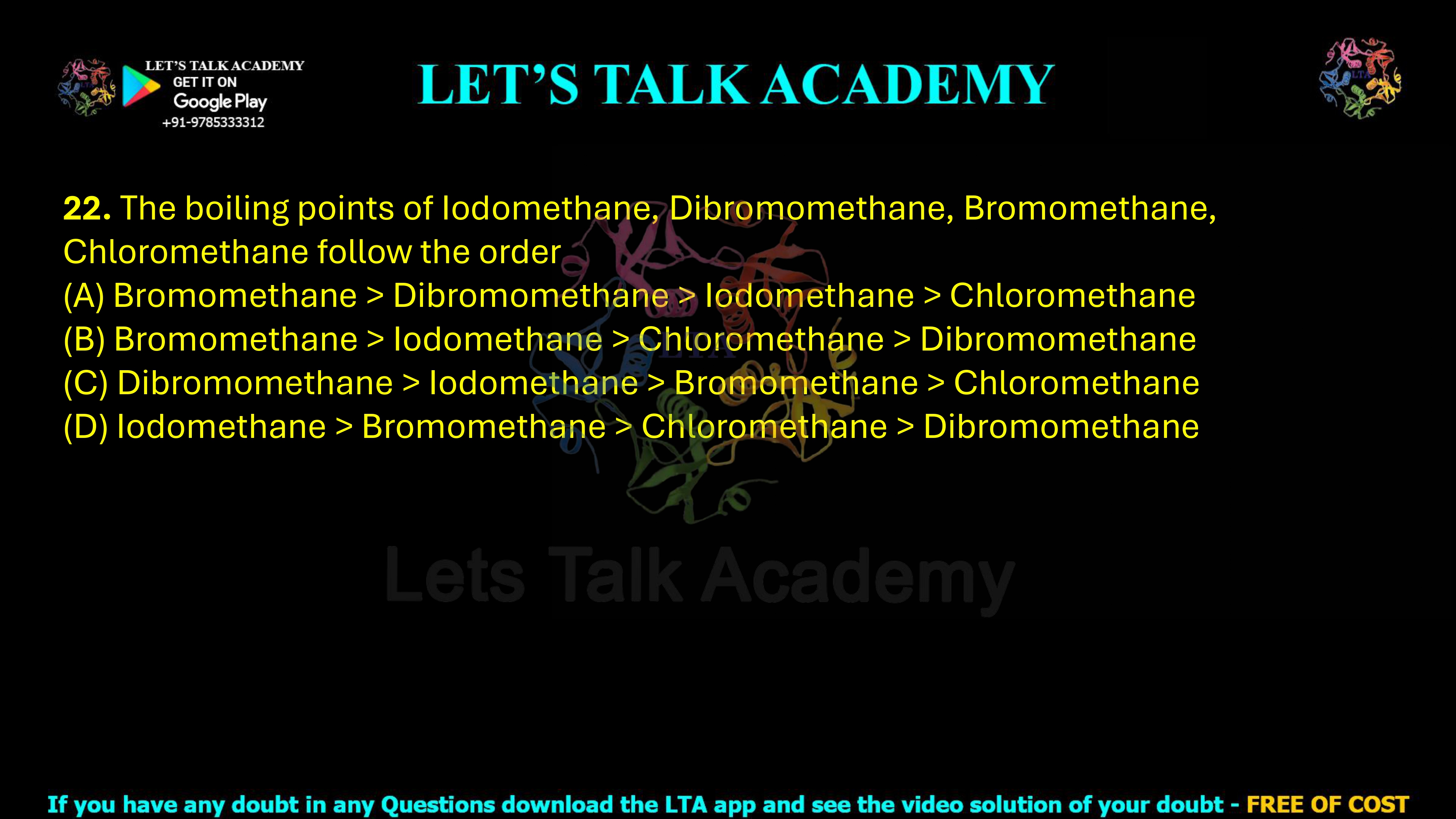
22. The boiling points of iodomethane, dibromomethane, bromomethane, and chloromethane follow which order?
What Is the Correct Boiling Point Order of Iodomethane, Dibromomethane, Bromomethane and Chloromethane?
Correct Answer: Option (C) – Dibromomethane > Iodomethane > Bromomethane > Chloromethane
Detailed Explanation of the Boiling Point Order
To arrange iodomethane (CH3I), dibromomethane (CH2Br2), bromomethane (CH3Br), and chloromethane (CH3Cl) according to their boiling points, we need to compare the overall strength of the intermolecular forces operating between their molecules. The most important factors in this series are molecular size, molecular mass, number of electrons, and polarizability of the electron cloud.
The correct decreasing order of boiling points is:
CH2Br2 > CH3I > CH3Br > CH3Cl
Therefore:
Dibromomethane > Iodomethane > Bromomethane > Chloromethane
Hence, Option (C) is the correct answer.
Why Do These Compounds Have Different Boiling Points?
The boiling point of a molecular substance depends primarily on the amount of energy required to separate its molecules from one another and convert the liquid into the gaseous state. Stronger intermolecular attractions require more thermal energy to overcome, resulting in a higher boiling point.
The compounds given in this question do not form conventional intermolecular hydrogen bonds because they do not contain hydrogen atoms directly bonded to highly electronegative atoms such as oxygen, nitrogen, or fluorine. Therefore, their boiling point differences are mainly controlled by London dispersion forces, along with contributions from permanent molecular dipoles.
For this series, the increase in molecular size and polarizability has a particularly strong influence. Larger and more easily distorted electron clouds produce stronger instantaneous dipoles and stronger London dispersion forces. As a result, compounds with greater polarizability generally have higher boiling points.
Understanding London Dispersion Forces in Haloalkanes
London dispersion forces arise from temporary fluctuations in the distribution of electrons around atoms and molecules. At any instant, the electron cloud may become unevenly distributed, creating a temporary dipole. This temporary dipole can induce another dipole in a neighbouring molecule, producing an attractive intermolecular force.
The strength of these forces increases when the electron cloud becomes larger and more easily distorted. This property is called polarizability. Heavy halogen atoms such as bromine and iodine possess large electron clouds and many electrons, so compounds containing these atoms generally experience stronger dispersion forces than corresponding compounds containing lighter halogens.
This concept explains why simply comparing molecular polarity is not enough to determine the correct boiling point order in this question.
Boiling Point of Chloromethane
Chloromethane has the molecular formula CH3Cl. Among the four compounds given, it has the smallest molecular mass and the least polarizable electron cloud. Chlorine is smaller and less polarizable than bromine and iodine.
Because the intermolecular dispersion forces between chloromethane molecules are relatively weak, less energy is required to separate the molecules during boiling. Therefore, chloromethane has the lowest boiling point among the compounds listed.
Its boiling point is approximately:
CH3Cl ≈ −24 °C
Why Does Bromomethane Have a Higher Boiling Point Than Chloromethane?
Bromomethane has the molecular formula CH3Br. Replacing chlorine with bromine increases the molecular mass, the number of electrons, and the polarizability of the molecule.
The electron cloud of bromine is larger and more easily distorted than that of chlorine. Consequently, bromomethane molecules experience stronger London dispersion forces than chloromethane molecules. More energy is therefore required to separate bromomethane molecules from one another.
Thus:
CH3Br > CH3Cl
The boiling point of bromomethane is approximately:
CH3Br ≈ 4 °C
Why Does Iodomethane Have a Higher Boiling Point Than Bromomethane?
Iodomethane has the molecular formula CH3I. Iodine is larger and much more polarizable than bromine. Its electron cloud contains more electrons and can be distorted more easily, producing stronger instantaneous dipoles.
As a result, the London dispersion forces between iodomethane molecules are stronger than those between bromomethane molecules. Therefore, iodomethane requires more energy for vaporization and has a considerably higher boiling point.
Thus:
CH3I > CH3Br
The boiling point of iodomethane is approximately:
CH3I ≈ 42 °C
Why Does Dibromomethane Have the Highest Boiling Point?
Dibromomethane has the molecular formula CH2Br2. Unlike bromomethane, which contains only one bromine atom, dibromomethane contains two bromine atoms. This significantly increases the molecular mass, total number of electrons, and overall polarizability of the molecule.
The presence of two large bromine atoms produces much stronger London dispersion forces between dibromomethane molecules. Consequently, considerably more thermal energy is required to overcome these intermolecular attractions and convert the liquid into the gaseous state.
Therefore, dibromomethane has the highest boiling point among the four compounds:
CH2Br2 > CH3I
The boiling point of dibromomethane is approximately:
CH2Br2 ≈ 97 °C
Comparison of the Approximate Boiling Points
The correct order becomes very clear when the approximate boiling points are compared directly:
CH2Br2 ≈ 97 °C
CH3I ≈ 42 °C
CH3Br ≈ 4 °C
CH3Cl ≈ −24 °C
Arranging these values from the highest boiling point to the lowest gives:
CH2Br2 > CH3I > CH3Br > CH3Cl
Therefore, the correct sequence is:
Dibromomethane > Iodomethane > Bromomethane > Chloromethane
Role of Molecular Mass in the Boiling Point Order
Molecular mass is an important indicator when comparing structurally related molecules because heavier molecules generally contain more electrons and have more polarizable electron clouds. Greater polarizability usually produces stronger London dispersion forces and a higher boiling point.
The approximate molar masses of the compounds follow the order:
CH2Br2 > CH3I > CH3Br > CH3Cl
This trend agrees with the observed boiling point order. Dibromomethane is the heaviest and most strongly polarizable compound in the series, while chloromethane is the lightest and least polarizable.
Why Molecular Polarity Alone Cannot Predict the Correct Order
It may be tempting to compare only the permanent dipole moments of the compounds, but this approach can lead to an incorrect answer. Boiling point depends on the total intermolecular attraction, not on a single molecular property.
For heavier haloalkanes, London dispersion forces become increasingly important because large halogen atoms possess highly polarizable electron clouds. Therefore, even if a lighter molecule has a significant permanent dipole, a heavier and more polarizable molecule may still have a much higher boiling point due to stronger overall intermolecular forces.
For the compounds in this question, the increase in molecular size and polarizability correctly explains the sequence:
CH2Br2 > CH3I > CH3Br > CH3Cl
Explanation of All Answer Options
Option (A): Bromomethane > Dibromomethane > Iodomethane > Chloromethane
Option (A) is incorrect because bromomethane cannot have a higher boiling point than dibromomethane. Dibromomethane contains two highly polarizable bromine atoms and has much stronger London dispersion forces. Therefore, dibromomethane must have a significantly higher boiling point than bromomethane.
Option (B): Bromomethane > Iodomethane > Chloromethane > Dibromomethane
Option (B) is incorrect because it places dibromomethane at the end of the sequence. In reality, dibromomethane has the highest boiling point among the given compounds. The option also incorrectly places bromomethane above iodomethane, even though iodomethane is larger and more polarizable.
Option (C): Dibromomethane > Iodomethane > Bromomethane > Chloromethane
Option (C) is correct. Dibromomethane has the highest boiling point because of its large molecular mass and strong polarizability. It is followed by iodomethane, bromomethane, and chloromethane. Therefore, the correct decreasing order is CH2Br2 > CH3I > CH3Br > CH3Cl.
Option (D): Iodomethane > Bromomethane > Chloromethane > Dibromomethane
Option (D) is incorrect because it places dibromomethane at the lowest position. Dibromomethane actually has the strongest intermolecular dispersion forces and the highest boiling point among all four compounds. Therefore, it must appear first in the decreasing order.
Final Answer
The correct answer is Option (C): Dibromomethane > Iodomethane > Bromomethane > Chloromethane. The boiling point increases mainly with increasing molecular size, number of electrons, and polarizability. Dibromomethane has the strongest London dispersion forces and therefore the highest boiling point, while chloromethane has the weakest intermolecular attractions and the lowest boiling point. Hence, the correct order is CH2Br2 > CH3I > CH3Br > CH3Cl.


