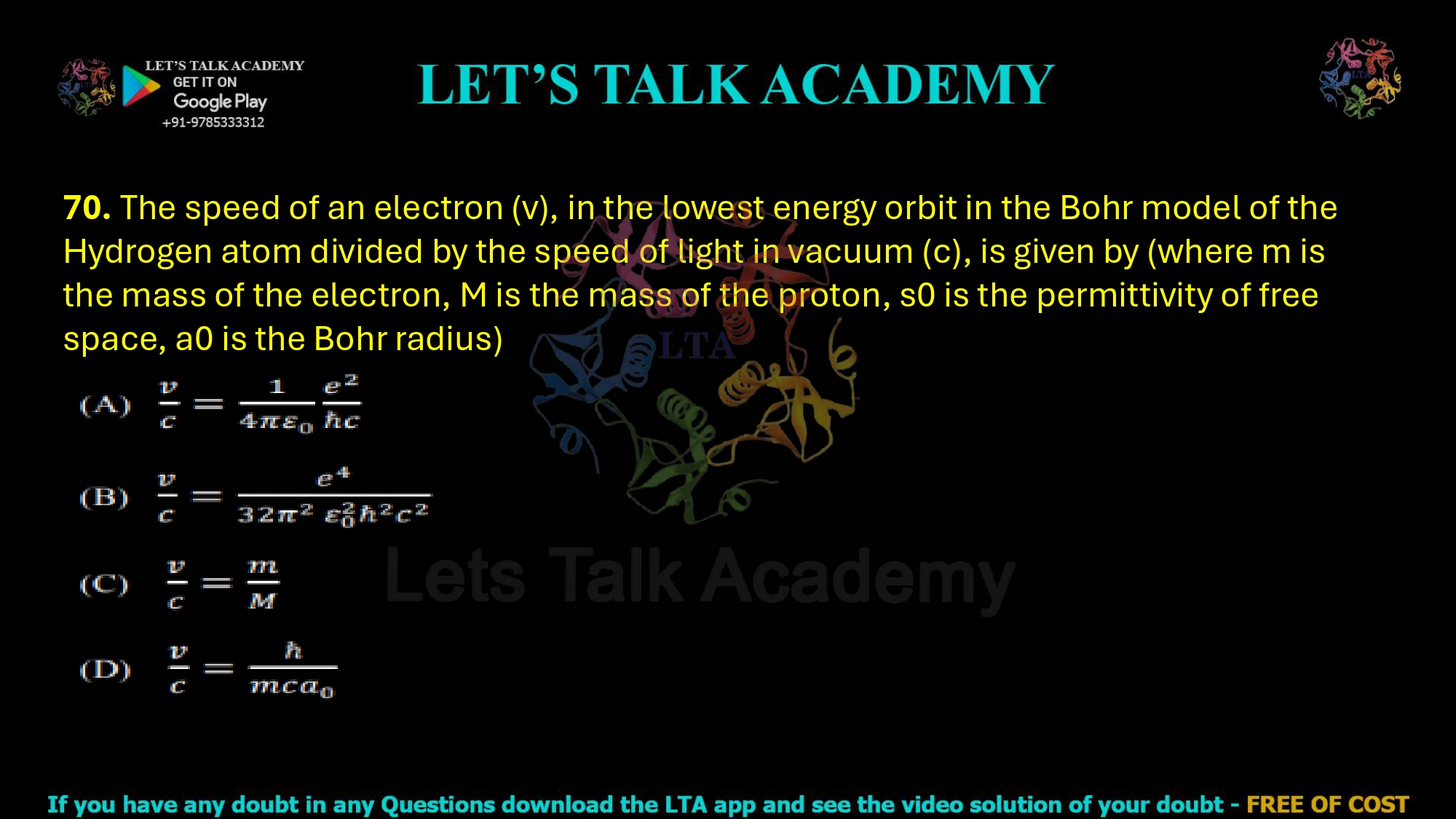
70. The speed of an electron (v), in the lowest energy orbit in the Bohr model of the Hydrogen atom divided by the speed of light in vacuum (c), is given by (where m is the mass of the electron, M is the mass of the proton, s0 is the permittivity of free space, a0 is the Bohr radius)
Speed of an Electron in the First Bohr Orbit Divided by the Speed of Light (Bohr Model)
Correct Answer
✅ Correct Option: (A)
v/c = e² / (4π ε₀ hc)
Understanding the Bohr Model
According to Bohr’s atomic model, electrons revolve around the nucleus only in specific circular orbits called stationary orbits. In these permitted orbits, the electron neither gains nor loses energy. The motion of the electron is governed by two important conditions. First, the electrostatic attraction between the positively charged nucleus and the negatively charged electron provides the necessary centripetal force for circular motion. Second, the angular momentum of the electron is quantized according to Bohr’s postulate.
For an electron moving in the first orbit (n = 1), the electrostatic force is balanced by the centripetal force. Therefore,
(1 / 4π ε₀) × (e² / r²) = mv² / r
Bohr also proposed the quantization condition,
mvr = h / 2π
where h is Planck’s constant.
Derivation of the Velocity of the Electron
Using the force balance equation together with Bohr’s quantization condition, the radius is eliminated to obtain the velocity of the electron in the first Bohr orbit.
The resulting expression is
v = e² / (4π ε₀ h) × (1)
To obtain the required ratio, divide both sides by the speed of light c.
v/c = e² / (4π ε₀ hc)
This expression is also known as the fine-structure constant (α).
α = e² / (4π ε₀ hc)
Its numerical value is approximately
α ≈ 1/137
This means that the electron in the first Bohr orbit moves with a speed nearly equal to one hundred thirty-seventh of the speed of light.
Physical Significance of the Result
The quantity v/c is dimensionless and is known as the fine-structure constant. It is one of the most important constants in modern physics because it measures the strength of electromagnetic interaction between charged particles. The fact that the electron travels at only about 0.73% of the speed of light in the ground state of hydrogen also justifies the use of non-relativistic mechanics in the original Bohr model.
Explanation of Each Option
Option (A)
This option gives the exact expression obtained from the Bohr model. The ratio of electron speed to the speed of light is equal to the fine-structure constant, making this the correct answer.
Option (B)
This expression contains incorrect powers of Planck’s constant and the speed of light. It is not obtained from the Bohr model equations and is dimensionally inconsistent. Therefore, this option is incorrect.
Option (C)
This option expresses the ratio of electron mass to proton mass. Although the electron-to-proton mass ratio is an important physical constant, it has no relation to the velocity ratio of an electron in the Bohr orbit. Hence, this option is incorrect.
Option (D)
This expression incorrectly relates the electron velocity to the Bohr radius without incorporating the electrostatic force equation and quantization condition correctly. It does not produce the required ratio and therefore is incorrect.
Concept Behind the Question
Always remember that the ratio of electron speed in the first Bohr orbit to the speed of light is not an arbitrary formula but represents one of the most fundamental constants in physics. Recognizing this relationship allows such questions to be solved immediately without lengthy calculations.
Final Answer
Using the Bohr model equations, the speed of the electron in the first orbit is given by
v/c = e² / (4π ε₀ hc)
Therefore, the correct choice is:
✅ Correct Answer: Option (A)


