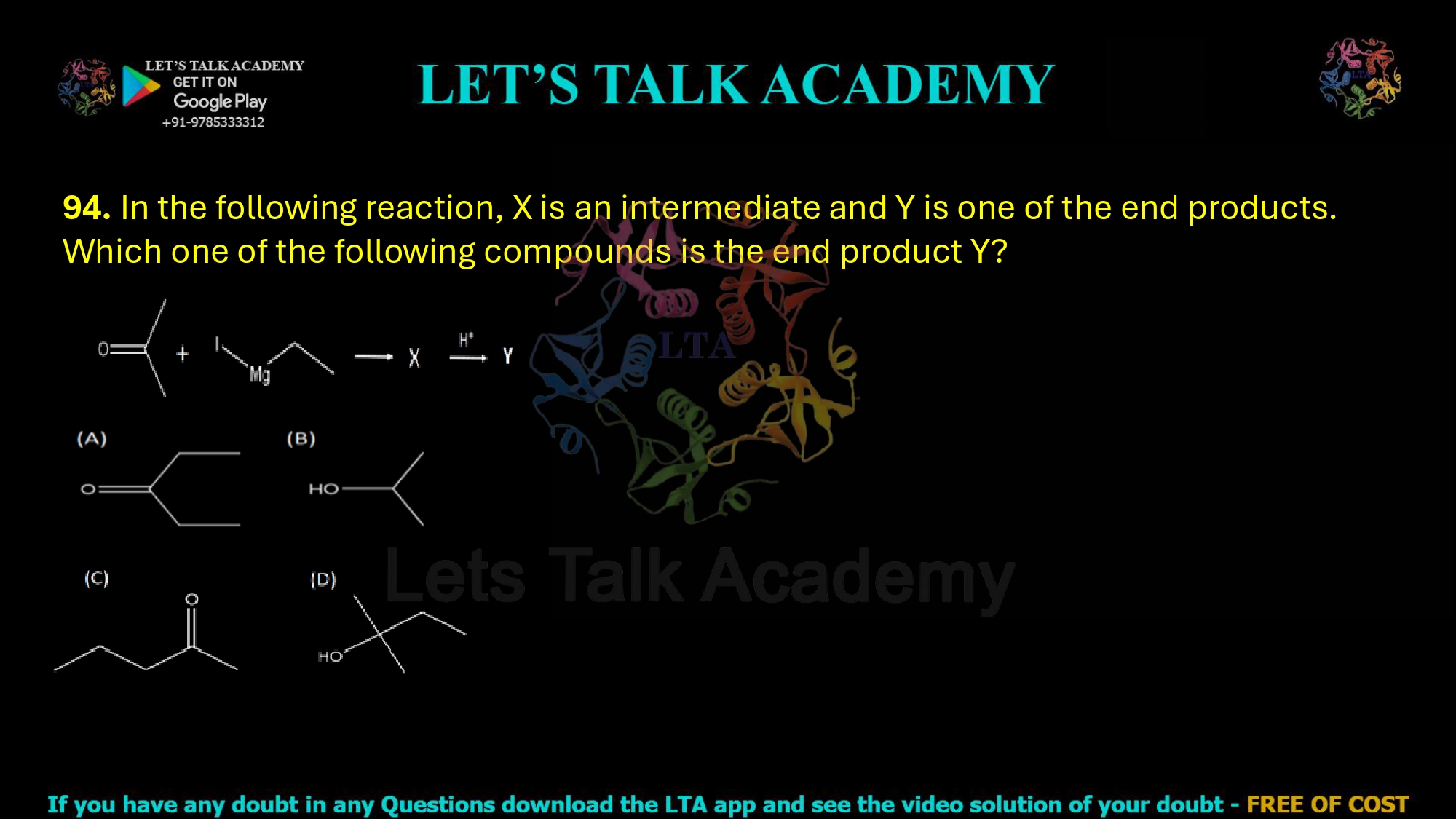
94. In the following reaction, X is an intermediate and Y is one of the end products. Which one of the following compounds is the end product Y?
Major Product Formed When Acetone Reacts with Ethylmagnesium Iodide – Complete Grignard Reaction Mechanism
In the given reaction, acetone reacts with ethylmagnesium iodide (EtMgI), followed by acidic hydrolysis (H+). The reaction proceeds through a tetrahedral alkoxide intermediate (X), which upon protonation gives the final alcohol (Y). To identify the correct product, it is essential to understand the mechanism of Grignard addition rather than relying on memorization.
Understanding the Reactants
The carbonyl compound shown is acetone (propanone), whose structure is:
CH3–CO–CH3
The reagent used is ethylmagnesium iodide (C2H5MgI), a Grignard reagent. Grignard reagents behave as strong nucleophiles because the carbon attached to magnesium possesses significant carbanion character.
During the reaction, the ethyl group attacks the electrophilic carbonyl carbon of acetone.
Reaction Mechanism
Step 1: Nucleophilic Addition
The ethyl group from ethylmagnesium iodide attacks the carbonyl carbon of acetone. Simultaneously, the π electrons of the carbonyl bond shift onto oxygen, producing a magnesium alkoxide intermediate.
This intermediate is represented as X.
Step 2: Acidic Hydrolysis
When the reaction mixture is treated with dilute acid, the alkoxide ion is protonated to produce the corresponding alcohol.
The final product becomes
(CH3)2C(OH)CH2CH3
This compound is 2-methylbutan-2-ol, which is a tertiary alcohol.
Why the Product is a Tertiary Alcohol
Acetone is a ketone. A ketone already possesses two alkyl groups attached to the carbonyl carbon. When the ethyl group from the Grignard reagent is added, the carbon bearing the hydroxyl group becomes attached to three carbon atoms.
Therefore, the resulting alcohol is tertiary.
Explanation of Every Option
Option (A)
This option represents a ketone. After Grignard addition followed by acidic work-up, the carbonyl group is converted into an alcohol. Therefore, the product cannot remain a ketone.
Option (B)
This option is a secondary alcohol. Such products are typically obtained when Grignard reagents react with aldehydes (except formaldehyde). Since the starting compound here is acetone, this structure is incorrect.
Option (C)
This option is another ketone and therefore cannot be the product after nucleophilic addition of a Grignard reagent. The carbonyl group is consumed during the reaction.
Option (D)
This is the correct answer. It represents 2-methylbutan-2-ol, the tertiary alcohol obtained by addition of an ethyl group to acetone followed by protonation of the alkoxide intermediate.
Reaction Summary
CH3COCH3 + C2H5MgI → Alkoxide Intermediate (X)
Alkoxide Intermediate + H+ → (CH3)2C(OH)CH2CH3
The overall transformation converts a ketone into a tertiary alcohol while forming a new carbon–carbon bond.
Concept Behind Grignard Reagents
Grignard reagents behave as powerful nucleophiles because the carbon bonded to magnesium carries partial negative character. They readily attack electrophilic carbonyl carbons of aldehydes and ketones.
The nature of the alcohol formed depends on the carbonyl compound used:
- Formaldehyde → Primary alcohol
- Other aldehydes → Secondary alcohol
- Ketones → Tertiary alcohol
This classification is one of the most important concepts in synthetic organic chemistry and is frequently tested in competitive examinations.
Final Answer
Correct Option: (D)
The final product Y is 2-methylbutan-2-ol, a tertiary alcohol formed after nucleophilic addition of ethylmagnesium iodide to acetone followed by acidic hydrolysis.


