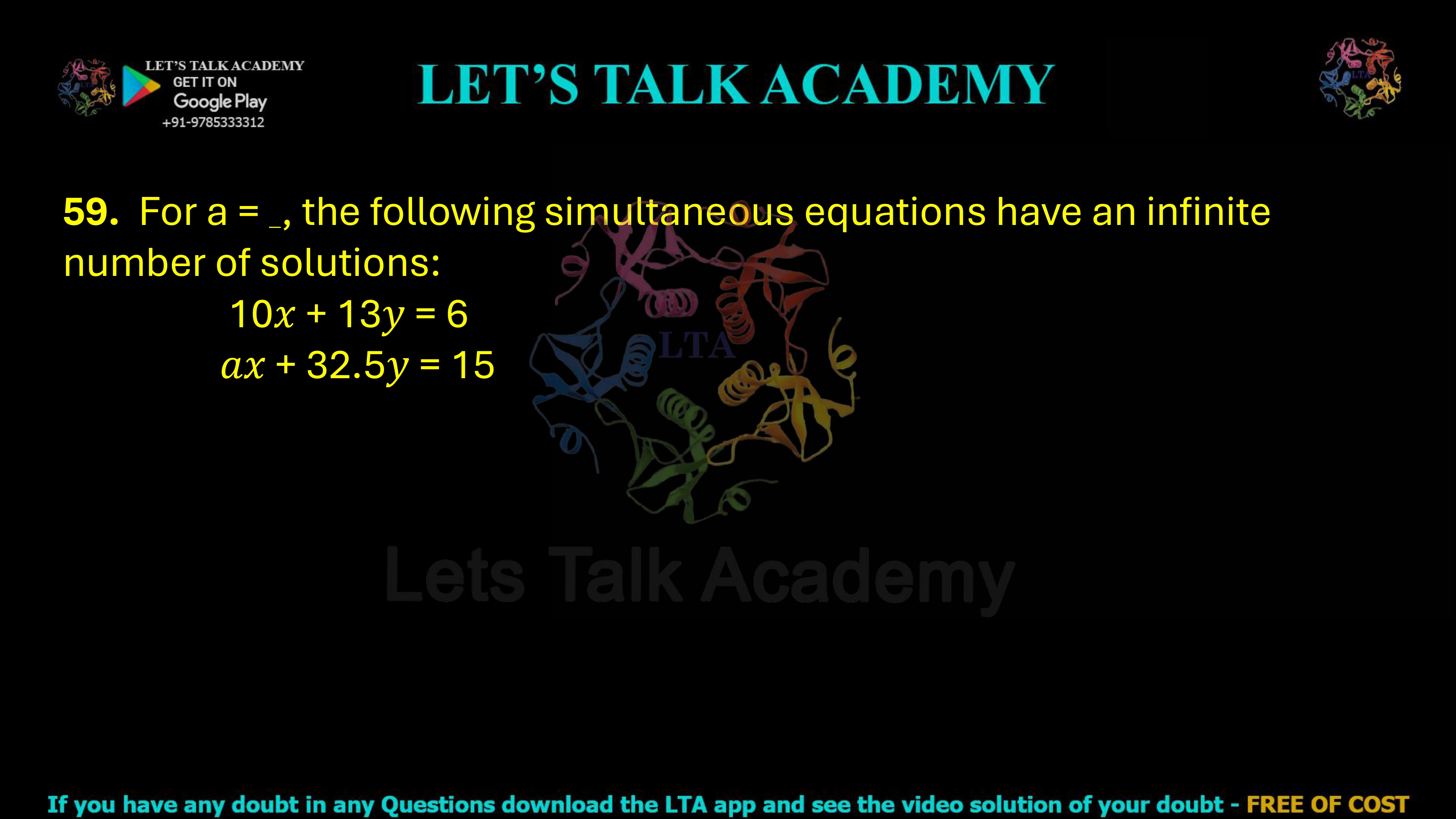
59. For a = ____, the following simultaneous equations have an infinite number of solutions:
10x + 13y = 6
ax + 32.5y = 15
Find the Value of a for Which the Simultaneous Equations Have Infinitely Many Solutions
Correct Answer
Answer: 25
Concept Behind Infinite Solutions
Two linear equations in two variables have an infinite number of solutions only when they represent the same straight line. This happens when the coefficients of both variables and the constant terms are proportional.
Mathematically, the following condition must be satisfied:
a₁/a₂ = b₁/b₂ = c₁/c₂
where the equations are written in the form:
a₁x + b₁y = c₁
a₂x + b₂y = c₂
Step-by-Step Solution
The given equations are:
10x + 13y = 6
ax + 32.5y = 15
Since the equations have infinitely many solutions, their corresponding coefficients must be proportional.
First, compare the coefficients of y and the constants:
13 / 32.5 = 6 / 15
Calculating both ratios:
13 ÷ 32.5 = 0.4
6 ÷ 15 = 0.4
The ratios are equal, confirming that the coefficient of x must satisfy the same ratio.
Therefore,
10 / a = 6 / 15
Simplifying,
10 / a = 2 / 5
Cross-multiplying gives:
50 = 2a
Hence,
a = 25
Verification
Substituting a = 25:
10/25 = 13/32.5 = 6/15 = 0.4
All three ratios are identical. Therefore, both equations represent the same line and have infinitely many common solutions.
Final Answer
The required value of a is:
25


