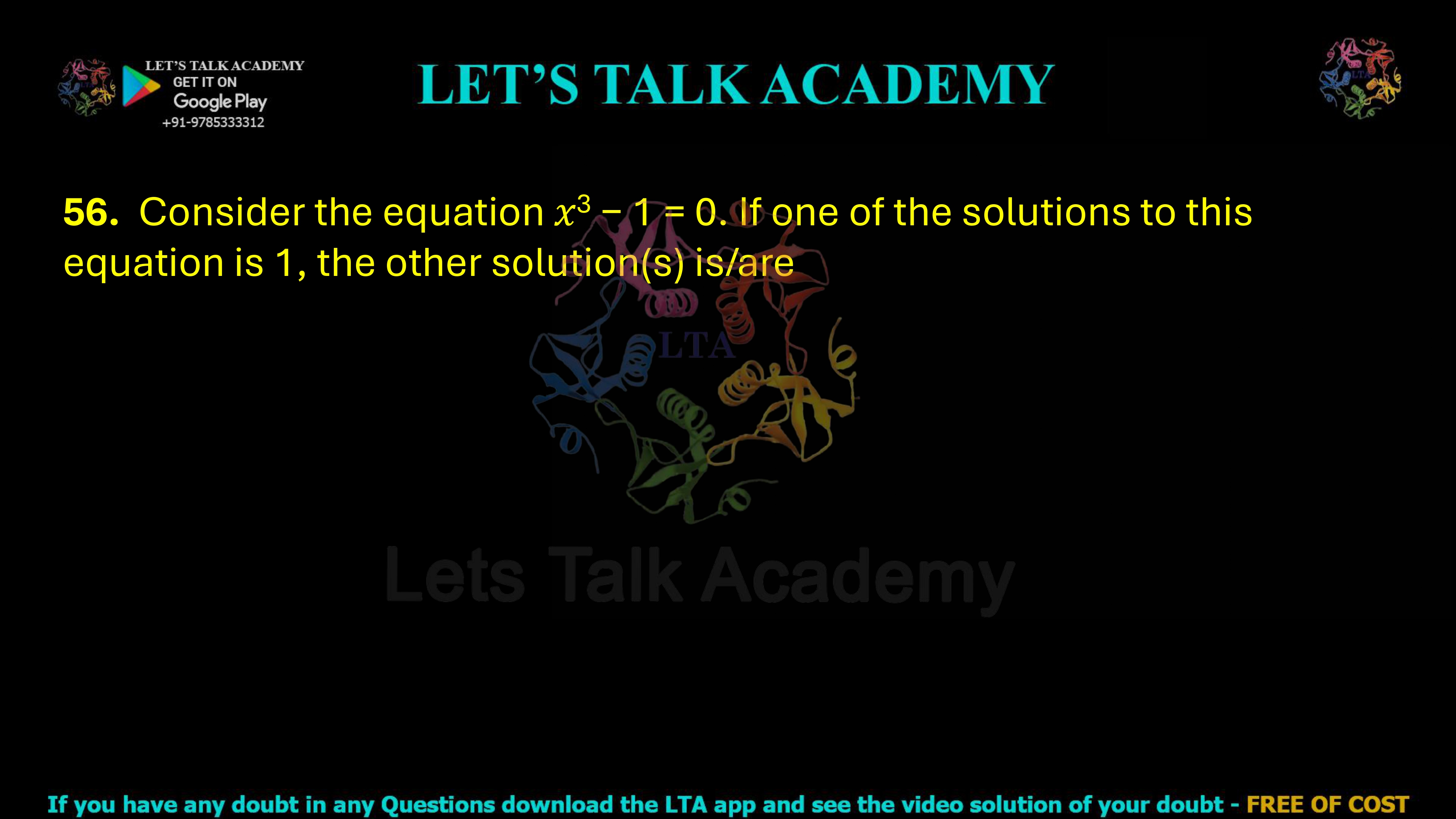
56. Consider the equation
x3 − 1 = 0.
If one of the solutions to this equation is 1, the other solution(s) is/are ______.
How to Solve x3 − 1 = 0? Complete Explanation of the Cube Roots of Unity
The equation x3 − 1 = 0 is one of the most famous polynomial equations in mathematics. Although it appears simple, it introduces the important concept of the cube roots of unity, which has applications in algebra, complex analysis, Fourier transforms, signal processing, and higher mathematics.
In this question, one solution of the cubic equation is already given as 1. Our task is to determine the remaining solutions of the equation.
Understanding the Equation
The given equation is
x3 − 1 = 0
Since the equation is a polynomial of degree three, it must possess exactly three roots (real or complex), counting multiplicity, according to the Fundamental Theorem of Algebra.
One root has already been provided:
x = 1
Therefore, we only need to determine the remaining two roots.
Step 1: Factorize the Cubic Equation
The expression x3 − 1 is the difference of two cubes.
Using the standard algebraic identity
a3 − b3 = (a − b)(a2 + ab + b2)
where
a = x
b = 1
we obtain
x3 − 1 = (x − 1)(x2 + x + 1)
Hence, the equation becomes
(x − 1)(x2 + x + 1) = 0
This immediately gives one solution
x = 1
The remaining roots satisfy
x2 + x + 1 = 0
Step 2: Solve the Quadratic Equation
To determine the remaining roots, we use the quadratic formula
x = [−b ± √(b2 − 4ac)] / 2a
For the equation
x2 + x + 1 = 0
the coefficients are
a = 1
b = 1
c = 1
Substituting these values,
x = [−1 ± √(1 − 4)] / 2
x = [−1 ± √(−3)] / 2
Since
√(−3) = i√3
the two remaining roots are
x = (−1 + i√3)/2
and
x = (−1 − i√3)/2
Final Solutions of the Equation
The three roots of the equation are therefore
x = 1
x = (−1 + i√3)/2
x = (−1 − i√3)/2
Connection with Cube Roots of Unity
The three solutions of the equation x3 = 1 are known as the cube roots of unity.
They are represented as
1, ω, ω2
where
ω = (−1 + i√3)/2
and
ω2 = (−1 − i√3)/2
These numbers satisfy several important algebraic identities.
ω3 = 1
1 + ω + ω2 = 0
ω × ω2 = 1
These identities are extensively used in algebra, number theory, discrete mathematics, and signal processing.
Geometrical Interpretation
In the complex plane, the cube roots of unity lie on the unit circle, which has a radius of one and is centered at the origin.
The roots are equally spaced at angles
0°, 120°, and 240°
forming an equilateral triangle.
This symmetry explains why these numbers are called the roots of unity and why they possess many elegant mathematical properties.
Why the Remaining Roots are Complex
The quadratic equation
x2 + x + 1 = 0
has discriminant
Δ = b2 − 4ac = 1 − 4 = −3
Since the discriminant is negative, the equation has no additional real solutions.
Instead, it possesses two complex conjugate roots.
This is consistent with the Fundamental Theorem of Algebra, which guarantees that every polynomial of degree three has exactly three roots in the complex number system.
Final Answer
The other two solutions are
x = (−1 + i√3)/2
x = (−1 − i√3)/2


