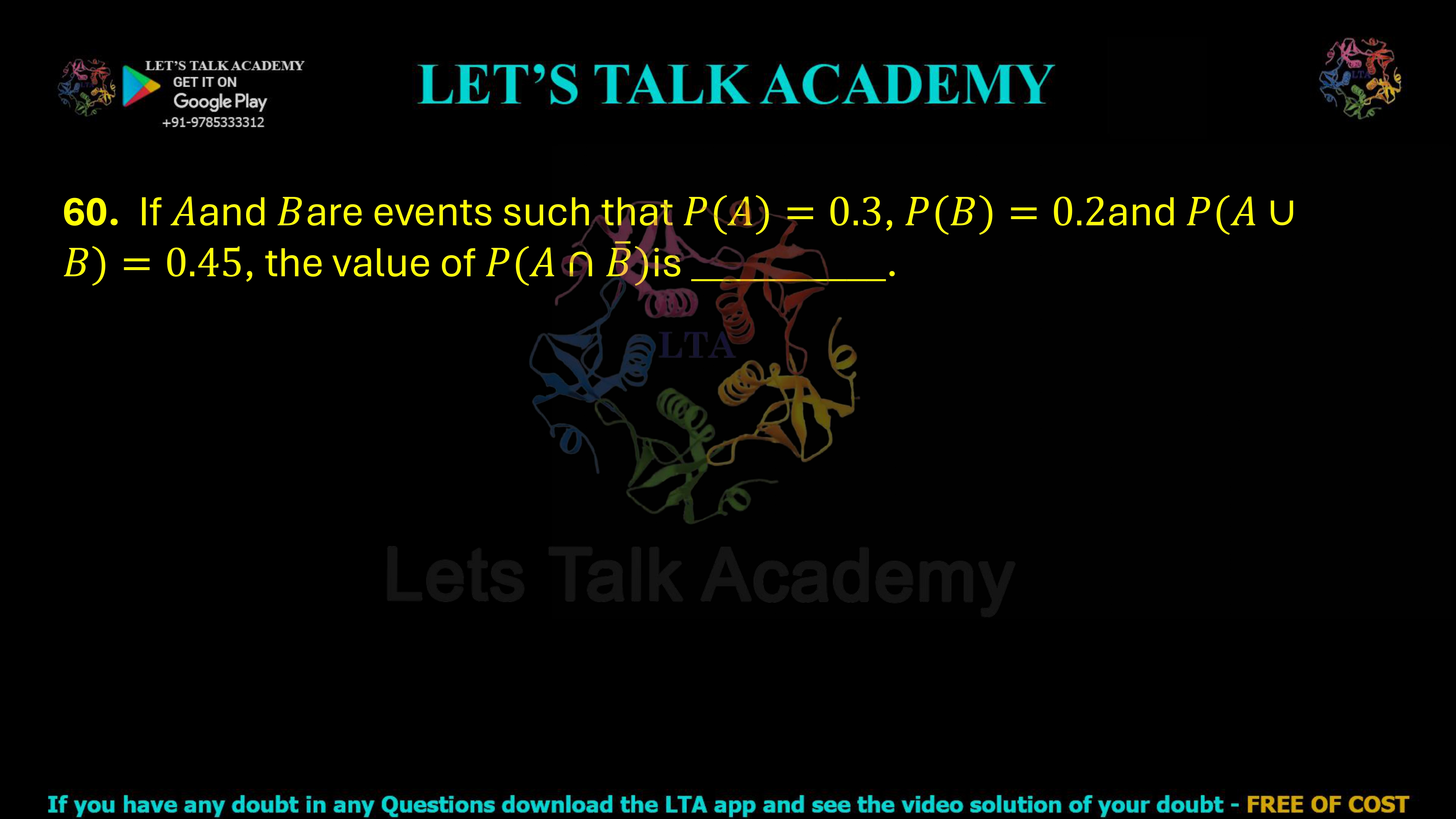
60. If A and B are events such that
P(A) = 0.30
P(B) = 0.20
P(A ∪ B) = 0.45
Find the value of P(A ∩ B̅).
How to Calculate P(A ∩ B̅) Using Probability Formula
This question tests the understanding of relationships among different probability events. Rather than performing lengthy calculations, it requires the correct application of the addition theorem of probability and the concept of complementary events. Once these concepts are understood, similar questions can be solved within a few seconds.
Understanding the Given Information
The probability of event A occurring is 0.30, while the probability of event B occurring is 0.20. We are also given the probability that at least one of the two events occurs, which is represented by the union of A and B.
The required probability is P(A ∩ B̅), which means the probability that event A occurs but event B does not occur.
In a Venn diagram, this corresponds to the portion of circle A that lies outside circle B.
Formula for the Union of Two Events
The addition theorem of probability states that
P(A ∪ B) = P(A) + P(B) − P(A ∩ B)
This equation is one of the most important identities in elementary probability because it avoids double-counting the common region between the two events.
Step 1: Calculate the Intersection
Substituting the given values into the formula,
0.45 = 0.30 + 0.20 − P(A ∩ B)
Simplifying,
0.45 = 0.50 − P(A ∩ B)
Therefore,
P(A ∩ B) = 0.50 − 0.45
P(A ∩ B) = 0.05
Step 2: Calculate P(A ∩ B̅)
Event A can be divided into two mutually exclusive parts:
- A occurs together with B.
- A occurs while B does not occur.
Hence,
P(A) = P(A ∩ B) + P(A ∩ B̅)
Rearranging,
P(A ∩ B̅) = P(A) − P(A ∩ B)
Substituting the known values,
P(A ∩ B̅) = 0.30 − 0.05
P(A ∩ B̅) = 0.25
Final Calculation
P(A ∩ B̅) = 0.25
Correct Answer
0.25
Alternative Conceptual Approach
The event A consists of two disjoint regions in the Venn diagram:
- The common region shared with B, represented by A ∩ B.
- The region belonging only to A, represented by A ∩ B̅.
Since these two regions do not overlap, their probabilities add up to the probability of A.
Therefore, subtracting the intersection from the total probability of A immediately gives the required answer.
Venn Diagram Interpretation
Imagine two overlapping circles representing events A and B.
The overlapping portion corresponds to P(A ∩ B), which is 0.05.
The remaining part of circle A represents the event where A occurs but B does not occur. This shaded portion has probability 0.25.
This visual interpretation helps students solve similar questions without memorizing formulas.
Why the Addition Formula is Necessary
If we simply added P(A) and P(B), the common region would be counted twice because it belongs to both events simultaneously.
Therefore, the probability of the intersection must be subtracted once to obtain the correct probability of the union.
This principle forms the basis of many advanced probability concepts, including inclusion-exclusion principles and conditional probability.
Final Answer
P(A ∩ B̅) = 0.25


