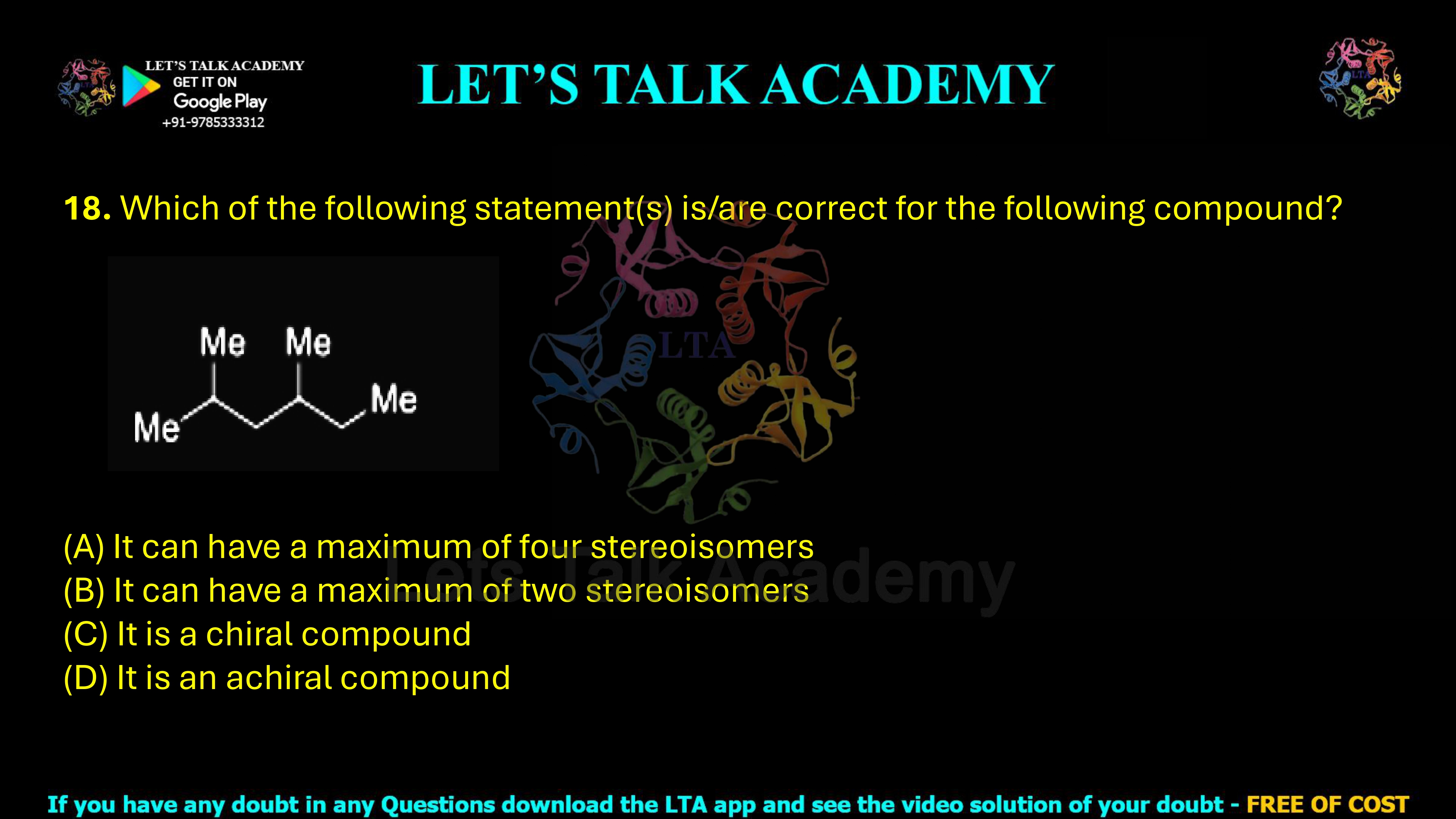
18. Which of the following statement(s) is/are correct for the following compound?
(B) It can have a maximum of two stereoisomers.
(C) It is a chiral compound.
(D) It is an achiral compound.
Which Statement Is Correct for the Given Compound Regarding Its Maximum Number of Stereoisomers?
Correct Answer: Option (B) – It can have a maximum of two stereoisomers
Detailed Explanation of the Given Compound
The given organic compound is 2,4-dimethylhexane. To determine the maximum number of stereoisomers possible for this molecule, the most important step is to identify the number of actual stereogenic or chiral carbon atoms. A carbon atom is not automatically chiral merely because it is attached to four single bonds. For a tetrahedral carbon atom to act as a stereogenic centre, it must be bonded to four different groups.
The structure of the given compound can be written in condensed form as:
CH3–CH(CH3)–CH2–CH(CH3)–CH2–CH3
The molecule contains two carbon atoms that may initially appear capable of being stereogenic centres: carbon-2 and carbon-4. However, a careful comparison of the groups attached to each carbon reveals that only carbon-4 is a true chiral centre. Therefore, the compound can have a maximum of only two stereoisomers.
Step 1: Identify the Possible Stereogenic Carbon Atoms
The two branched carbon atoms in the structure are carbon-2 and carbon-4. Since both are tetrahedral carbon atoms, each one must be examined individually. The four groups attached to each carbon must be compared carefully because the presence of four different groups is the essential requirement for a chiral centre.
The general rule is simple: if a tetrahedral carbon atom is attached to four different substituents, it is a stereogenic centre. If even two of the attached groups are identical, that carbon atom cannot be a stereogenic centre.
Analysis of Carbon-2 in 2,4-Dimethylhexane
Carbon-2 is attached to four groups: one hydrogen atom, one methyl substituent, the terminal methyl group at carbon-1, and the remaining carbon chain extending toward carbon-3. At first glance, the branched appearance of this carbon may suggest that it is chiral. However, two of its attached groups are identical methyl groups.
The groups attached to carbon-2 can be represented as:
–H
–CH3
–CH3
–CH2–CH(CH3)–CH2–CH3
Because carbon-2 is attached to two identical –CH3 groups, it does not satisfy the requirement of having four different substituents. Therefore, carbon-2 is not a chiral centre.
Analysis of Carbon-4 in 2,4-Dimethylhexane
Carbon-4 must now be examined in the same way. This carbon is attached to a hydrogen atom, a methyl group, an ethyl group on one side, and a different branched alkyl chain on the other side.
The four groups attached to carbon-4 are:
–H
–CH3
–CH2CH3
–CH2CH(CH3)2
All four groups attached to carbon-4 are different. Therefore, carbon-4 is a true stereogenic centre. This is the only chiral carbon atom present in the molecule.
Calculating the Maximum Number of Stereoisomers
For a molecule containing n independent stereogenic centres, the maximum possible number of stereoisomers is generally calculated using the formula:
Maximum number of stereoisomers = 2n
In the given compound, the number of actual stereogenic centres is:
n = 1
Therefore:
Maximum number of stereoisomers = 21
= 2
Thus, the given compound can have a maximum of two stereoisomers. Hence, Option (B) is correct.
What Are the Two Possible Stereoisomers?
Since the molecule contains one stereogenic centre at carbon-4, two different three-dimensional configurations are possible at this carbon. These configurations are designated as the R configuration and the S configuration according to the Cahn–Ingold–Prelog priority rules.
The two stereoisomers are:
(4R)-2,4-dimethylhexane
(4S)-2,4-dimethylhexane
These two forms are non-superimposable mirror images of each other and therefore constitute a pair of enantiomers. This pair accounts for the maximum of two stereoisomers possible for the given molecular structure.
Why Is the 22 Calculation Incorrect Here?
A common incorrect approach is to count both branched carbon atoms as chiral centres and then apply the formula 22 = 4. This approach gives four stereoisomers, but it is chemically incorrect because carbon-2 is not stereogenic.
The formula 2n should be applied only after the actual number of stereogenic centres has been determined correctly. A carbon attached to two identical groups must not be included in the value of n. Since carbon-2 has two identical methyl groups, only carbon-4 is counted, giving 21 = 2 stereoisomers.
Is the Given Compound Chiral or Achiral?
The structure drawn in the question uses an ordinary line-angle representation and does not specify the three-dimensional configuration at the stereogenic carbon using a wedge or dashed bond. Therefore, the drawing itself does not identify one particular R or S stereoisomer.
The important conclusion is that the molecular constitution is capable of existing as a pair of chiral enantiomers because carbon-4 is stereogenic. The definite and unambiguous statement among the given options is that the compound can have a maximum of two stereoisomers. Therefore, Option (B) is the correct answer.
Explanation of All Answer Options
Option (A): It Can Have a Maximum of Four Stereoisomers
Option (A) is incorrect. Four stereoisomers would normally be expected from two independent stereogenic centres using the expression 22 = 4. However, the given molecule has only one actual stereogenic centre. Carbon-2 cannot be counted because it is bonded to two identical methyl groups. Therefore, the maximum number of stereoisomers is not four.
Option (B): It Can Have a Maximum of Two Stereoisomers
Option (B) is correct. Carbon-4 is the only stereogenic centre because it is attached to four different groups. A molecule with one stereogenic centre can have a maximum of 21 = 2 stereoisomers. These two stereoisomers form an R/S enantiomeric pair.
Option (C): It Is a Chiral Compound
The molecule is capable of existing in chiral R and S forms because it contains a stereogenic centre at carbon-4. However, the two-dimensional structure shown in the question does not specify a particular configuration at that centre. The directly determinable statement asked through the stereoisomer count is that the structure can have a maximum of two stereoisomers, making Option (B) the intended correct choice.
Option (D): It Is an Achiral Compound
Option (D) does not correctly describe the configurational possibilities of the molecule. Carbon-4 has four different substituents and can generate two non-superimposable mirror-image configurations. Therefore, the molecular structure is capable of stereoisomerism and is not restricted to an achiral form.
Importance of Identifying Four Different Groups Correctly
The key concept in this question is that a branched carbon atom is not necessarily a chiral carbon. Every suspected stereogenic centre must be checked by writing or mentally tracing all four attached groups. Two groups that appear to extend in different directions in a line-angle structure may still be chemically identical.
At carbon-2 of the given molecule, two bonds lead to methyl groups, so this carbon is immediately eliminated as a stereogenic centre. At carbon-4, all four substituents are different, so it qualifies as the only stereogenic centre. This careful structural comparison leads directly to the correct stereoisomer count.
Final Answer
The correct answer is Option (B): The compound can have a maximum of two stereoisomers. The given compound is 2,4-dimethylhexane. Carbon-2 is not a stereogenic centre because it is attached to two identical methyl groups, whereas carbon-4 is attached to four different substituents and is therefore a stereogenic centre. Since the molecule contains only one stereogenic centre, the maximum number of stereoisomers is 21 = 2.


